

📌 Introduction to Magnifying Glasses for Children
A child's magnifying glass is not just a simple toy: this simple and fascinating tool invites young ones to explore the world around them from a new perspective. Used correctly, it becomes a wonderful vehicle for learning and curiosity, transforming every walk into a scientific expedition and every observation into an educational adventure. Whether for observing nature, participating in classroom experiments, or simply stimulating their minds, magnifying glasses open a door to a universe of discoveries. In this guide, we invite you to explore in depth the world of magnifying glasses for children, from their use to precautions, including selection criteria and different uses adapted to each age.
📌 At what age should you introduce a magnifying glass to a child?
Considering the ideal age to offer a magnifying glass to your child is essential for safe and beneficial use. Generally, it is considered that children can start handling a magnifying glass from 3 or 4 years old, but the maturity of each child and certain motor skills are necessary to fully enjoy it. We will detail below the different stages of development and the importance of natural curiosity at this age.
🔍 The Importance of Psychomotor Development
Optimal use of a magnifying glass requires the child to master certain gestures. Indeed, holding the magnifying glass correctly, adjusting its position at a distance from the object, and focusing attention are not innate skills. From the age of 3, many children are able to manipulate small objects safely and show an active interest in exploring their environment. It is at this stage that hand-eye coordination begins to improve, making careful observation through a magnifying glass possible. Manipulation also develops fine motor skills and autonomy.
Nevertheless, each child progresses at their own pace. It is therefore crucial to introduce the magnifying glass when the child is ready, i.e., when they can hold the tool safely, follow simple instructions, and show curiosity for what is not immediately visible to the naked eye. Models for toddlers are often more robust, lighter, and easy to hold, to encourage handling without frustrating the child with too much complexity or fragility.
🔍 The Interest of Children's Natural Curiosity
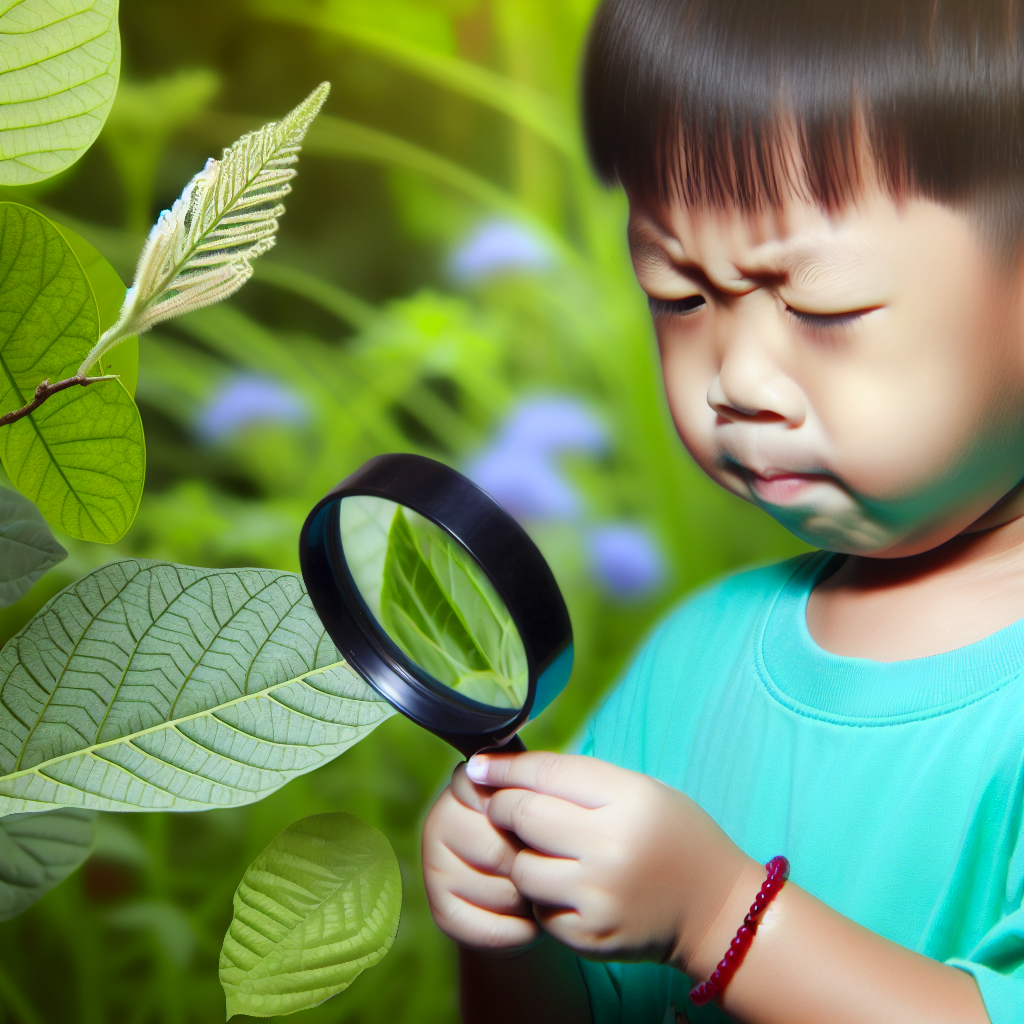
Childhood is the reign of curiosity and "why?". A well-chosen magnifying glass can extend this natural impulse, by providing the opportunity to explore, observe, and question the world. The first steps with a magnifying glass can transform ordinary walks into real scientific treasure hunts: observing the veins of a leaf, scrutinizing an ant carrying a blade of grass, or examining salt crystals on a kitchen table.
This tool promotes concentration, stimulates observation skills, and develops critical thinking, all desirable skills from an early age. Establishing an observation ritual with the magnifying glass also helps to build self-confidence through independent discovery and valuing findings. In short, the magnifying glass for children is a wonderful lever for catalyzing the thirst for learning, which is why many educators recommend its early introduction, coupled with benevolent support.
📌 Types of Magnifying Glasses Suitable for Children
The market offers a wide range of magnifying glasses dedicated to children, designed to meet various uses, ages, and levels of autonomy. We distinguish mainly pocket models, table models, binocular magnifiers for scientific experiments, or even clip-on magnifiers ideal for first investigations in the garden. It is essential to choose a magnifying glass adapted to the child's motor and cognitive development in order to make the tool accessible, motivating, and above all, safe.
Some magnifying glasses have specific features to encourage little explorers: ergonomic non-slip handle, unbreakable lens, or simplified focusing mechanism. Others are intended for specific uses, such as discovering nature or participating in scientific workshops.
🔍 Magnifying Glasses for Discovering Nature
Field magnifiers are specially designed for outdoor exploration. Their robust design and ease of use make them ideal for walks in the forest, park, or even the garden. Generally equipped with a magnification of 2 to 5 times, they allow observing insects, leaves, barks, stones, or animal tracks.
- Short-handled magnifying glass: Easy to hold, it is suitable for smaller hands.
- Wide-frame magnifying glass: The large viewing area facilitates collective investigations or the discovery of large objects.
- Double-lens magnifying glass: This model combines low and high magnification, ideal for varying uses without multiplying tools.
Some models come with a strap or case for easy transport during nature outings. There are also exploration kits including the magnifying glass, an insect box, tweezers, and other fun small instruments to extend the pleasure and immersion.
🔍 Magnifying Glasses for Scientific Activities
Magnifying glasses oriented towards science often feature advanced functionalities, intended for children aged 6 or 7 and older, or even a little earlier depending on the child's appetite and maturity. The choice of higher magnification (generally x5 to x10) allows for interest in the structure of paper, the observation of crystals, or aquatic microfauna.
There are binocular magnifiers or stand magnifiers, which stand on their own and free the child's hands to manipulate the object to be observed. These are particularly recommended for introducing children to experimentation protocols, whether it is sorting small seeds or observing small mineral fragments.
| Type of Magnifying Glass | Main Use | Recommended Age |
|---|---|---|
| Pocket Magnifying Glass | Outdoor Observation | 3-8 years old |
| Binocular Magnifier | Laboratory Experiments | 7 years and up |
| Stand Magnifier | Hands-free manipulation | 6 years and up |
Finally, for even more in-depth observations, one can opt for more technical instruments, such as optical microscopes adapted for children, described in more detail in this article on the value of quality optical microscopes.
📌 Specific Uses of Magnifying Glasses for Children
The uses of a child's magnifying glass extend far beyond simple entertainment. From an educational perspective, this tool easily integrates into school, family, or individual activities. It allows for fascinating observations in nature as well as an introduction to the scientific method at home or at school.
Regular handling of a magnifying glass develops meticulousness, patience, a taste for experimentation, and logical thinking. It also encourages the child to formulate hypotheses from their observations, a central skill in scientific learning. Let's look in more detail at the main contexts of use.
🔍 Nature Observation
Nothing equals the wonder-filled discovery of the natural riches around us. With a magnifying glass, a child can appropriate their immediate environment, scrutinizing the smallest detail of a leaf, the patterns of a butterfly's wings, or the organization of an ant colony.
- Identify different insect species and observe their behaviors.
- Examine the textures of tree bark or the symmetry of flowers.
- Note tiny details that escape the naked eye and train their explorer's eye.
Many educators advocate the use of a magnifying glass during educational walks to strengthen the connection between the child and nature. Besides the playful aspect, this practice develops attention, respect for living things, and patience, virtues so precious in an increasingly fast-paced world.
By encouraging the child to keep an observation notebook or to draw their discoveries, the magnifying glass also becomes a tool for memorization and structuring knowledge.
🔍 Educational Activities and Experiments
Scientific activities adapted for children using magnifying glasses are practically limitless. In class, during science workshops, or at home during manual activities, the magnifying glass can introduce key concepts of observation, comparison, and measurement.
Some ideas for concrete experiments:
- Compare the texture of different fabrics or papers with and without a magnifying glass.
- Observe the development of a seed from the embryonic stage to a young sprout.
- Analyze the composition of grains of sand to reveal their invisible diversity.
- Study the capillarity of water on a leaf or on different surfaces.
Integrating a magnifying glass into an educational project allows the child to become an active participant in their learning, to strengthen their understanding of natural phenomena, and to inspire early scientific vocations.
For more ideas and models for children, please consult our collection of products on the children's magnifying glasses page.
📌 Tips for Choosing the Right Magnifying Glass for a Child
Choosing a child's magnifying glass must be done carefully, taking into account several criteria: user's age, magnification level, lens type, manufacturing material, and also safety of use. Here are our recommendations for making the best choice, adapted to your child's specific needs.
Always consider ease of handling, material robustness, and image clarity. A magnifying glass that is too complex or fragile could discourage the child, while a magnifying glass that is too simplistic would limit their scope of exploration.
🔍 Appropriate Magnification Level
Magnification is the first characteristic to consider when buying a magnifying glass for a child. A magnification of x2 to x5 is considered perfectly suitable for children aged 3 to 7. This level of magnification is sufficient to reveal a multitude of details while facilitating focusing. For children from 8 years old and for more academic or experimental activities, you can go up to x8 or x10.
It is important to favor:
- A large lens diameter to appreciate objects more easily.
- A double magnification level on the same model to vary experiences.
- Lenses made of optical acrylic, which are more resistant and lighter than glass, while maintaining a clear image.
A tool that is too powerful will become unnecessarily complex to use and risks causing frustration or disinterest. Opt for progression as the child develops.
🔍 Materials and Safety
Safety remains an essential criterion when choosing a magnifying glass for a child. Always prefer magnifying glasses whose lens is made of quality optical plastic (acrylic, polycarbonate, etc.), as they are unbreakable and lightweight. Frames must be robust, non-slip, and free of potentially toxic substances (bisphenol A, phthalates, etc.).
Also check for the absence of protruding parts or small detachable pieces that could present a choking hazard, especially for younger children. Finally, the design should facilitate ergonomic grip: a large handle, a non-slip surface, and a shape adapted to the child's palm contribute to a positive experience and safe use.
Some magnifiers are even designed to float, to prevent any accidents during experiments in water or near a water source.
📌 Safety and Precautions with Magnifying Glasses
Allowing a child to have fun while remaining cautious is the challenge of introducing a magnifying glass into daily games and learning. Even if the majority of models for children are designed to limit risks, parental vigilance is necessary.
The use of a magnifying glass involves some basic safety instructions to avoid accidental injuries or misuse.
🔍 Parental Supervision
It is recommended that an adult supervise the first uses, regardless of the child's age. Parental supervision allows both to provide necessary explanations (optimal distance, how to move the magnifying glass, etc.) and to avoid any dangerous behavior, such as directing sunlight through the magnifying glass or trying to look directly at an intense light source.
The adult can also encourage discoveries, ask questions to guide observation, and value the child's discoveries, a key element for personal development.
🔍 Precautions to Prevent Injuries
The use of a magnifying glass can present certain dangers if not supervised, although they remain rare when the equipment is adapted for young children. Here are some precautions to observe:
- Never use the magnifying glass to observe the sun, as this can cause serious eye injury.
- Be careful not to expose the magnifying glass to intense heat, as it can focus rays and cause burns to materials or skin.
- Ensure that the child does not put the magnifying glass in their mouth or try to disassemble the lens.
Finally, always favor models specifically designed for children and comply with current European safety standards (CE marking, EN71 standards, etc.).
📌 Maintaining and Storing Magnifying Glasses for Children
Proper maintenance and appropriate storage for a magnifying glass preserves observation quality and the tool's longevity. It's also an excellent way to empower the child by involving them in taking care of their equipment, thus promoting respect for their belongings and learning to tidy up daily.
Children's magnifying glasses are most often designed to withstand heavy use, but a few simple actions can further extend their lifespan.
🔍 Cleaning and Maintenance
To clean a magnifying glass, avoid abrasive products or rough cloths that could scratch the lens. Opt for a soft microfiber cloth, slightly dampened if necessary. In case of persistent stains, a mild soap or a specific product for optics can be used with caution.
Make sure never to fully immerse the magnifying glass, especially if it has metal parts or a wooden stand, as this risks damaging them. Air drying or drying with a lint-free cloth is recommended.
- Clean the lens regularly to prevent fingerprints or dust from forming.
- Check the general condition of the frame and tighten screws or replace worn elements if possible.
- Store the magnifying glass away from direct sunlight to prevent plastic alteration or lens deformation.
🔍 Secure Storage
The storage of a magnifying glass should be designed to prevent accidental impacts or loss. Preferably use a protective box or pouch, placed out of reach of very young children to ensure safety and easy access during future explorations.
Many models come with a protective case or have a hole for attaching the magnifying glass to a lanyard, ideal for children who love to go on adventures and bring back new treasures after each outing. Storing the magnifying glass in a dedicated space at home or in class also creates a reassuring landmark and encourages autonomy.
📌 FAQ: Magnifying Glass for Children
- From what age can a child use a magnifying glass?
Children can handle a magnifying glass from 3 years old under adult supervision, provided they use a model adapted to their hand and motor skills. - What magnification level is recommended for a child's magnifying glass?
A magnification of x2 to x5 is ideal for young children. Models from x8 are more suitable from 8 years old or for more technical activities. - What precautions should be taken with a child's magnifying glass?
Avoid exposing the magnifying glass to the sun, looking at direct light sources, and always accompany the child during the first uses. - How do you clean a child's magnifying glass?
Use a soft microfiber cloth, a little soapy water if needed, and avoid abrasive products or total immersion.
Opt for models made of optical plastic (acrylic), which are robust, lightweight, and comply with European safety standards.
Yes, there are kits that include a magnifying glass, an insect box, and tweezers, perfect for stimulating curiosity during nature walks.
📌 Conclusion and Recommendations
Introducing a children's magnifying glass at the right moment, choosing a model adapted to their age, associating it with rich activities, and raising awareness about safety rules: these are the key points to make the magnifying glass a tool that is both fun and educational. Whether it's to contemplate nature, conduct scientific experiments, or stimulate curiosity, the magnifying glass accompanies the child in an active and autonomous discovery process.
Investing in a quality magnifying glass that is easy to maintain and suitable for young hands is offering much more than an object: it's opening up a world of observation, wonder, and an appetite for science and life. To go further, browse our specialized selections to find the magnifying glass that will perfectly suit your child, and do not hesitate to consult our other articles to deepen the experimental approach with reliable scientific equipment.