


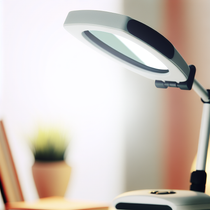
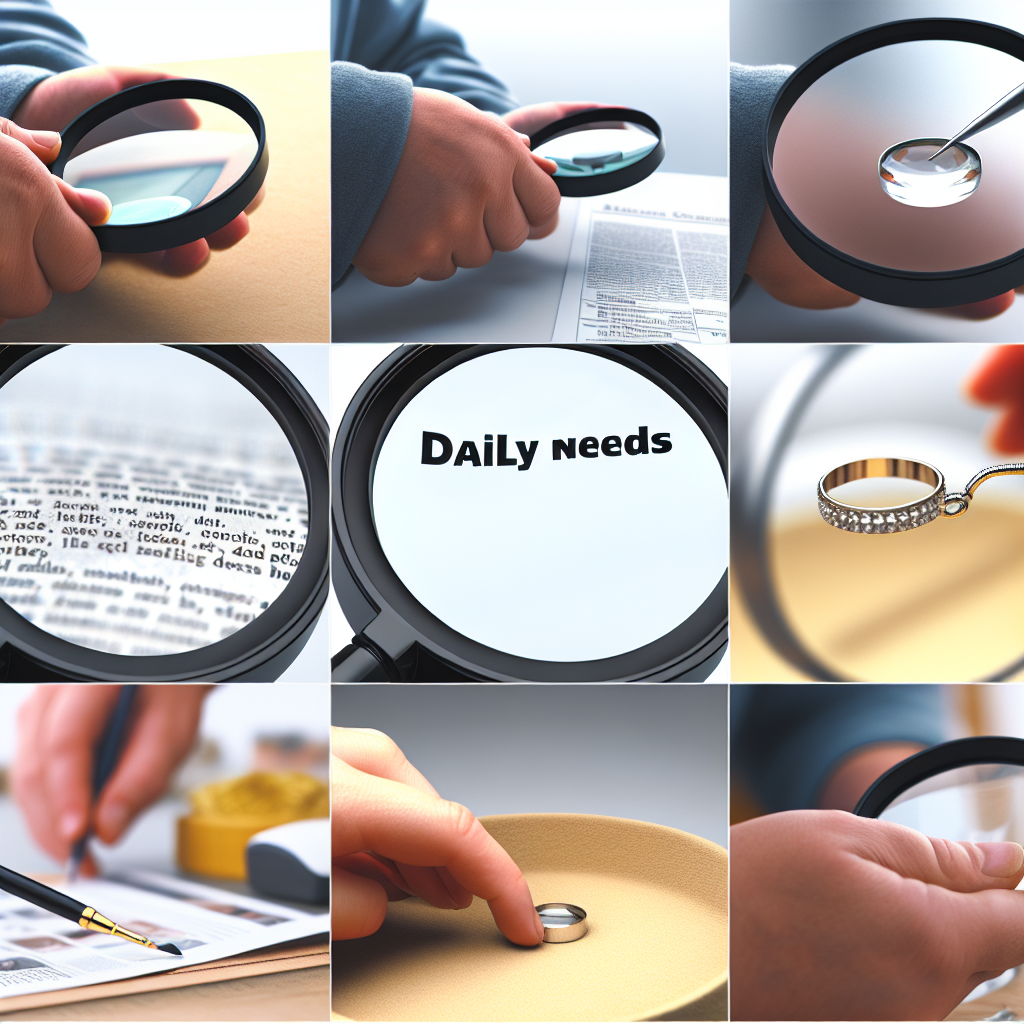
📌 Why Use a Jeweler's Loupe for Your Daily Needs
The jeweler's loupe has established itself as a valuable tool, not only for professionals in the sector but also for anyone who wants to benefit from an increased view of details in their daily life. Whether it's to check a piece of jewelry, read small print, tinker at home, or appreciate the texture of a collectible item, it provides unparalleled visual precision.
Using a jeweler's loupe means opting for time-saving and quality assurance in many areas. Imagine trying to read tiny numbers on an old watch or wanting to check an invoice with faint print: without a loupe, the task becomes difficult, if not impossible. On the contrary, with this accessory, clarity and detail are at your fingertips.
Its usefulness is not limited to professions related to jewelry. Indeed, many people find the jeweler's loupe an ally for their daily activities. Whether it's sewing, model making, numismatics, repairing small objects, or creative hobbies, this tool ensures perfect visibility where the naked eye reaches its limits.
- For quick inspection of small objects, coins, or stamps.
- To facilitate reading tiny texts or logos on products.
- To control the quality of materials, fabrics, prints, or engravings.
- To secure a purchase by identifying certainties and anomalies.
Using a jeweler's loupe also helps increase self-confidence: the ability to meticulously inspect, detect, or verify something brings autonomy and peace of mind in everyday life.
Finally, with their robust design and intuitive handling, these loupes are designed to last and meet various needs without requiring complex learning. In short, integrating a jeweler's loupe into your routine means valuing every detail and investing in your comfort of life.
🔍 How a Jeweler's Loupe Works
At first glance, the operation of a jeweler's loupe seems simple, but it relies on essential optical principles, designed to guarantee clear magnification and precise observation. A loupe is often just a set of lenses strategically placed to capture and focus light, allowing the eye to distinguish details invisible to the naked eye.
The magnification effect comes from the fact that the lens converges light rays to a point, enlarging the perceived image without noticeable distortion. By modifying the curvature, thickness, or composition of the glass, different magnification powers can be achieved.
In the case of the jeweler's loupe, the emphasis is on precision and contrast: image quality and aberration correction are priorities. Some sophisticated models have multiple or aspheric lenses, which virtually eliminate any blurring effect even at the edges of the field of view.
- Ambient light plays a role: the stronger and better oriented the light, the better the observation precision.
- The focal distance, i.e., the ideal distance between the loupe and the object, must be respected to obtain optimal magnification.
- Some models have an adjustment ring to fine-tune the sharpness according to the observation distance.
Finally, ergonomics are very important: the size, weight, and type of grip are designed to allow prolonged inspection without fatigue or discomfort.
✔️ The Main Components of a Jeweler's Loupe
A good quality jeweler's loupe owes its performance to a precise assembly of different components, where every detail counts. Here are the essential elements that compose it:
- The optical lens(es): The heart of the instrument, they are made of highly transparent glass or quality optical acrylic. Several lenses can be assembled to limit distortion and improve visual rendering.
- The casing or frame: It must protect the lens, ensure its stability, and provide a good grip. The best models are made of metal, sometimes aluminum or stainless steel, for increased robustness and balanced weight.
- The lighting system: On some models, micro-LEDs are integrated to provide homogeneous lighting, eliminating shadows and highlighting the smallest details.
- Mobile adjustments: Present mainly on advanced models, they allow adjusting the focus or magnification according to the observed object.
- The protective case or cover: Essential for protecting the loupe from shocks and scratches during travel.
The quality of a jeweler's loupe also depends on the precision of assembly of these components, thus ensuring durable and comfortable use. To learn more about the different styles and models, you can consult our dedicated jeweler's loupe collection.
📏 The Different Types of Jeweler's Loupes Available
The current market offers a wide range of jeweler's loupes, each responding to specific uses or preferences. Among the differentiating criteria are the type of handle, the frame format, the presence of lighting, and even portability or comfort of use.
We generally distinguish three main families:
- The foldable or "pocket" loupe: Easy to transport, it folds completely to protect the lens during travel. Ideal as a daily accessory.
- The handle loupe: With its ergonomic handle, it resembles the traditional loupe, highly appreciated for reading or examining larger flat objects.
- The headband loupe: More cumbersome but hands-free, often favored for model making, DIY, or meticulous repairs.
Depending on the activities, it may be preferable to opt for a light and simple version or for an advanced model with multiple functionalities.
| Loupe Type | Main Strengths | Ideal for |
|---|---|---|
| Foldable / Pocket | Discretion, lens protection, easy transport | Traveling jewelers, collectors, occasional use |
| Handle | Comfort, wider field of view, easy handling | Reading, observing flat documents |
| Headband | Hands-free, multiple adjustments, long-term comfort | DIY, model making, watch repair |
The extended versatility within this wide offer thus makes it possible to find the jeweler's loupe perfectly adapted to each situation.
✨ Jeweler's Loupes with Integrated Lighting
Among recent innovations, the integration of a light source – generally low-consumption LEDs – has become widespread in jeweler's loupes. This type of device offers a considerable advantage: it provides targeted and uniform light, essential for revealing details, especially in dimly lit environments.
- Main advantages: better visibility, accentuation of contrasts, reduced eye fatigue.
- Adapted to any situation: from quick verification of an engraving in a shop to meticulous examination of a stone at home, light becomes an indispensable ally.
- Options: several models allow adjusting the light intensity or using neutral white lighting for faithful color rendering.
If you often work in poorly lit places or want to inspect objects on site (at a flea market, market, etc.), investing in a loupe with integrated LED is a wise choice.
🔧 Monocular vs. Binocular Loupe
When it comes to choosing between a monocular or binocular loupe, it is useful to identify the context and duration of use.
- Monocular loupe: More common, it concentrates vision on one eye, which is perfect for quick and occasional inspection. Light and compact, this model easily fits in the palm of the hand or a pocket.
- Binocular loupe: It offers a double optical system allowing observation with both eyes. Much more bulky and generally fixed on a headband, the binocular loupe is ideal for long-term work or work requiring precision with two free hands (watch repair, microscopic and meticulous work).
Thus, the monocular is ideal for portable use, while the binocular version finds its place on a workbench or when trying to limit eye fatigue.
| Model | Typical Use | Main Strengths |
|---|---|---|
| Monocular | Jeweler, quick check, mobility | Compactness, easy transport |
| Binocular | Restoration, precision, prolonged use | Comfort, natural posture |
Depending on the needs, it will therefore be relevant to orient your choice towards one or the other system.
👁️ Specific Advantages of Using a Jeweler's Loupe
The use of a jeweler's loupe goes far beyond jewelry or goldsmithing: it proves useful in many aspects of daily life. Let's discover the most frequent fields of application.
- Inspection and evaluation of the quality of jewelry, watches, and precious stones
- Reading tiny characters, numbers, or logos on documents, tickets, identity cards
- Checking details during assembly work, meticulous tasks, or model making
- Verifying the finish of artisanal products (wood, ceramic, leather, etc.)
- Examining defects or signs of wear on clothing, accessories, etc.
Elderly people or those with visual impairment also adopt it to maintain their autonomy at home: the simple fact of being able to follow a recipe, consult instructions, or examine medication without difficulty improves their quality of life.
Professionally, the jeweler's loupe is essential in the resale of second-hand jewelry, the appraisal of antique watches, or even in the field of restoring antique objects, where detecting the slightest chip or scratch is crucial.
💎 Evaluation of Jewelry and Precious Stones
The core of a jeweler's profession relies on the precision and reliability of diagnosis. Thanks to the jeweler's loupe, it is possible to instantly distinguish the purity of a stone, any inclusions, traces of treatments or settings, and the quality of the setting.
An expert will thus be able to:
- Spot fakes, imitations, or damage invisible to the naked eye.
- Verify the hallmark on precious metals.
- Evaluate the color, fluorescence, and polish of a diamond or gemstone.
- Observe the regularity of an engraving or a setting.
In the world of luxury, trust often arises from the certainty of observed detail. A simple anomaly detected with a jeweler's loupe can have a major impact on the value or negotiation of an object.
Moreover, many appraisal houses require the use of a loupe when buying or selling valuable jewelry, thus guaranteeing the authenticity and security of each transaction.
📚 Reading and Deciphering Documents with a Loupe
Beyond the world of jewelry, the jeweler's loupe is a valuable tool for reading tiny texts or information printed in low quality. Contracts, certificates, references of watches or rare pieces, serial numbers: all benefit from careful examination.
- It allows distinguishing micro-writings on passports or credit cards.
- It facilitates reading dosages on medicine or food boxes.
- It helps verify the absence of printing defects or falsification.
For philately enthusiasts, ancient literature readers, or stamp collectors, the loupe helps identify the finesse of a graphic design, the rarity of an edition, or any defects that determine the value of an object.
Thus, the jeweler's loupe proves to be an everyday ally for all those concerned with precision and subject to handling or reading small formats.
To learn how to use a loupe precisely, consult our tutorial How to Use a Jeweler's Loupe Correctly.
🔩 Use for Repair and Craftsmanship
Artisans, watchmakers, restorers, electronics technicians, and model makers all attach particular importance to the magnification quality and ergonomics of their jeweler's loupe. This instrument is often the key to performing work with extreme precision:
- Changing a tiny mechanism (watch, mobile jewelry)
- Removing or installing an electronic component in a circuit
- Performing fine soldering or gluing
- Restoring a delicate figurine, toy, or art object
In the field of DIY and creative hobbies, users also benefit from the reach of a loupe to create detailed works or avoid errors during the meticulous assembly of miniatures, models, or very fine knitting.
Its versatile application therefore extends to any situation where performance and attention to detail make the difference between amateur work and a professional result.
✔️ How to Choose the Best Jeweler's Loupe for Your Needs
Selecting the ideal jeweler's loupe requires analyzing your specific needs, frequency of use, and the tasks for which it will be intended. Several technical and ergonomic criteria come into play – they guarantee tailored use and avoid disappointments in use.
Start by listing the main activities (jewelry, reading, crafts, collection, quality control...): each of them implies different requirements in terms of magnification, field of vision, grip, and additional options.
- The type of loupe: compact, with handle, headband?
- The magnification factor: magnification that is too strong or too weak will cause discomfort, imprecision, or adaptation difficulties.
- Ergonomics: weight, grip, angle of inclination, fixing options for prolonged use.
- Lighting: an indispensable function if the lighting in your work environment is lacking.
- Material quality: a professional loupe made of metal or anti-scratch acrylic offers increased durability.
Do not hesitate to try several models and consult user reviews to refine your choice.
🔎 Magnification Factors
The "magnification factor" of a jeweler's loupe indicates the number of times an object will be enlarged compared to its actual size. Common models range from 5x to 30x, each level being suitable for a specific use.
- 5x - 10x: Ideal for reading, checking documents, verifying medium-sized stones, or quick examination of jewelry.
- 15x - 20x: Perfect for detecting defects or inclusions in stones, setting errors, and for more in-depth inspections.
- 25x - 30x and +: Professional or specialized use, ideal for fine watchmaking or detecting fakes on rare stamps.
Excessive magnification generally reduces the field of vision and requires greater stability. Conversely, low magnification allows for a wider view, at the cost of less pronounced enlargement.
For versatile use, it is advisable to opt for a model between 10x and 15x: an ideal compromise between sharpness, comfort, and ease of use.
⚖️ Portability and Ease of Use
Your choice should also consider daily comfort. A loupe that is too heavy or bulky will quickly be abandoned, even if its optical capabilities are excellent.
- Foldable and pocket-sized models are perfect for travel, shopping, or on-site inspections.
- Opt for an ergonomic handle if you frequently engage in extended reading or manual tasks requiring stability and precision.
- For workshop use, prefer a loupe that can be mounted on a headband or equipped with a non-slip base, thereby freeing your hands.
The frame material (metal or reinforced plastic) greatly influences the feeling of robustness and the product's longevity.
For seniors or individuals with dexterity issues, lightweight models with non-slip grips or adaptations for glasses are available: they ensure safety and maneuverability.
💡 Lighting options and ergonomics
The addition of integrated lighting promotes optimal visual comfort and reduces fatigue, especially in dimly lit environments. Prioritize a jeweler's loupe with:
- Powerful LED bulbs with "cool" light (close to daylight) for accurate color rendering
- A dedicated and easily accessible power button
- Economical power supply (rechargeable battery or long-lasting battery)
In terms of ergonomics, a wide-grip loupe prevents cramps, while an adjustable lens tilt offers a customized and more natural experience.
For professional use, consider models with multiple interchangeable lenses, making it easy to adapt to the task at hand without needing multiple accessories.
💬 How to maintain and clean your jeweler's loupe
To preserve the transparency of the lenses and the magnification quality of your jeweler's loupe, regular maintenance is essential. Here are our recommendations:
- Always wipe the lens with a soft, lint-free cloth, ideally optical microfiber.
- In case of significant deposits, use a special optical lens solution or a puff of dry air to remove dust and particles without scratching the glass.
- Avoid all contact with water, aggressive solvents, alcohol, or conventional detergents, which can damage the anti-reflective coating.
- Store the loupe in its protective case when not in use, to prevent shocks, scratches, or UV exposure.
- For lighted models, regularly remove dust accumulation around the LEDs and plan for battery replacement or recharging if the light weakens.
- Remember to periodically check the moving parts: hinges, adjustment screws, frames... Slight lubrication or tightening, if necessary, limits their wear over time.
Proper maintenance guarantees flawless observation for many years and helps preserve the value of your equipment.
🔗 Where to buy a jeweler's loupe online or in-store
Equipping yourself with a quality jeweler's loupe is now accessible to everyone thanks to the internet and specialized distribution networks. Several options are available to you:
- Online: Expert e-commerce stores specializing in optics or professional accessories offer a wide choice, with precise descriptions, customer reviews, and extended warranties. Online comparators help you find the best price in just a few clicks.
- In specialized stores: Optical stores, jewelers, watchmakers, and creative hobby supply stores often display a varied sample of jeweler's loupes. You can thus check the quality of the grip before purchase.
- Trade shows and fairs: Some exhibitions dedicated to jewelry, hobbies, or craftsmanship offer demonstration stands where it is possible to test various models.
Don't hesitate to compare technical specifications and ask for advice to find a model truly suited to your needs.
To discover all of our selection, visit our page: Jeweler's Loupe Collections.
🛒 Price comparison and recommended brands
The budget to plan for the purchase of a jeweler's loupe primarily depends on the magnification factor, optical quality, and integrated options. Entry-level models are available starting from €10, while professional or high-end solutions can exceed €150.
- Entry-level: compact models without lighting, suitable for occasional or auxiliary use.
- Mid