


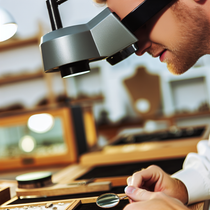

📌 Introduction to Binocular Magnifiers
Binocular magnifiers have become indispensable in numerous scientific, industrial, and medical fields. Their history reflects centuries of human ingenuity, and their evolution parallels that of knowledge and technology. In this article, we will explore the origin, evolution, and current role of binocular magnifiers, highlighting their importance and adaptation to contemporary demands. From their earliest uses to today's innovations, they are distinguished by their ability to provide precise stereoscopic vision, facilitating the discovery and manipulation of the infinitely small.
📍 What is a Binocular Magnifier?
A binocular magnifier, also known as a stereomicroscope, is an optical instrument that allows objects to be observed in relief with a depth effect, through the simultaneous use of two eyepieces. Unlike a classic microscope, which magnifies objects along a single optical axis and produces a flat image, a binocular magnifier uses two distinct light paths. Each eye receives a slightly different image, which creates the perception of relief and facilitates the precise examination of small structures.
The structure of a binocular magnifier typically includes:
- Two adjustable eyepieces, generally between 10x and 20x
- Objectives allowing different levels of magnification
- An integrated lighting device, often LED or fiber optic
- An adjustable arm to adapt the height and working distance
The ergonomics of these instruments are designed for long hours of observation, thanks to precise adjustments that allow the position of the eyepieces, the interpupillary distance, and the sharpness to be adjusted for each user.
📍 Importance and Uses of Binocular Magnifiers
Binocular magnifiers play a key role in the precision of scientific, educational, and industrial work. Their ability to provide a three-dimensional image facilitates the manipulation of delicate objects, the assembly of micro-components, or the analysis of minute details in living organisms. Their importance extends to several levels:
- Increased precision: relief vision, easier object manipulation
- Visual health: reduction of eye strain during prolonged observations
- Versatility: application in medicine, biology, electronics, geology, jewelry, etc.
Thanks to their innovative design and constant evolution, binocular magnifiers today offer unparalleled performance, combining precision, comfort, and versatility of use. It is therefore not surprising that they have become the instrument of choice for many disciplines.
To view our complete selection, browse the binocular magnifiers collection on our website.
📌 Historical Origins of Binocular Magnifiers
Understanding the history of binocular magnifiers requires going back to the very origins of optical instruments. These inventions were essential in discovering the microscopic world and understanding matter, laying the groundwork for many future scientific advances.
📍 The First Optical Instruments
The history of magnifiers and magnifying lenses begins long before the appearance of binocular instruments themselves. As early as Antiquity, simple magnifying glasses were used to see better, particularly in Mesopotamia or the Roman Empire, where crystal spheres serving as magnifiers were made.
However, it was in the Middle Ages, with the improvement of glass polishing in Europe, that the first more sophisticated optical devices appeared: reading glasses, and then, around the 13th century, the first converging lenses. The revolution came in the 17th century, notably thanks to the development of the optical microscope by Zacharias Janssen and Galileo Galilei. These instruments, still monocular, nevertheless offered a fascinating glimpse into the world invisible to the naked eye.
The first microscope allowing stereoscopic vision appeared much later, testifying to a long technological journey from simple magnifying glasses to complex instruments capable of reproducing relief.
📍 Evolution of Design and Technology
Innovation in optics accelerated over the centuries. The need for more precise and detailed vision motivated researchers and artisans to perfect lenses, tubes, and mounts. Major advances emerged in the 19th century, notably driven by progress in glassmaking and precision mechanics.
The first truly stereoscopic binocular magnifiers appeared during this period. Their design uses two independent optical paths, creating the vision of relief. The manufacture of such optics requires advanced skills, both in making the lenses and in aligning the optical axes to ensure comfortable and effective observation.
As science advanced, particularly in the fields of biology and mineralogy, the demand for these instruments increased. Efforts to standardize and improve the design marked the transition to binocular magnifiers as we know them today.
📌 Development in the 19th Century
The 19th century marks a decisive step in the history of binocular magnifiers. This period is dominated by unprecedented scientific effervescence and a spectacular development of optical technology.
📍 Victorian Era Innovations
At the heart of the Victorian era, European industrialization stimulated scientific research and the improvement of instrumentation. Opticians like Charles Wheatstone and John Leonard Riddell contributed to the development of instruments allowing binocular relief vision.
In 1838, Wheatstone proposed the stereoscope, a device that uses two slightly different images to create a 3D effect. It was only a matter of time before this approach was adapted to microscopes. In 1852, Riddell developed a binocular microscope, with two eyepieces and two optical paths, paving the way for a new generation of three-dimensional observations. The Victorian era thus saw the emergence and spread of the binocular magnifier as a precision tool for scientific research, mainly in biology, anatomy, and geology.
The craftsmen of the time competed in creativity to perfect the ergonomics, lighting (introduction of adjustable mirrors then gas lamps), and optical construction. Binocular magnifiers gradually became accessible to a wider population of scientists and enlightened amateurs.
📍 The Impact of Scientific Discoveries
The end of the 19th century was marked by a true explosion of knowledge in biology, medicine, and chemistry. The binocular magnifier accompanied all these major discoveries:
- Precise observation of animal and plant tissues
- Study of insects and microorganisms
- Detailed examination of mineral and crystalline structures
Through its innovative design, the binocular magnifier became an essential tool for 19th-century research. It was then constantly perfected to meet human curiosity, which was ever more pronounced in the face of the complexity of living things and minerals.
📌 The 20th Century: A Century of Refinement
From the beginning of the 20th century to the present day, technological advancements have radically transformed the design, use, and performance of binocular magnifiers. This century saw miniaturization, industrialization, and the integration of new materials and light sources.
📍 Significant Technological Advances
The 20th century was particularly rich in innovations. The advent of fiber optics, the introduction of halogen and then LED lamps, as well as the design of apochromatic lenses significantly improved the quality of observations. Engineers also rethought the mechanics of articulated arms and the fluidity of adjustments to offer greater flexibility and stability to the user.
| Decade | Major Innovation |
|---|---|
| 1920 – 1950 | Anti-reflective lenses, precision mechanical parts |
| 1950 – 1980 | Fiber optic lighting, new polymer materials |
| 1980 – 2000 | Appearance of continuous zoom, motorized stages |
Thanks to these developments, the binocular magnifier became more powerful, more reliable, and easier to use, for both professionals and amateurs.
📍 Integration of New Materials
The integration of new materials during the 20th century played a decisive role in the popularization and improvement of the performance of binocular magnifiers:
- Special optical glasses with high transparency and low dispersion
- Polymers and light alloys for frames and articulated arms
- Composites improving robustness and ergonomics
In parallel, advances in computing (miniaturization of electronic components, digital sensors) paved the way for the subsequent integration of screens, cameras, and image processing software, thus revolutionizing the use of binocular magnifiers.
📌 Recent Innovations
In the 21st century, the binocular magnifier reaches a new stage. The convergence between traditional optics and digital technologies gives rise to a generation of connected, intelligent, and high-performance instruments. The main objective remains the same: to enable precise and comfortable observations, while adapting the tool to the new needs of users.
📍 Digital and Connected Binocular Magnifiers
Recent years have seen the emergence of digital and connected binocular magnifiers, which integrate high-definition cameras, touch screens, and real-time data sharing capabilities. These advances offer numerous advantages:
- Possibility to display the image on an external monitor for group learning
- Recording and archiving of observations in the form of photos or videos
- Immediate sharing via the internet for remote collaborations
Some binocular magnifiers are now equipped with USB, HDMI, or Wi-Fi ports, making integration into complex digital environments possible, such as analysis laboratories or connected schools. They thus establish themselves as tools for scientific popularization, while bringing added value to research and education.
To delve deeper into the subject, also discover our article on the advantages of binocular magnifiers.
📍 Improvements in Ergonomics and Comfort
Ergonomics and user comfort have also seen decisive improvements:
- Eyepieces tilted at 45° or 60° to limit neck movements
- Highly precise micrometric focusing adjustments
- Adjustable intensity and wide spectrum lighting to reduce visual fatigue
- Non-slip handles and stages for optimal control
Manufacturers are increasingly taking ergonomics into account to combat Musculoskeletal Disorders (MSDs) in intensive users. These adjustments help to democratize the use of binocular magnifiers in various contexts, and to guarantee unparalleled user comfort.
Today, the combination of digital technology and advanced ergonomics makes binocular magnifiers more powerful, more accessible, and perfectly suited to their functions.
📌 Contemporary Uses of Binocular Magnifiers
Versatile and reliable, binocular magnifiers hold essential positions in many modern fields of application. Thanks to the diversity of their configurations and the precision of their optics, they are used for fundamental research, training, and cutting-edge professional applications.
📍 In the Medical Field
In the medical sector, the use of binocular magnifiers is crucial for many disciplines:
- Surgery: increased precision during delicate interventions (neurosurgery, microsurgery, dental surgery, ophthalmology)
- Diagnosis: detailed observation of samples, tissues, cells, or parasites
- Training: learning technical gestures in complete safety
Medical binocular magnifiers are often associated with sterile rooms and complementary equipment, such as operating cameras. Their contribution in terms of visual precision is decisive for the success of highly technical surgical procedures.
The widespread use of these instruments in hospitals and medical practices attests to their added value in terms of patient safety and professional comfort.
📍 In Research and Education
In university research laboratories and education, the binocular magnifier is an indispensable partner:
- Biology: observation of cells, living organisms, dissections
- Veterinary medicine: parasitic analyses, animal microsurgery
- Geology, paleontology: study of minerals, fossils
Schools and universities are now equipping themselves with digital binocular magnifiers, capable of projecting observations to groups of students. This pedagogical dimension helps to make science more visual, interactive, and accessible from middle school, thus fostering scientific curiosity from an early age.
In fundamental research, binocular magnifiers contribute to the validation of experimental protocols, the monitoring of cell cultures, and plant or animal selection work.
📍 Industrial Applications
In industry, the binocular magnifier is essential in fields requiring detailed and precise observation:
- Electronics: assembly of printed circuit boards, quality control of solders
- Watchmaking-jewelry: assembly of miniature parts, setting
- Metallurgy: surface inspection, defect analysis
- Industrial R&D: prototype study, reverse engineering
Its robustness and ability to provide detailed vision are particularly sought after to improve product quality and reliability. Industrial mass production thus regularly relies on this type of instrument to guarantee demanding standards.
The automation of certain workstations allows for perfect integration of the binocular magnifier into the production line, associated with smart cameras and motorized arms for optimal precision.
📌 Impact of Technology on the Evolution of Magnifiers
Technological evolution, particularly in digital and artificial intelligence, continues to push the limits of what binocular magnifiers can do. The latest innovations facilitate the personalization of analyses and automate certain complex tasks.
📍 Integrated Analysis Software
The integration of analysis software within digital binocular magnifiers transforms observation methods:
- Automatic measurement of structures or distances
- Image comparison and tracking of changes over time
- Annotation, sharing, and collaboration among researchers
Some software solutions even integrate databases, allowing quick access to catalogs of reference images or previous analyses. This facilitates documentation and research work while ensuring full traceability of observations.
Connecting the stereomicroscope to open digital environments multiplies the possibilities in terms of innovation, interactive pedagogy, and remote diagnostics.
📍 The Role of Artificial Intelligence
Artificial intelligence (AI) is now a major growth driver in the evolution of stereomicroscopes:
- Automatic recognition and identification of shapes, tissues, cells, or defects
- Assistance with diagnostic decision-making and treatment suggestions
- Personalization of focus and automatic adaptation of observation parameters
By coupling with AI algorithms, the stereomicroscope becomes a proactive tool, capable of assisting the researcher or operator in their analysis. It helps reduce error margins and optimize productivity, while adapting to demanding environments where speed of execution is a success factor.
This convergence of optics, digital technology, and AI foreshadows future uses, where the instrument will become an intelligent partner for scientific observation.
📌 Future Trends
While stereomicroscopes have already undergone profound changes, their evolution does not stop there. Future trends focus on sustainability, ergonomics, and even deeper integration of advanced technologies to offer an innovative and environmentally friendly user experience.
📍 Expected Innovations in the Coming Decades
In the coming decades, here's what to expect in the field of stereomicroscopes:
- Miniaturization: reduced size while increasing optical performance
- Augmented reality integration: overlaying information onto the observed image
- Intelligent light management systems: real-time adjustment based on the object being studied
- Increased connectivity: universal compatibility with smartphones, tablets, and various operating systems
Collaboration between manufacturers and universities will also allow the instrument to adapt more quickly to specific uses related to evolving professions, thus ensuring constant relevance.
Innovative materials ("green" alloys, bioplastics) will continue to gain ground, reducing the environmental impact of the design and distribution of these instruments.
📍 Towards More Sustainable Stereomicroscopes
Sustainability is becoming a major challenge for the future development of stereomicroscopes. The main areas of innovation will focus on:
- Recyclable and non-toxic materials
- Reduced energy consumption (low-power LEDs, solar power)
- Increased modularity to facilitate repair and replacement of parts
- Eco-design aimed at extending the lifespan of instruments
Manufacturers are striving to integrate these criteria from the design stage, ensuring that technical innovation also goes hand in hand with ecological responsibility. This trend allows market players to reconcile performance, accessibility, and respect for the environment, benefiting users and the planet.
📌 FAQ on the History and Evolution of Stereomicroscopes
- When did the first stereomicroscopes appear?
The first instruments allowing stereoscopic vision emerged in the first half of the 19th century, with John Leonard Riddell's binocular microscope in 1852. - How do stereomicroscopes differ from conventional microscopes?
They offer 3D vision, allowing objects to be observed in relief, while conventional microscopes produce a flat, two-dimensional image. - What were the main technological advances in the 20th century?
The integration of new materials (alloys, polymers), the invention of LED and fiber optic lighting, and the appearance of continuous zoom are among the major advances. - Does artificial intelligence impact the use of stereomicroscopes?
Yes, AI enables automated image analysis, assists with diagnosis, and customizes the focus of instruments. - How are stereomicroscopes used today?
They are essential in medicine, research, education, and industry for any task requiring precise, three-dimensional observation. - What future innovations are envisioned?
Universal connectivity, miniaturization, sustainable materials, augmented reality, and intelligent light management systems are among the upcoming trends.
📌 Conclusion
Through a rich evolution spanning several centuries, stereomicroscopes have established themselves as essential instruments for research, industry, and education. Their history is inseparable from major scientific advances, and their recent developments make them more powerful, accessible, and ecological than ever before.
📍 Summary of Evolution and Current Importance
From the first optical trials to today's digital and connected tools, the stereomicroscope embodies the spirit of human innovation. It has enabled the detailed exploration of the microscopic world, revolutionized surgery and research, and has become democratized thanks to technological progress. Its ability to offer highly precise relief vision remains as relevant as