



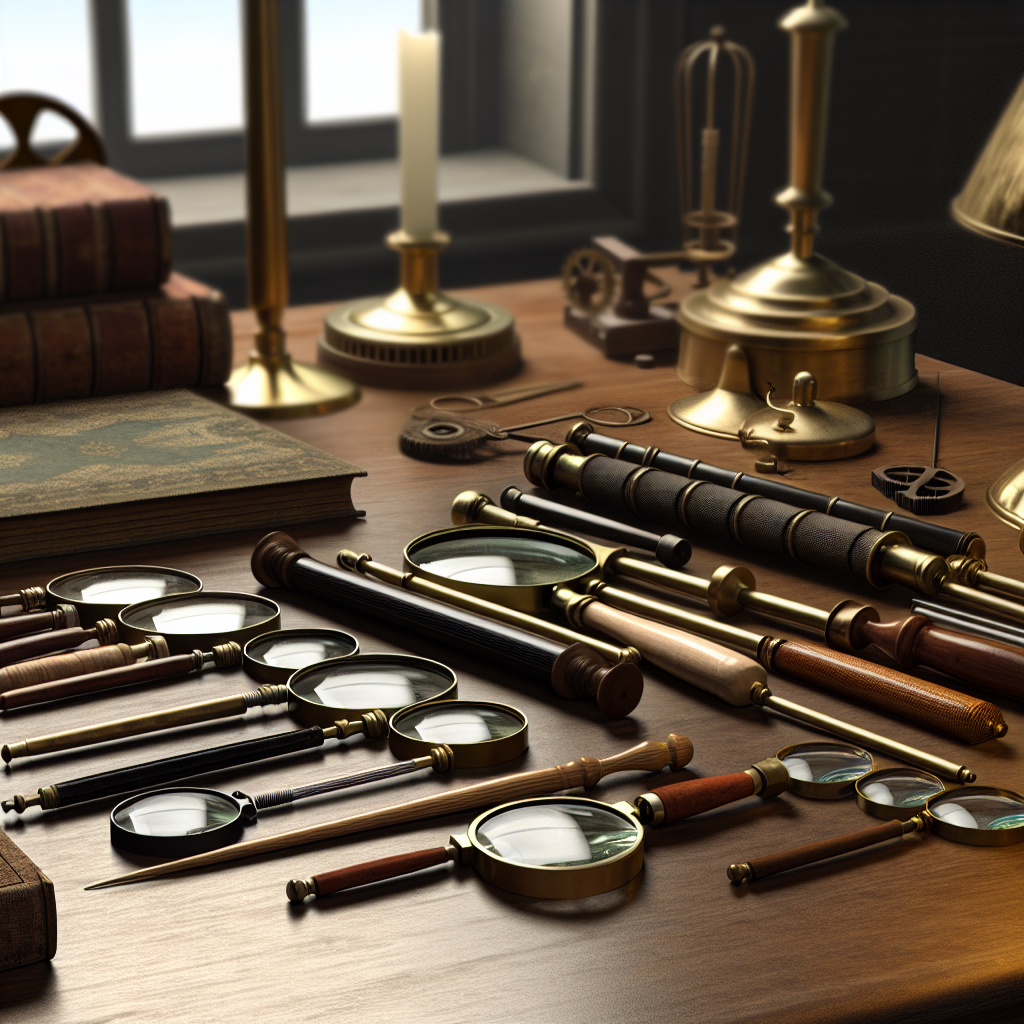
📌 Introduction to Magnifying Glasses
Magnifying glasses, truly revolutionary optical tools, have accompanied human beings for centuries in the quest for precision, discovery, and innovation. Whether for reading difficult-to-decipher texts, industrial quality control, or scientific exploration, they have become indispensable in many fields. Their history, marked by technological progress and significant discoveries, testifies to their ability to adapt to the needs of each era. This article offers a journey through the history and evolution of magnifying glasses, from antiquity to today, highlighting their impact on society, science, and technology.
📌 The Ancient Origins of Magnifiers
To understand the history of the magnifying glass, we must go back several millennia, to an era when humanity gradually discovered the power of light and transparent materials. The first mentions of objects that could magnify vision appear in texts from Mesopotamia and ancient Egypt, where polished quartz crystals were used to observe small objects or to light fires by concentrating solar rays.
In Babylon, "lenses" made of rock crystal have been found, such as the famous Nimrud lens, dated to around 700 BC. These artifacts, slightly convex in shape, were probably used to magnify objects during meticulous work, such as engravings or jewelry. Among the Egyptians, some hieroglyphs evoke the concentration of light rays with the help of transparent stones, suggesting similar uses.
The Greeks and Romans were not to be outdone: Aristophanes, in the 5th century BC, referred to "glass globes" used to concentrate light, and Seneca, in the 1st century AD, spoke of reading made easier through a globe filled with water. Although these early devices were far from modern magnifying glasses, they laid the foundations for understanding the optical phenomena essential to their development.
- Nimrud Lens: an emblematic example of the first ancient magnifying lenses.
- Use of polished crystals: for observing fine details and lighting fires.
- Transmission of knowledge: from the Mediterranean basin to Persia, then to medieval Europe.
In summary, antiquity marks the starting point of the optical adventure. Even rudimentary, the first attempts bear witness to our ancestors' fascination with visual amplification, a quest that would continue to be refined over the centuries.
📌 The Invention of the Magnifying Lens in the Middle Ages
The Middle Ages marked a decisive turning point in the history of magnifiers. Glass craftsmanship progressed, the understanding of optical laws became more refined, and the need for magnifying devices for reading and study became pressing. It was in this context that the modern "convex lens" was born, a direct ancestor of the magnifying glass.
In Italy, from the 13th century, glassmakers in Venice and Florence perfected the manufacture of blown glass. They then produced small convex lenses capable of magnifying texts, popularized under the name of reading stones. These instruments quickly became precious for scholars, scribes, or religious figures, as the first illuminated manuscripts saw their writing reduced to save parchment.
The "magnifier" as we know it truly emerged thanks to the work of Arab opticians such as Alhazen (Ibn al-Haytham, 11th century), who developed a precise understanding of the refraction and focusing of light. This knowledge then circulated in Europe, leading to the appearance of the first reading glasses around the end of the 13th century.
- Reading stone: a thickened lens, placed flat on a text to magnify the writing.
- Convex glasses: direct ancestors of the magnifying glass and eyeglasses.
- Knowledge transfer: through Arab translations and the School of Salerno.
A famous anecdote refers to Roger Bacon, a 13th-century English Franciscan monk, who described in his works the principles of the converging lens to improve the eyesight of the elderly or visually impaired. The influence of these inventions was felt in all intellectual communities, laying the foundations of modern optics.
📌 The Scientific Revolution and Optical Advances
The Renaissance and the Scientific Revolution marked an era of rapid progress in optics. As humanists rediscovered ancient texts and scholars multiplied experiments, the engineering of the magnifying glass experienced a real boom.
From the 15th century, glass manufacturing experienced unprecedented refinement: the purity of the material increased, polishing techniques improved, and convex shapes were produced with greater precision. Magnifying glasses were no longer reserved for scribes, but found their way into cabinets of curiosities, goldsmiths' workshops, and natural sciences.
Two major innovations emerged during this period:
- The optical microscope: Invented by Zacharias Janssen around 1595 in the Netherlands, it uses several aligned lenses, the combination of which initially resulted from a simple, perfected magnifying glass.
- Improvement of simple lenses: Advances in glassmaking allowed for the design of more powerful and less distorting magnifiers, used in botany, zoology, and mineralogy.
Leonardo da Vinci, Galileo, and then Antonie van Leeuwenhoek, an emblematic figure of the 17th century, used magnifying glasses to observe the fine structure of living things. Leeuwenhoek, considered the father of microbiology, designed his own lenses and observed the first protozoa – opening up a new world to science.
The magnifying glass became a symbol of scientific method, essential for confirming new theories or describing nature with unparalleled precision. Through its performance, it provided research with an observational power that revolutionized knowledge.
📌 Magnifiers in the Age of Enlightenment
The 18th century, known as the "Age of Enlightenment," saw the magnifying glass establish itself at the heart of educated and scholarly societies. In a Europe where science was emancipating and flourishing, figures such as Buffon, d'Alembert, and Linnaeus relied on magnifying glasses to rigorously document the diversity of life and explore chemical mechanisms invisible to the naked eye.
Artisanal manufacturing expanded, particularly in Paris and London, where optical houses such as Dollond and Cuff innovated tirelessly. Scholars were passionate about the anatomy of insects, the microstructures of plants, and the study of crystals. The magnifying glass also became an educational tool, introduced into salons and academies to amaze the public with the mysteries of nature.
Among the notable advances:
- Dissemination of the magnifier among amateurs: botany, entomology, numismatics, and jewelry.
- First popularization works: Buffon used the magnifier for his studies on reproduction in small animals. Diderot recommended its use to complement encyclopedic understanding.
- Ergonomic progress: appearance of portable frames with sculpted handles for easier grip.
At this time, the magnifying glass entered the domestic sphere; it was no longer just a sign of erudition but also a daily instrument. A symbol of intellectual emancipation.
📌 The Innovations of the 19th Century
The 19th century was one of democratization. With the industrial revolution, manufacturing processes evolved: glass became more accessible, molding techniques became industrialized, and production costs decreased significantly. From then on, the magnifying glass truly entered homes, schools, and workshops.
In education, it became a valuable aid for learning natural sciences. Children discovered the microscopic world of insects, and teachers illustrated their lessons with unprecedented observations. The range of uses expanded in precision trades:
- Jewelers and watchmakers refined their work on tiny mechanisms.
- Pharmacists and chemists analyzed fragments of plants or minerals.
- Artisans and engravers checked the regularity of their work.
The 19th century also saw functional innovations: folding handheld magnifiers, stand magnifiers to keep hands free, and magnifiers attached to eyeglass frames (monocles). The appearance evolved with the rise of Victorian design. For the first time, the market offered a diversity of sizes, shapes, and magnifications adapted to each use.
It was also during this period that the magnifying glass was equipped with accessories such as integrated lighting, perfecting observation in low light conditions.
| Type of Magnifier | Main Use |
|---|---|
| Classic Handheld | Reading, simple observation |
| On Stand | Manual work, crafts |
| With Lighting | Inspection of details in shadow |
| Folding | Easy transport |
Thanks to advances in manufacturing techniques and the development of international trade, the magnifying glass was never as widely disseminated as it was in the 19th century.
📌 The Impact of Magnifiers in Medicine
If modern medicine can boast increasingly precise diagnoses, it is largely thanks to the decisive contribution of magnifying glasses. Since the end of the 18th century, their use has been perfected to meet the growing demands of clinical and surgical practice.
In surgery, the introduction of binocular magnifiers enabled the initiation of microsurgery, a discipline requiring extreme precision. Surgeons then used models equipped with double lenses, or even coupled with headlamp systems, to operate on the finest tissues: microvasculature, nerve repair, delicate transplants.
- Odontology: Dentists use magnifiers to improve the precision of treatments and ensure invisible prosthetic care.
- Dermatology: Meticulous examination of skin lesions makes it possible to detect early signs of cancers or rare diseases.
- Ophthalmology: Surgical interventions on the eye require flawless magnification, a valuable asset of the magnifying glass.
Anesthesiology, ENT, and rheumatology also benefit from this tool, which quickly became indispensable for ensuring patient safety and comfort. Medical research laboratories also use sophisticated magnifiers to manipulate cell cultures and tissues, accelerating the discovery of new treatments.
The recent development of magnifiers mounted on glasses, ergonomic and lightweight, marks a significant advance for the practicality and preservation of the health of healthcare professionals, reducing visual fatigue and potential errors.
📌 Optical Magnifiers in Education
The advent of the magnifying glass in classrooms significantly transformed science education throughout the 19th and 20th centuries. By putting the power of observation at the service of curiosity, it allows students of all ages to experience science "live," making concepts that are sometimes difficult to grasp concrete.
- Observation of nature: leaves, pollen, insects, and minerals become study objects within easy reach.
- Understanding microscopic structures: unsuspected details are revealed to students, fostering scientific questioning and an understanding of living things.
- Democratization of experimentation: schools are equipped with robust and economical models, accessible to all.
The magnifying glass encourages collaborative work, active observation, and the development of critical thinking—essential qualities for budding scientists. It paves the way for autonomous exploration, wonder, and methodological rigor from an early age.
Furthermore, the use of the magnifying glass extends to other school subjects: in history, for examining coins or manuscripts; in technology, for disassembling complex objects. Its adaptation to each school level allows for coherent pedagogical progression, from simple magnification to advanced analysis.
Since the 20th century, the practice of science in schools cannot be conceived without the magnifying glass, a testament to the constant evolution of education through practice and observation.
📌 Technological Advances of the 20th Century
The 20th century revolutionized the magnifying glass with the advent of advanced technologies. The introduction of new materials – such as plastic polymers – made it possible to produce lightweight, resistant, and inexpensive lenses, paving the way for multiple innovations.
One of the major upheavals was the appearance of electronic magnifiers and digital microscopes, which integrate cameras and screens, offering a radically transformed observation experience. Key revolutions include:
- Integrated illuminated magnifiers: equipped with LEDs, they provide optimal brightness for working day and night.
- Electronic magnifiers: capable of displaying the magnified image on a screen, facilitating the work of visually impaired people or collective demonstrations in class.
- Portable microscopes: combining optical magnification and digital recording, useful in field biology or the electronics industry.
Mass production, refined design, and the use of high-precision components contribute to making these innovations accessible to the general public. Today, the magnifying glass adapts to all circumstances:
| Type of Magnifier | Main Innovation |
|---|---|
| Digital | Screen transmission |
| Foldable | Easy transport |
| With self-contained lighting | Adjustable brightness |
| With recording | Photo or video capture |
The digital age marks a constant acceleration in miniaturization, autonomy, and versatility, making the magnifying glass an object always at the forefront of progress.
📌 Magnifiers and the High-Tech Industry
In today's world, high technology could not exist without the indispensable contribution of magnifying glasses and microscopes. The electronics industry, in particular, relies on these tools for the manufacturing, verification, and repair of miniaturized components.
The assembly techniques for printed circuits, the soldering of microchips, and quality control on production lines require precise magnification combined with perfect chromatic neutrality. Engineers use magnifiers mounted on articulated arms, equipped with aspherical lenses to limit distortions and LED lighting arranged in a ring to eliminate any bothersome shadows.
- Cleanroom control: handling sensitive electronic components under high visual magnification.
- Fiber optic assembly: precision required by the extreme fineness of the parts.
- Final inspection: detection of micro-solder defects or dust invisible to the naked eye.
Beyond electronics, jewelry, luxury watchmaking, the manufacture of medical devices, and the aeronautical industry also make extensive use of magnifying glasses to guarantee impeccable quality and safety.
One of the major advantages lies in the integration of the magnifier into multi-functional tools, capable of transmitting the magnified image remotely or performing automated measurements, revolutionizing maintenance, optimization, and innovation in the high-tech industry.
📌 Various Applications of Magnifiers Today
The magnifying glass is now a universal tool, adopted by professionals and amateurs alike. Its utility transcends disciplines, meeting needs as varied as jewelry inspection, stamp collecting, genealogy, or reading tiny printed texts.
- Jewelry and watchmaking: to detect flaws, engrave microscopic inscriptions, or assemble tiny components.
- Electronics and Repair: detecting faulty solder joints, mounting and checking SMT (surface-mount technology) components.
- Reading and Accessibility: support for visually impaired or elderly individuals with stand-alone, portable, or illuminated models.
- Natural Sciences: exploring and classifying insects, minerals, observing microscopic samples.
- Art Trades: embroidery, bookbinding, miniature painting require precise magnifications.
Each field adapts to specific needs: workbenches integrating a retractable magnifying glass, lightweight portable models for outdoor use, magnification software coupled with digital magnifiers for expert analysis of artworks or ancient manuscripts.
In addition to these uses, new practices have emerged in the connected era, such as shared reading or remote collaborative inspection, thanks to the real-time transmission of magnified images via the Internet.
For a detailed overview of different models and uses, please consult the magnifying glass collection.
📌 The Design and Ergonomic Evolution of Magnifying Glasses
Aesthetics and functionality, long secondary in the design of magnifying glasses, have become a key criterion throughout the 20th century. It's no longer just about magnifying, but about doing it with comfort, style, and efficiency.
Manufacturers are now working on:
- Lightness: thanks to composite or plastic materials, reducing fatigue even during prolonged use.
- Ergonomic shape: curved, non-slip handles, adapted for elderly or children's grip.
- Compact design: folding or pocket magnifiers for easier transport.
- Multiplatform innovation: magnifiers on stands, on feet, or with magnetic attachment to free hands during meticulous work.
- Manufacturing quality: anti-scratch treatments, high-definition optical lenses, meticulous, sometimes artistic finishes.
This pursuit of ergonomics has also opened up magnifying glasses to audiences long neglected: children, seniors, people with visual or manual disabilities. Recent models sometimes integrate additional functions such as UV lamps for banknote inspection or smartphone holders for connected magnifiers.
| Design Evolution | User Benefit |
|---|---|
| Ergonomic handle | Less fatigue, secure grip |
| Lightweight lenses | Easy transport, maneuverability |
| Stand magnifier | Precision work without holding the tool |
| Revisited aesthetics | Appeals to a wide audience, gifts |
📌 Connected Magnifying Glasses: A Digital Revolution
The rise of connected devices has revolutionized the world of magnifying glasses. Digital magnifiers, equipped with high-definition cameras and Wi-Fi, Bluetooth, or USB connectivity, can now project a magnified image in real-time onto smartphones, tablets, or computers.
- Telework and distance learning: teachers can share observations of samples with their students, and experts can provide remote diagnoses.
- Enhanced accessibility: for visually impaired people, connected magnifiers offer an adapted reading experience, improving quality of life.
- International collaboration: easy transmission of magnified data for museums, laboratories, or craft workshops.
Some connected magnifiers have features for image capture, live annotation, or even automated defect analysis thanks to artificial intelligence. Portable models are becoming true pocket laboratories, capable of collecting and sharing data anywhere in the world.
To understand the differences between connected magnifiers and magnifying glasses, read opticians' opinions on reading magnifiers or magnifying glasses.
This new generation of magnifiers promises to radically change the observation experience, expert training, and access to precision, while being part of a constantly evolving digital ecosystem.
📌 Ecological Practices and Sustainable Production of Magnifying Glasses
The optical industry is now addressing environmental challenges. The production of magnifying glasses is evolving to reduce its carbon footprint, limit the use of non-renewable resources, and ensure responsible end-of-life for products.
Some major areas for improvement