



📌 Introduction to Electronic Magnifiers
Recent technological advancements have transformed many everyday tools, and electronic magnifiers are no exception. Once reserved for laboratories or healthcare professionals, these advanced devices are now widely adopted by both professionals and individuals. Reading magnifiers, medical examination tools, accessories for crafts or model making: their versatility is matched only by their ease of use. In this guide, we will explore the various professional and personal applications of electronic magnifiers, analyze the essential criteria for choosing them, and understand the technology behind their effectiveness.
Whether you are a technician, a student, a healthcare professional, or a creative hobbyist, this guide aims to provide you with all the necessary resources to fully exploit the potential of electronic magnifiers in your daily life and optimize each of your professional or personal actions.
📌 What is an electronic magnifier?
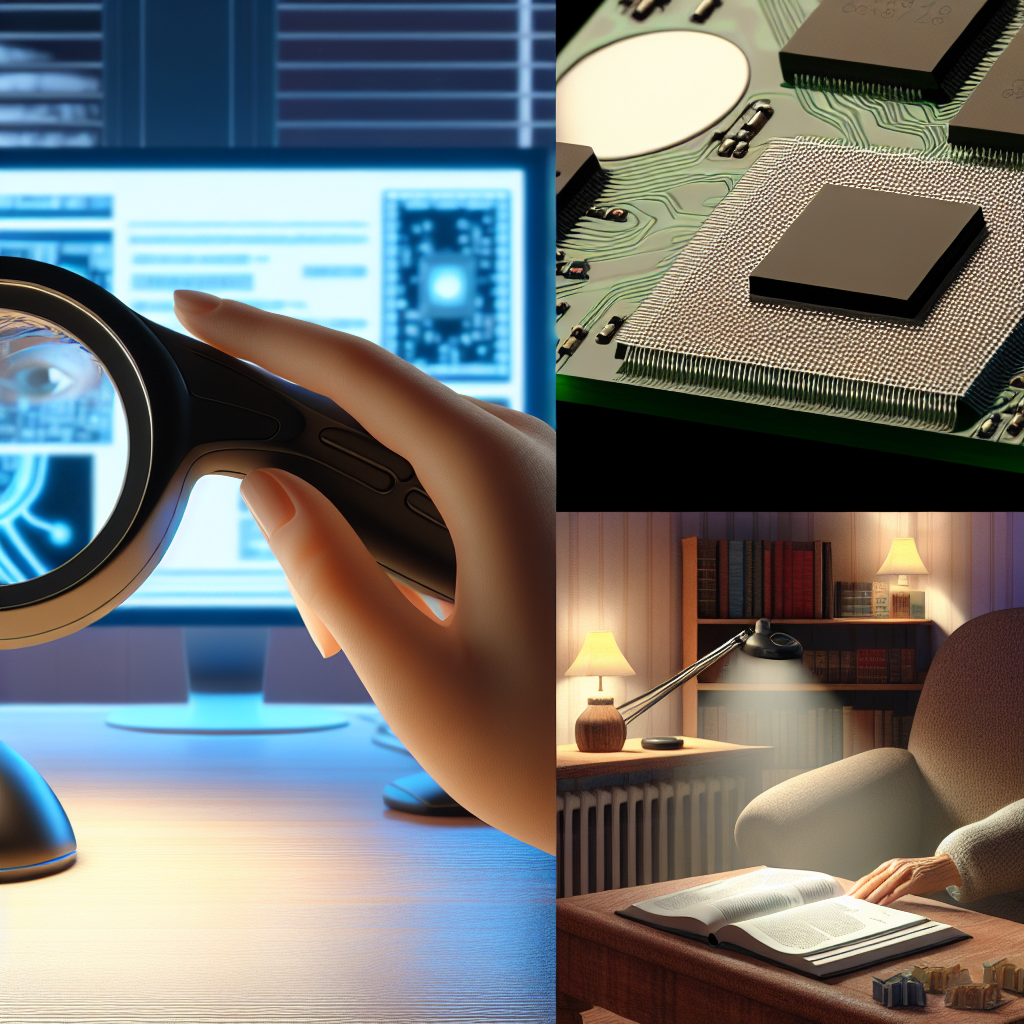
An electronic magnifier is a digital optical device capable of magnifying and displaying images on an integrated or external screen. Unlike traditional magnifiers, it uses a high-performance camera that captures the image of the object to be observed and transmits it live to an LCD monitor, a tablet, or sometimes even via a connection to a computer.
The main components of an electronic magnifier generally include:
- A high-definition camera
- An integrated LED lighting system for optimal rendering
- A screen (fixed or mobile depending on the model)
- Controls to adjust the zoom level and other settings
There are many types of electronic magnifiers:
- Portable electronic magnifier: lightweight, compact, easy to transport, and ideal for reading or travel.
- Desktop (or fixed) magnifier: equipped with a larger screen, perfect for extended use at home or in a professional environment.
- Connected magnifier: allows image transmission to a workstation or a remote medical team.
The diversity of models thus offers a suitable solution for every need: simple reading, precise analysis of medical images, examination of details for collectors, etc. The rapid evolution of technology has significantly reduced the cost of this equipment while improving its performance.
In short, the electronic magnifier is now an essential companion combining comfort, precision, and accessibility for a wide audience.
📌 How to choose an electronic magnifier?
Choosing an electronic magnifier adapted to one's needs requires a good understanding of several key criteria. These characteristics directly influence image quality, ease of use, and effectiveness in the application context.
- Resolution: a decisive criterion for image clarity and analytical finesse.
- Magnification level and zoom range: depending on the intended use (reading, observation of fine details, professional use).
- Portability: some models are designed for frequent travel, while others prioritize comfort at home.
- Battery life: the battery life should be considered for extended or mobile use.
- Accessibility & ergonomics: intuitive controls, weight, screen size, and type of support.
It is also recommended to consult user reviews and specialized electronic magnifier comparisons to target the model suitable for your field.
📌 Importance of resolution
Resolution refers to the level of detail that the magnifier can display on the screen. It is generally expressed in pixels (e.g., 720p, 1080p, or even 4K for some high-end models).
| Resolution | Recommended Use |
|---|---|
| 640x480 px (VGA) | Simple text reading, observation of medium-sized objects |
| 1280x720 px (HD) | Detailed reading, inspection of more complex elements |
| 1920x1080 px (Full HD) | Minute analyses, intensive professional use |
| 4K UHD | Scientific work, advanced microstructure analyses |
The higher the resolution, the sharper and more faithful the projected image will be to the original, which is essential for detecting color nuances, defects invisible to the naked eye, or fine characters of writing.
- In medicine, a blurry image can distort the interpretation of results.
- In jewelry, only excellent resolution will allow working on tiny details.
However, be careful to adapt the resolution to the screen size: a very high resolution on a small screen will not always be usable.
📌 Magnification and zoom ranges
Magnification represents the maximum enlargement allowed by the electronic magnifier. It is often between x2 and x50, or even more, depending on professional models. Some devices offer an adjustable zoom range, allowing the enlargement to be adapted to each situation:
- Optical zoom: magnification is obtained by physical components, without loss of quality.
- Digital zoom: the image is enlarged by software, which can lead to a slight degradation of details at high magnification.
A flexible magnification range is ideal for:
- Reading text at low magnification (x2 to x5)
- Inspecting electronic circuits at higher levels (x10 to x30)
- Analyzing the details of a jewel or a miniature painting (x20 to x50)
Choosing the right zoom capability ensures versatile use of the electronic magnifier. Ergonomic controls offer the convenience of quickly changing levels, simplifying the transition between different tasks.
📌 Professional Applications of Electronic Magnifiers
Electronic magnifiers have become indispensable in many professional fields, thanks to the precision and ease of use they offer. They have become essential in the medical world, crafts, electronics maintenance, and education. Let's examine in more detail the specific uses in these sectors.
📌 Use in medicine and healthcare
In medical settings, the electronic magnifier is a valuable device for:
- Examining skin lesions with superior sharpness
- Analyzing cell morphology or tissues during biopsies
- Monitoring the evolution of chronic pathologies through image recording
Some models even allow remote consultation: a very precise image can be sent to a colleague for a second opinion diagnosis or for teleconsultation needs. The use of electronic magnifiers thus contributes to the accuracy of diagnoses and the improvement of patient care.
For ophthalmologists, they offer a detailed analysis of the ocular condition. For dermatologists, they are essential for detecting anomalies difficult to see with the naked eye.
In dental surgery and odontology, these devices facilitate delicate interventions such as root canal treatment or prosthesis placement.
📌 Role in crafts and jewelry
Artisan jewelers, watchmakers, and art restorers use electronic magnifiers to ensure an unparalleled level of precision. They allow:
- To visualize inclusions in precious stones or diamonds
- To meticulously adjust settings, engravings, and solders
- To restore ancient works without risk of error
Magnification and LED lighting help reveal every imperfection or particularity. This allows them to highlight their expertise, ensure a high-end finish, and increase the value of the produced or restored items.
In addition to jewelry, many craft trades (cabinetmaking, engraving, or artisanal bookbinding) highly value electronic magnifiers for checking finishes or quality control.
📌 Education and academic research
In schools, colleges, high schools, and universities, electronic magnifiers are becoming essential educational tools. Science teachers can:
- Project live microscopic slide observations onto a large screen
- Bring biology, physics, or chemistry experiments to life
- Allow each student to discover structures invisible to the naked eye
Students benefit from an interactive and immersive experience, improving their understanding of natural or technical phenomena.
The ability to record images allows researchers and academics to archive their observations, document their discoveries, and effectively share their results with the scientific community.
📌 Repair of electronic equipment
Technicians in the maintenance and repair of electronic devices rely heavily on electronic magnifiers in their interventions. Here's how:
- Inspection of printed circuits and microcomponents
- Soldering or desoldering tiny parts with precision
- Detection of short circuits, cracks, or structural anomalies
In the workshop or in the field, the detailed visualization offered by a digital magnifier guarantees the reliability of operations. Some models offer image capture or export for traceability and in-depth analysis.
A common use is to compare welds made before and after intervention, significantly reducing the risk of error and optimizing the quality of the repair performed.
📌 Personal applications of electronic magnifiers
While professional applications are numerous, the personal uses of electronic magnifiers are no less varied and innovative. Their democratization particularly benefits people wishing to improve their reading comfort, enjoy their hobbies, or maintain collections.
📌 Reading and visual aids
People with low vision, AMD, or ophthalmic disorders particularly benefit from electronic magnifiers for:
- Easily reading newspapers, books, or mail
- Viewing instructions, user manuals, or labels
- Writing notes, filling out forms effortlessly
The display quality, the ability to adjust lighting and contrast, and the ease of handling make these devices very popular in daily life.
Some models offer text-to-speech conversion, ideal for visually impaired people or seniors. The control buttons are generally large, tactile, and easy to recognize.
To learn more about the differences between an electronic magnifier and a classic magnifier, consult our detailed comparison guide.
📌 Observation of collectible objects
Stamp collectors, numismatists, philatelists, or lovers of old manuscripts: the electronic magnifier can reveal subtleties invisible to the naked eye:
- Study of micro-details on collectible stamps
- Identification of vintages, engravings, or defects on coins
- Analysis of texture, watermarks, or inks on old documents
Image capture and archiving facilitate comparison between items, information sharing, or remote expertise. For enthusiasts, it is also about exploring heritage from a new angle, while preserving the integrity of the observed objects.
📌 Creative leisure activities
Many hobbies benefit from the contributions of electronic magnifiers:
- Model making (assembly, fine painting of figurines or models)
- Knitting, embroidery, and sewing, to inspect the regularity of stitches
- Miniature painting, calligraphy, restoration of ancient books
The possibility of capturing realization stages in images, working in controlled lighting conditions, and benefiting from adjustable magnification is valuable. These devices make precise movements more comfortable and improve the overall quality of the works produced.
The arrival of compact, robust, and affordable models has contributed to democratizing their use, making electronic magnifiers a true ally for unleashing creativity every day!
📌 Technology Behind Electronic Magnifiers
Electronic magnifiers are the result of major innovations in several areas of technology: optics, digital imaging, software processing, and artificial intelligence. Understanding these advancements helps to better grasp why these tools are so effective today.
Their operation is based on an integrated technological chain:
- HD or even 4K cameras for crystal clear images
- Adjustable multi-color LED lighting with low heat emission
- LCD or OLED screens offering fatigue-free viewing
- Image processing chips that allow zoom, focus, and automatic correction of brightness and contrast
Furthermore, advancements in miniaturization have allowed for a reduction in the weight and size of models, while improving the battery life of embedded lithium-ion batteries.
📌 Recent innovations
In recent years, the electronic magnifier market has seen numerous innovations:
- Hybrid optical zoom combining mechanical and digital for increased performance without loss of detail.
- Touchscreens allowing for more intuitive navigation and parameter adjustment.
- Wi-Fi and Bluetooth connectivity facilitating image transfer, shared viewing on TV screens, or remote collaboration.
- Enhanced battery life with long-lasting batteries and energy-saving modes.
- Miniaturization to make them even more portable, without sacrificing performance.
These new features meet efficiency, comfort, and safety needs, while making electronic magnifiers accessible to a wider audience.
📌 Impact of artificial intelligence

Within 14 days - Unconditional

Products tested and approved

Support a local business

Guarantee of a Smooth Transaction



Research