


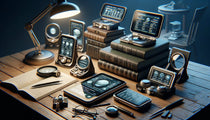

📌 Introduction to the world of reading magnifiers
Reading magnifiers play an essential role in the daily lives of many people, particularly those suffering from visual impairments such as presbyopia, AMD, or low vision. Today, the choice is mainly between classic models and increasingly sophisticated electronic models. This article offers an in-depth comparison between electronic and classic reading magnifiers, including practical advice, testimonials, case studies, and trends to help you make a choice suited to your current and future reading needs.
➡️ Understanding classic reading magnifiers
The classic reading magnifier is an optical instrument characterized by its simplicity and efficiency. Used since the 18th century, it instantly magnifies text to facilitate reading. It can be found in homes, libraries, doctors' or notaries' offices, and even in the creative leisure sector. Most often equipped with a convex lens, it magnifies the size of characters or details once placed between the eye and the surface to be read. But there are actually several types of magnifiers, each adapted to very different situations.
❇️ Types of classic magnifiers
- Handheld magnifiers: The most common, with a handle; ideal for occasional reading of a label, contract, or instruction manual.
- Stand magnifiers: Mounted on a base or articulated arm; they free up the hands, perfect for prolonged reading or manual work.
- Pocket magnifiers: Compact and lightweight; they slip into a bag or pocket for use away from home (menus, maps, tickets).
❇️ Advantages of classic magnifiers
Choosing a classic magnifier offers undeniable benefits, appreciated by both individuals and professionals who need reliable and accessible tools.
🔸 Simplicity and durability
Classic magnifiers are intuitive, ready to use without electrical power or complex adjustments. Their robust construction allows them to last for years without technical failures.
🔸 Accessibility and cost
Available in all pharmacies, bookstores, supermarkets, and specialized websites, their entry price makes them accessible to the greatest number. Even professional quality models often remain economical, especially if you consult a wide selection of models on the reading magnifiers page.
➡️ Focus on electronic reading magnifiers
In contrast to the classic magnifier, technology now offers the electronic reading magnifier. Generally equipped with an HD camera that relays the image to an LCD screen, it provides a more dynamic and personalized experience. At the crossroads between a tablet and a visual aid, it adapts to everyone, from schoolchildren to seniors, and meets multiple needs: reading texts, menus, studies, document observation, manual work, medical monitoring, etc. Innovation is now in everyone's hands.
❇️ Features of electronic magnifiers
- Adjustable screen sizes: from small portable screens to large desktop screens for optimal comfort.
- Digital text enlargement: allows for magnification far beyond traditional optical magnification (sometimes up to 20x or more).
- Customizable contrasts: possibility to invert colors, increase contrast, or display text in yellow on a black background, particularly useful in cases of color perception disorder or light sensitivity.
❇️ Advantages of electronic magnifiers
🔸 Superior magnification
The electronic magnifier allows for much more precise and higher magnification, almost instantly, often adjustable via simple rotation or touch control. Tiny characters on medication, instructions, or even complex diagrams can be magnified, making reading and learning accessible to everyone, regardless of the level of visual impairment.
🔸 Versatility of use
Beyond reading, these tools often offer screen capture, computer connection, image storage, or audio rendering of text. Recent models integrate OCR (optical character recognition) function, which vocalizes detected text, a real revolution for home autonomy.
🔄 Comparison of the two types of magnifiers
To choose your reading magnifier well, it is important to compare their practical performance, comfort, price, and compatibility with specific needs (age, activities, pathologies, etc.). This 2025 comparison aims to provide you with an exhaustive analysis between these two main types.
❇️ Magnification performance
A classic magnifier generally offers a magnification between 2x and 8x, some models going up to 10x, but at the cost of a reduced field of vision. In contrast, electronic magnifiers display magnifications from 3x to 20x, sometimes more, while maintaining a clear and bright image across the entire screen, which limits eye strain.
❇️ Portability and ease of use
The classic reading magnifier easily slips into a bag, pocket, or drawer. Its lightness and lack of batteries make it the ideal companion outdoors. Modern portable electronic models try to imitate this compactness, but are currently more bulky or require regular recharging. However, if you mainly stay at home or work, the desktop electronic version is preferable for visual comfort and versatility.
❇️ Initial cost and long-term value
With a classic magnifier, the investment remains low (from 5 to 80 euros), even for high-end models. Electronic magnifiers start at about 100 euros for basic models and can exceed 1500 euros for professional versions. Nevertheless, they offer real added value through improved quality of life, the possibility of being autonomous even in cases of severe deficiency, and versatility of use (reading, writing, observation).
❇️ Adaptability to specific visual problems
In cases of significant acuity loss, degenerative diseases, or specific needs (e.g., recognizing a prescription, reading a check), the electronic magnifier with personalized settings will be the ideal ally. The criteria for choosing a reading magnifier for seniors include precisely this ability for tailor-made adaptation. Classic magnifiers primarily meet common and minor needs.
🔬 Concrete examples of usage situations
Let's ground theory in reality with concrete scenarios where one tool or the other will be most suitable:
❇️ Ideal for daily reading
Do you want to decipher a list of food ingredients, read a novel, complete a crossword puzzle, or consult a TV program at home? A classic handheld or stand magnifier is usually sufficient to provide quick magnification and takes up little space. It is the bedside accessory for many seniors and people who do few outdoor activities.
❇️ People on the go
For those who travel regularly, attend trade shows, or frequently use public transportation, the electronic pocket magnifier stands out. Despite a higher cost, compact models ensure flexible magnification while adapting to reading train tickets, restaurant menus, or city maps. Some devices combine Bluetooth connectivity and image capture, useful for sharing or archiving information found while traveling.
💬 Testimonials and user reviews
When users are asked, opinions are often divided between habits and evolving needs. Mrs. Lefort (73, Lyon) says: I used a handheld magnifier all my life to read in the morning, but with age and eye strain, I adopted an electronic tablet magnifier. It allows me to adjust everything according to the light or the font. Mr. Benarroche (retired teacher in Marseille) specifies: The classic magnifier is enough for me for crosswords or reading a newspaper, but I recommend the electronic one to my students suffering from severe disorders. For Lucas, 32, web developer: My electronic magnifier stays in the office, but a classic pocket magnifier accompanies me everywhere else. These testimonials highlight that there is no universal solution. The choice depends on the context, the severity of the visual impairment, the budget, and the frequency of use.
🛠️ Tips for choosing the right magnifier for your needs
Selecting a reading magnifier should not be taken lightly. It is necessary to evaluate several personal criteria to fully enjoy your device.
❇️ Assessment of your personal needs
Identify the frequency of use (daily or occasional?), situations (reading, observation, writing?), and the degree of your visual impairment. For mild presbyopia, a classic magnifier is often sufficient. For a visually impaired person or someone suffering from an evolving disorder, opt for electronic.
❇️ Budget and value seeking
Consider the cost as an investment in your comfort. If your budget is limited, the classic magnifier will guarantee the essentials. If your autonomy or quality of life risks being impacted, investing in an electronic magnifier proves relevant.
❇️ Consultation with a professional
Do not neglect the advice of an optician or a specialized ophthalmologist. A professional will be able to guide your choice, or even recommend a tailor-made adaptation according to your pathology and daily use. Some points of sale also offer tests and demonstrations before purchase, allowing you to try different models in real conditions.
🔧 Maintenance and care of magnifiers
To ensure the longevity of your magnifier, a few simple steps should be adopted:
- Regularly clean the lens with a soft microfiber cloth to avoid scratches.
- Protect from shocks by storing the magnifier in a dedicated case.
- For electronic models, avoid exposure to humidity and only charge the battery with the recommended charger. Remember to perform software updates on connected models.
A little attention will save you a lot of trouble and guarantee years of reliable use, whether for a traditional or electronic reading magnifier.
🛒 Where to buy magnifiers and accessories
In France, a wide range of magnifiers is available from opticians, pharmacies, medical equipment stores, and specialized online shops. Some distributors even offer support or partial coverage by Social Security for people suffering from severe blindness. Prioritize recognized brands for their after-sales service and expertise, such as specialized sites for vision aids. Compare prices, warranties, and customer reviews before purchasing to avoid any disappointment.
📈 Trends and upcoming innovations
The reading aid sector is experiencing rapid growth in technological offerings: voice recognition, artificial intelligence for document analysis, remotely connected magnifiers for education or teleassistance. The integration of augmented reality also promises new uses for the visually impaired. Future innovations focus on miniaturization, lightness, and interfacing with smartphones for ever more intuitive and accessible solutions for all budgets.
❓ FAQ – Frequently asked questions about reading magnifiers
- What is the main difference between a classic and an electronic reading magnifier?
The classic magnifier magnifies text optically, while the electronic version uses a camera and a screen to offer digital magnification, often more powerful and customizable.
- Is the electronic magnifier suitable for all ages?
Yes, although more technical, it is suitable for children, students, adults, and seniors. Its ergonomics have greatly improved, and even seniors adopt it easily thanks to large buttons and simplified menus.
- How much does a good electronic reading magnifier cost?
The first models start around 100 euros, but for optimal comfort, expect between 200 and 1000 euros depending on the features (screen size, voice reading, portability, storage).
- Is the classic magnifier suitable for AMD?
In an early stage, yes, but in case of advanced AMD, it is better to favor electronic magnifiers which offer high contrast and strong zoom adapted to this pathology.
- Do you need a prescription to buy an electronic magnifier in France?
No, but in case of recognized visual impairment, an optician or ophthalmologist can recommend a visual aid partially reimbursed by Social Security upon presentation of a medical certificate.
- Can you read long novels with an electronic magnifier?
Absolutely, especially with models equipped with a large screen and a page memorization function. This provides an experience similar to that of a tablet, while being optimized for low vision.
🎯 Conclusion: Making the right choice
In 2025, the choice between a classic and electronic reading magnifier will primarily depend on your personal needs, your budget, the context of use, and the nature of the visual impairment. The simplicity and low price of optical models are still very appealing, while the comfort, autonomy, and power of electronic versions meet specific and evolving needs. Take the time to try, compare, and seek professional advice to find the tailor-made solution that will permanently improve your visual quality of life.