


📌 Introduction to Reading Magnifiers for Seniors
As we age, it's common for vision to decline, making reading, sorting mail, or deciphering labels more difficult for many. Fortunately, specialized tools exist to overcome these challenges, particularly reading magnifiers. Practical, discreet, and suitable for all daily uses, they greatly promote the independence of seniors. This comprehensive guide aims to help every reader discover the different models, essential criteria to check before purchasing, and best practices for use. Thanks to this detailed content, you will have all the knowledge to select the most suitable magnifier for your vision or that of your loved ones.
Discover below every fundamental aspect to consider for choosing the ideal reading magnifier for seniors, balancing comfort, efficiency, and safety of use.
📌 Why Seniors Need Reading Magnifiers
One of the most common visual phenomena with aging is presbyopia, which makes near reading more complex. After 60, other conditions such as AMD (age-related macular degeneration) or cataracts can also impair vision. These disorders often result in blurred lines, letters too small to decipher without assistance, or significant visual fatigue after reading.
The reading magnifier is then a simple and effective solution to alleviate these difficulties. It is not only for reading novels: it is also invaluable for:
- Reading medication instructions
- Deciphering product labels at the supermarket
- Filling out a check
- Following a TV program
- Consulting a cooking recipe, etc.
By allowing everyone to see better, the magnifier improves confidence, encourages autonomy, and limits dependence on others. It is an essential visual aid accessory for continuing to lead an active and engaged life.
Numerous studies show that integrating an adapted reading magnifier into daily life reduces feelings of isolation among seniors, while increasing satisfaction in everyday tasks. Investing in an adapted magnifier therefore contributes to maintaining independence at home for as long as possible.
In the rest of this guide, we will explore the different options available to meet the very diverse needs of seniors.
📌 Different Types of Reading Magnifiers
🔍 Pocket Magnifiers
Pocket magnifiers are small, compact models designed to be taken anywhere. They easily fit into a bag, jacket pocket, or wallet, making them ideal for shopping, reading prices, or prescriptions while on the go. They are usually equipped with a protective case to prevent the lens from scratching.
These magnifiers often have a magnification between x3 and x10, with small lenses (30 to 60 mm in diameter). Their lightness and ease of use appeal to seniors who want an accessible and convenient accessory for temporary use at any time.
- Perfect for mobility.
- Ideal for deciphering labels or menus outside the home.
- Easily stored in a pocket or handbag.
However, they cover a smaller reading surface and are less suitable for sustained reading of a book or newspaper.
🔍 Handheld Magnifiers
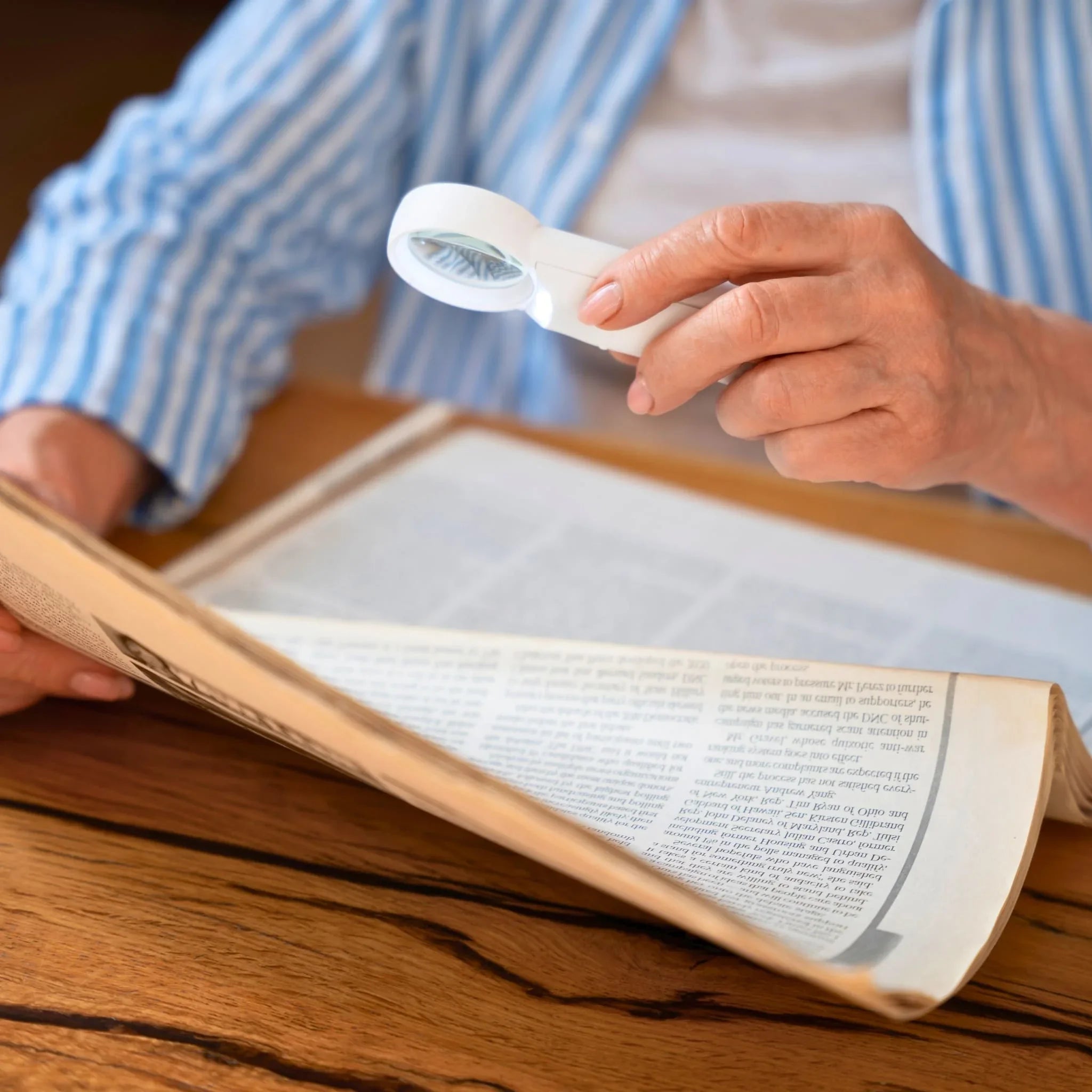
Classic and popular, the handheld magnifier is the version one spontaneously imagines. It features a round or oval lens mounted on an ergonomic handle. It comes in many lens formats, generally 60 to 100 mm in diameter, for comfortably reading entire pages, maps, or long articles.
This model is favored by seniors who want to read at home in an armchair or at a table with more "relaxed" reading. Some prototypes, equipped with a stand or support, can be placed over text to completely free the hands. Other models offer non-slip or extra-wide handles for optimal grip – a major asset in cases of arthritis or reduced dexterity.
- Solution suitable for prolonged reading.
- Larger reading surface.
- Good stability and comfort during long sessions.
Their main drawback is their bulk, which makes them less suitable for outdoor transport.
🔍 Electronic Magnifiers
The latest generation of magnifiers, electronic magnifiers combine technology and visual comfort. They appear as portable devices, sometimes the size of a smartphone, equipped with a screen that displays text or objects in real-time using an integrated camera. Some electronic magnifiers can even be connected to a television screen, tablet, or computer for optimal readability, or feature "text-to-speech" functionality to read text aloud.
They offer:
- Variable magnification (often x2 to x30 or more)
- Contrast, brightness, and color inversion adjustment
- Ability to take screenshots or save text
Their cost is higher, but they represent a real revolution for seniors with severe visual impairment, providing them with great autonomy. Their only constraint: they require a minimum familiarity with technology.
📌 Important Criteria for Choosing a Reading Magnifier
🔍 Optimal Magnification
Choosing the magnification is crucial. Too little magnification will not be effective, while too much magnification can reduce the field of view to the point of making reading uncomfortable. For most seniors, a magnifier offering x2 to x4 magnification is ideal for everyday reading. Finer texts, such as instructions, may require x5 or more.
To choose well, it is advisable to test several levels of magnification and check at what distance to hold the magnifier to obtain a perfectly clear image. Multi-magnification magnifiers, integrating two different lenses, can be practical for alternating according to needs.
🔍 Size and Weight
A model that is too heavy could exacerbate hand or wrist fatigue during prolonged reading, especially for people with fragile joints. Look for a lightweight magnifier with a large but thin lens. The handle should allow for easy grip, ideally with an anti-slip coating or an ergonomic shape.
It is also important to consider the size of the lens: the larger it is, the more of an entire paragraph can be read without having to constantly move the magnifier. However, too large a magnifier risks being heavy. The compromise is around 75 to 90 mm in diameter.
🔍 Lens Quality
Two materials dominate the market: mineral glass (sometimes called optical) and acrylic. Each has its advantages:
- Optical glass: high scratch resistance and excellent optical quality, ensuring a precise and natural image. Heavier, but durable.
- Acrylic: very lightweight material, less fragile than glass, but slightly more susceptible to scratches. Ideal for travel, for easy handling.
In all cases, choose a lens without peripheral distortion, to avoid the "fisheye" effect that would hinder reading at the edges.
The ideal is to test different lenses in a store or systematically check for guarantees on optical quality when purchasing online, for example on the specialized collection of reading magnifiers.
📌 Additional Features for a Better Experience
🔍 Integrated Lighting
Nearly 95% of recent reading magnifier models include a light source, often LED. This option makes all the difference, especially in low ambient light or in the evening. It illuminates the page precisely, limits shadow areas, and optimizes visual comfort, reducing eye strain.
- Some models offer dimmable LEDs.
- There are magnifiers with multiple lighting modes (cool white, warm white, etc.) to suit every preference.
- Electronic magnifiers take adjustments even further, with customizable contrasts and tints.
Remember to check the ease of changing batteries or recharging if lighting is used frequently.
🔍 Ergonomic Adjustments
Ergonomics is crucial, as an uncomfortable magnifier will quickly be abandoned. A sufficiently wide, soft-touch, or non-slip handle prevents finger cramping. Some models tilt or fold to offer multiple reading positions.
For people with tremors or reduced strength, there are stand-alone or tabletop magnifiers, freeing the hands and promoting stable reading. Some models include a cord or kickstand for easy position readjustment without fatigue.
| Criterion | Advantage | For whom? |
|---|---|---|
| Ergonomic handle | Good grip | Fragile hands |
| Stand system | Hands-free reading | Arthritis, trembling individuals |
| Large lens | Easy reading | Reading books, newspapers |
In short, every ergonomic detail promotes reading, safety, and independence for seniors.
📌 Comparison of Popular Brands
Choosing a reading magnifier is also based on the manufacturer's reputation. In the French market, several brands stand out among opticians, occupational therapists, and users themselves.
- Eschenbach: A European leader, this German brand offers a vast range of precision magnifiers, from classic magnifying glass to high-end electronic magnifiers. Their products are renowned for the optical purity of their lenses, their robustness, and their user comfort, with models specifically designed for seniors.
- Magnifier: Praised for its entry- and mid-range solutions, Magnifier offers a wide choice of handheld, pocket, or stand magnifiers, often equipped with LED lights. Their ergonomic models are appreciated for their value for money.
- Daylight: Specialized in lighting, Daylight offers magnifiers equipped with powerful integrated lamps. Their strong point: natural, flicker-free light, ideal for long-term visual health.
Other manufacturers, such as Schweizer, Levenhuk, or CORDIS, are also emerging with innovative products. Always consult user reviews and analyses from specialized guides, such as our top 5 best reading magnifiers for seniors, to refine your choice.
However, remember that beyond the brand, the relevance of the model (magnification, ergonomics, features) to your needs or those of the senior is paramount in the final decision.
📌 Tips for Maintaining Your Reading Magnifier
Proper maintenance extends the life of a magnifier and ensures consistent vision quality. Here are the steps to take regularly:
- Clean the lens with a microfiber cloth (the same type used for glasses) to avoid scratches or dust deposits that could impair vision.
- Never use harsh chemicals or paper towels, as they risk dulling or scratching the optical surface.
- If you own an electronic magnifier, be sure to charge the battery and gently wipe the screen.
- Always store the magnifier in a hard case after use, especially when traveling, to protect it from shocks.
- Regularly check the proper functioning of the integrated light and be sure to replace batteries as soon as they weaken to maintain full brightness.
A quick visual check before each use prevents unpleasant surprises and ensures an optimal reading experience every time.
📌 How to Use a Reading Magnifier Effectively
Even the best reading magnifier requires a bit of technique to provide the best visual comfort. Follow these practical tips to unleash the full potential of your accessory:
- Position the magnifier at the correct angle: Hold the magnifier close to the page, then slowly move it back to get an enlarged but clear image. If you move the magnifier too far away, the image becomes blurry.
- Use the integrated lighting: Turn on the light to illuminate the reading area evenly. Orient the lighting so it doesn't create bothersome reflections.
- Stabilize your hands: To avoid tremors, rest your elbows on the table or use a magnifier with a stand.
- Don't strain your eyes: Take breaks, especially during prolonged reading. By regularly resting your eyes, you limit eye fatigue.
For electronic magnifiers, consult the manual to master zoom or contrast settings, to adapt the display to your vision and ambient light. Finally, do not hesitate to seek advice from an optician or an occupational therapist for personalized support.
📌 User Testimonials
Michel (74, Marseille): For a year now, I've been using an LED-lit reading magnifier to read my newspaper. It's become indispensable! I can finally read without asking my daughter for help with crosswords or bills.
Marie-Christine (82, Rennes): I lost some of my sight a few years ago due to AMD. The electronic magnifier has given me back the confidence to answer my mail or read my favorite novels. It even reads the text aloud to me when my eyes get tired!
Bernard (69, Paris): I bought a small pocket magnifier from my optician. I always keep it with me. I use it for menus at restaurants or reading train schedules. It's practical, discreet, and avoids many mistakes.
Many seniors report a significant improvement in their comfort of life and autonomy as soon as they find the reading magnifier adapted to their specific needs. The ability to continue enjoying hobbies and remaining independent motivates more and more seniors to equip themselves, regardless of their visual profile.
📌 FAQs: Frequently Asked Questions
🔍 What is the best magnifier for a senior?
There is no universal reading magnifier: everything depends on the level of visual impairment and usage needs. For everyday reading at home, a handheld magnifier with x3 or x4 magnification is ideal. For portability, prefer a lightweight pocket magnifier. In case of severe pathology like AMD, opt for an electronic magnifier. Ask an optician for advice or consult our selection of the best magnifiers for seniors to make the right choice.
🔍 Are electronic magnifiers more effective?
They provide superior comfort thanks to adjustable magnification, the ability to modify brightness and contrast, and innovative voice options. However, they are more expensive and may require an adaptation period for people less comfortable with technology.
🔍 Are there magnifiers suitable for reading maps or photos?
Yes, some extra-large or rectangular lens magnifiers cover large surfaces, ideal for reading maps, plans, or photo albums. Stand-alone or tabletop models are particularly suitable for this use.
🔍 Can a reading magnifier be used with glasses?
Absolutely: simply place the magnifier between the text and your glasses. Some people, however, find it more comfortable to remove their glasses when reading with a magnifier, depending on the correction needed.
🔍 Where to buy a magnifier suitable for an elderly person?
You can inquire with opticians, pharmacies, some medical supply stores or senior comfort stores, or on specialized websites offering many magnifiers suitable for all budgets. Consult our online reading magnifier collection to discover the most popular models.
🔍 What pitfalls should be avoided when purchasing?
Avoid "gadget" magnifiers of poor quality, too small, or without clear guarantees on lens performance. Prioritize recognized brands and models tested by senior users. Check magnification, optical quality, ergonomics, and after-sales service before finalizing your choice.
📌 Future of Reading Magnifiers for Seniors
The visual aids sector is evolving rapidly. New technologies are emerging alongside traditional magnifiers: augmented reality, for example, is starting to make reading simpler by projecting digital information or amplifying contrast directly onto the page.
Electronic magnifiers are regularly enhanced with new features: character recognition, speech synthesis, and personalized settings based on visual impairment. In the future, these innovations are expected to become increasingly accessible, connected, and easy to use, even for those less technologically savvy.
Designers are also working on lighter materials, long-lasting batteries, and even autonomous devices that automatically detect and correct reading posture. The goal is to enable every senior to read, regardless of their ocular health, without fatigue or frustration, in all daily conditions.
Today's reading magnifier is therefore already a concentrate of technology, and tomorrow's models are very likely to once again revolutionize seniors' visual comfort.
📌 Conclusion
Choosing the right reading magnifier is a concrete investment in preserving one's autonomy, freedom to read, and ability to stay active. Assessing real needs—the nature of visual impairment, usage environment, ergonomic preferences—guides towards the ideal solution, whether it's a simple handheld magnifier or a high-tech model. Remember to test several models, seek advice from professionals, and consult reviews from other seniors.
By following the criteria and advice presented in this guide, you or your loved ones can select the ideal magnifier to transform the reading experience and rediscover the pleasure of clearly legible text, with complete confidence and security.