


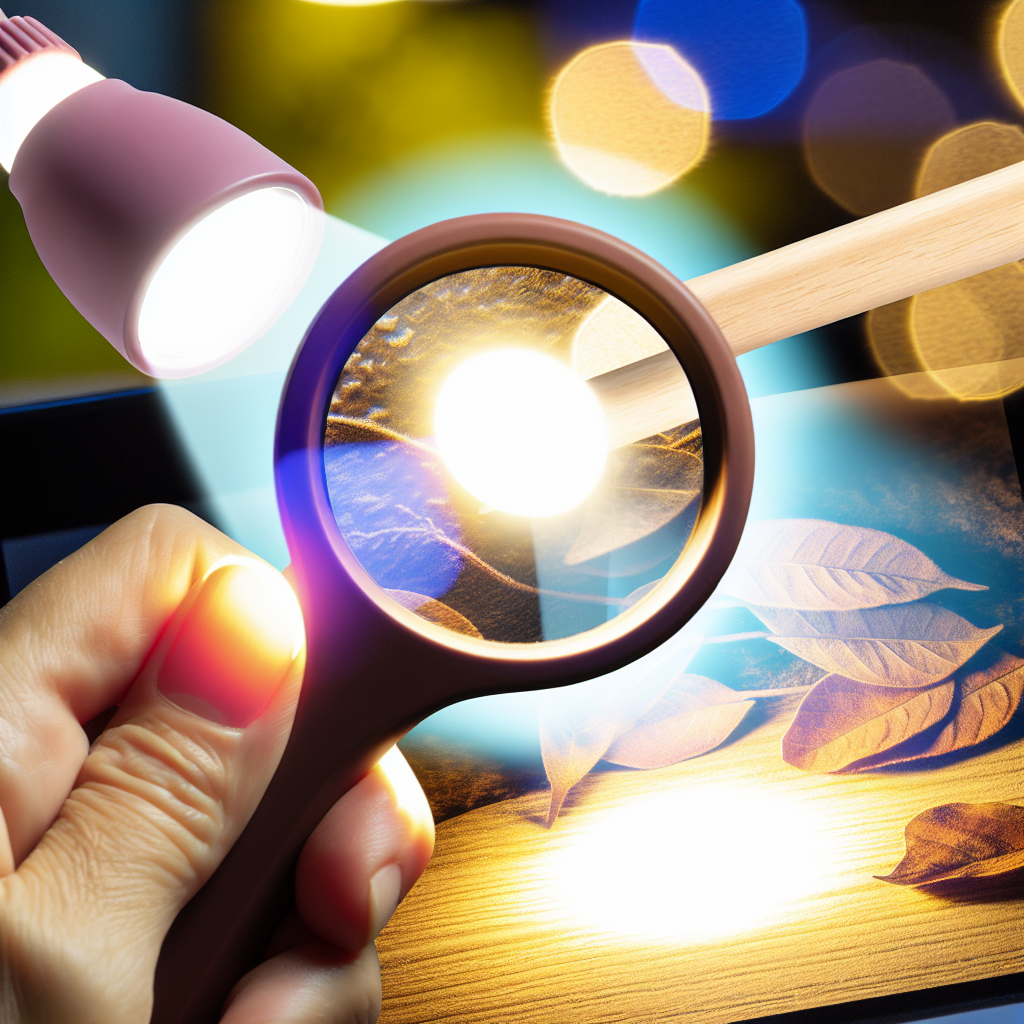
📌 Introduction: The Importance of Lighting when Using a Magnifying Glass
Using a magnifying glass is like opening a door to the invisible: the hidden detail, the delicacy of a line, the precision of an engraving... But often, light is the determining factor that makes all the difference in the clarity of observation. Without appropriate lighting, even the best lens can be disappointing. This is why modern models now offer an essential innovation: integrated lighting. Whether it's for fine reading, repairing a tiny component, or examining a precious stone, the illuminated magnifier revolutionizes habits and offers unparalleled visual comfort. In this article, we guide you through the world of illuminated magnifiers: their usefulness, technical innovations, and tips for choosing and enjoying these high-precision vision tools.
📌 Understanding Illuminated Magnifiers
Before exploring in detail the applications and technical qualities of illuminated magnifiers, let's lay the groundwork: what distinguishes a magnifier with an integrated lighting system from a classic magnifier? Let's discover together the definition, structural characteristics, and historical evolution of these technological gems.
🔍 What is an Illuminated Magnifier?
An illuminated magnifier refers to a magnifying glass equipped with an integrated lighting device, generally positioned around or below the main lens. While a traditional magnifier simply magnifies the observed object, the illuminated version goes much further by providing direct, homogeneous, and often adjustable light to minimize shadows and increase the visibility of the smallest details.
Here are some characteristics that distinguish an illuminated magnifier:
- Integration of a lighting system (LED, fluorescent, or halogen)
- Powered by batteries, rechargeable battery, or mains
- Sometimes, options for adjusting light intensity and color
- Varied shapes and sizes: pocket, desktop, head-mounted, or stand-alone
The key difference lies in the ability to project suitable light, significantly reducing visual fatigue and making details accessible that would otherwise be invisible, even in broad daylight.
🔍 History and Evolution of Illuminated Magnifiers
The history of magnifiers dates back to antiquity, but the addition of lighting is a 20th-century invention, linked to the miniaturization of bulbs and the rise of composite materials. The first illuminated magnifiers used incandescent bulbs, generating heat and high consumption. Rapidly, the arrival of fluorescent tubes and then, more recently, LEDs, allowed manufacturers to create more ergonomic, economical, and powerful models.
Some key milestones:
- 1930s-1950s: Appearance of the first incandescent magnifiers, mainly used by professionals (jewelers, watchmakers).
- 1970s: Popularization of models with fluorescent lighting, more economical and diffusing a more natural light.
- 2000s: Massive adoption of LED technology, synonymous with autonomy, reliability, and design diversity.
Today, the majority of the market offers models with LED technology, due to their modularity and the quality of the light rendering. Recent developments also offer a choice of color temperatures (warm, neutral, cold light) and adjustable intensities, for even greater personalization.
📌 Why Lighting is Essential
The integration of a lighting system into a magnifying glass is not just a technological gadget. On the contrary, lighting is the cornerstone of a successful observation experience. In this section, let's discover how light impacts the visibility, comfort, and precision of all those who use a magnifying glass daily or occasionally.
🔍 Improved Visibility and Detail
The absence of appropriate light is the main cause of frustration when examining an object with a magnifying glass. Shadows, parasitic reflections, or low ambient light can obscure crucial elements. An illuminated magnifier immediately compensates for this lack by directing a light source exactly where it is needed, in a concentrated and homogeneous manner.
The direct benefits:
- Reveals details invisible to the naked eye or with a simple classic magnifier
- Highlights asperities, micro-cracks, almost erased texts or patterns
- Facilitates reading old documents, technical plans, or notices in small print
- Improves contrast, acuity, and sharpness
Let's take the example of a person restoring a stamp or a collector of ancient coins: the bright, directional light allows them to observe the most subtle engravings, spot restorations, and identify the nature of the materials, without having to handle the object under different lamps. The illuminated magnifier thus offers a real leap in performance in fine analysis and accuracy of perception.
🔍 Reduced Eye Strain
Spending long hours bent over meticulous work can quickly become painful for the eyes. Inadequate light, too dim or poorly oriented, causes additional accommodation efforts, which, over time, strain the eyes and make prolonged observation difficult.
The integrated lighting of a magnifying glass uniformly illuminates the area being studied, thus reducing excessive contrasts and making the eye strain less to distinguish details. The ability to adjust the intensity or color temperature of some magnifiers also allows adaptation to individual needs, limiting visual disturbances, headaches, or tingling sensations related to intensive observation.
- Less excessive blinking
- Less tension on eye muscles
- More comfort, even with prolonged use
Visual health professionals strongly recommend the use of illuminated magnifiers for any activity requiring precision and duration: fine embroidery, prolonged reading, precision mechanics, etc. Preventing eye fatigue improves quality of life and daily productivity.
🔍 Precision and Efficiency in Professional Environments
Professions in jewelry, electronics, medicine, or art restoration require a perfect vision of details: microscopic cavities, sharp edges, tiny assembly defects. However, integrated lighting provides a major ally to the magnifying glass, as it cancels out the effects of parasitic light (coming from windows, outdoor lamps, etc.), thus providing consistency in analysis.
In some cases where the working environment does not allow control of ambient light or imposes space constraints, the autonomy of an illuminated magnifier is essential. It allows to:
- Keep both hands free (in the case of a head-mounted or stand-mounted model)
- Ensure a fair balance between shadow and light, preserving the true color of materials
- Make the task faster, smoother, and more precise
There is also a significant increase in safety for certain tasks (splinter removal, adjustment of mechanical parts, placement of electronic components), with lighting limiting inattention errors and maximizing the accuracy of movements. An illuminated magnifier thus becomes a guarantee of professional quality and productivity, regardless of the level of experience.
📌 Types of Illuminated Magnifiers and Corresponding Uses
There is today a wide choice of illuminated magnifiers, meeting all situations, from mobile needs to static work, including specialized professional activities. Let's continue our exploration of the three main families, associating them with their preferred uses to help you make the right choice.
🔍 Illuminated Pocket Magnifier
The illuminated pocket magnifier is undoubtedly the most versatile for anyone looking for mobility and practicality. Often compact in size (less than 10 cm), it slips into a pocket or handbag and activates with a simple push of a button. Its integrated lighting (usually LED) provides direct light, sufficient for quickly examining objects, checking jewelry, reading on the go, or scanning a receipt in low light conditions.
| Characteristic | Advantage |
|---|---|
| Small size, lightweight | Easy transport, maximum discretion |
| Battery/rechargeable battery powered | No dependence on mains power |
| Instant opening and lighting | Time saving, rapid efficiency |
Recommended use: mobile professionals (antiquarians, philatelists, market traders), elderly people seeking comfort in all circumstances, walkers, students, etc.
🔍 Illuminated Desktop Magnifier
The illuminated desktop magnifier is the ally of researchers, watchmakers, and meticulous DIY enthusiasts. Fixed to a stable base or mounted on an articulated arm, it offers a large magnification area, ideal for work surfaces or workshops. Its lighting system is often more powerful, with LEDs arranged in a ring around the lens, allowing diffusion equivalent to that of a desk lamp, but concentrated over a few square centimeters. The adjustment of light intensity, the possibility of orienting the lens, as well as accessories (clips, clamps, etc.) are among the major advantages of desktop magnifiers.
- Application areas: electronic circuit assembly, watch repair, model making, precise manual work
- Suitable for fixed workstations, but sometimes transportable depending on the model
- Perfect for users who want to keep their hands free
The diversity of models available (mobile support, ergonomics for lateral vision, replaceable bulbs, etc.) allows adaptation to a large number of professions and creative hobbies. Students and professionals appreciate its robustness and modularity, which ensures many years of effective use.
🔍 Illuminated Head-Mounted Magnifier
A growing category is the illuminated head-mounted magnifier, worn like a headband on the head and equipped with adjustable lighting. This type of magnifier completely frees the hands, a considerable advantage for all activities that require handling tools or manipulating small objects.
Key points:
- Lightness and comfort (adjustable headband, protective foam)
- Variable magnification (different clip-on lenses)
- Orientable LED lighting following the viewing angle
Typical users: dentists, model makers, electronics technicians, beauticians, goldsmiths' workshops, precision seamstresses.
Easy to transport, rechargeable, and effective even in hostile environments, the illuminated head-mounted magnifier changes the game in all meticulous manual trades. Its adaptability and flexibility make it popular with many users, from professionals to passionate amateurs.
📌 Lighting Technologies Used in Magnifiers
One of the major assets of illuminated magnifiers lies in the technological diversity of the light sources used. Each has its specificities, advantages, and constraints. At a time when mastering light is a central issue, let's review the state of the art in magnifier lighting.
🔍 LED Lighting
LED (Light Emitting Diode) is today the reference technology, massively adopted in the most modern magnifiers. Several reasons explain this success:
- Low energy consumption: perfect for battery or rechargeable battery power, it offers excellent autonomy
- Long lifespan: LEDs can operate for tens of thousands of hours
- Homogeneous and intense light: ideal for revealing hidden details
- Variety of colors and intensities: some models offer precise adjustment (warm, cold, neutral light, etc.)
- Heats up very little, reducing the risk for the user and the observed material
The collection dedicated to illuminated magnifiers offers a majority of models with LED technology, synonymous with performance, economy, and maintaining an acceptable temperature during prolonged use.
🔍 Fluorescent Lighting
Although largely supplanted by LED, fluorescent technology is still present on some very specific professional models. It consists of a circular tube, arranged around the lens, diffusing a softer and more extended light. Advantages include:
- A heat close to natural light, limiting color distortion
- Fewer cast shadows due to peripheral diffusion
- Low heat generation, although still higher than LED
Conversely, fluorescent lamps are more fragile, require a warm-up time when switched on, and can, depending on the model, generate a slight hum.
🔍 Halogen Lighting
Once very common, halogen systems sometimes remain on magnifiers designed for ultra-faithful color rendering (art work, painting restoration, pigment expertise). Halogen light offers:
- Very high light intensity
- Almost perfect color rendering (high color rendering index)
However, these systems have several limitations:
- Heat up quickly (risk of burns for delicate objects)
- Much shorter lifespan than LED or fluorescent
- More energy-consuming (often require mains connection)
For these reasons, halogen lighting is used very specifically, where color fidelity takes precedence over everything else, but it tends to disappear in favor of more modern, less energy-intensive, and more practical solutions.
📌 How to Choose the Ideal Illuminated Magnifier
Choosing the right illuminated magnifier is not improvised: it is necessary to adapt the tool to the real need to guarantee optimal comfort of use and the best possible efficiency in your tasks. Here is a practical guide to help you in this process.
🔍 Assess Your Specific Needs
Before any purchase, ask yourself the right questions:
- Do you want a magnifier for static or mobile use?
- Do you work on small surfaces or do you need a wide field of vision?
- Do you need to keep your hands free (manual work)?
- Do you require faithful color reproduction?
- Do you need a magnifier with adjustable intensity and color temperature?
For occasional reading, a pocket model is sufficient; for workshop work, opt for a desktop magnifier; and if mobility is paramount or if you need to manipulate objects continuously, choose a head-mounted magnifier.
Also consider the power source (battery, batteries, mains) depending on your work or leisure environment, as well as any accessories (case, articulated arm, clamps).
🔍 Consider Lighting Power and Color Temperature
Two parameters directly influence user comfort:
- Light power (in lumens): It must be sufficient to illuminate well without dazzling. Some models offer stepped or progressive adjustment to adapt to each task.
- Color temperature (in kelvins): Prefer a neutral white light (4000-5000K) for versatile rendering. Cold light (above 5500K) is suitable for situations requiring very high precision, while warm light (below 3500K) is more comfortable for prolonged reading.
It is advisable to test different levels, if possible, or refer to the recommendations of users with needs similar to yours. Do not hesitate to consult our article explanatory video on how to position your reading magnifier to further optimize visual comfort.
📌 Care and Maintenance of an Illuminated Magnifier
Like any electronic device, the longevity and efficiency of an illuminated magnifier largely depend on regular maintenance and the care given to the different components. Here are the good practices to adopt to extend the lifespan of your favorite tool.
🔍 Cleaning and Care of the Lighting
Thorough and periodic cleaning helps prevent the accumulation of dust or deposits that could alter the light beam or image quality. Always use:
- A microfiber cloth for the lens, thus avoiding scratches
- A soft brush or air blower for hard-to-reach areas around the light source
- Suitable products that will not damage seals or plastics
- Avoid water, pure alcohol, or any aggressive solvents on electrical contacts and the light source
Before any cleaning operation, make sure the magnifying glass is not powered (remove batteries if possible). Finally, store the magnifying glass away from heat and humidity to preserve the electronic components.
🔍 Replacing Light Sources
Depending on the technology used (LED, fluorescent, halogen), the frequency of bulb or module replacement varies. Always opt for original components or those recommended by the manufacturer to avoid loss of intensity or battery life.
- LED: very long lifespan, but sometimes replaceable as a module (consult the manual)
- Fluorescent: regular replacement required, delicate handling needed
- Halogen: more frequent replacement, pay attention to orientation and avoid handling the bulb with your fingers
Always ensure the magnifying glass is powered off before disassembly. If in doubt, it is best to entrust the operation to an authorized professional or the manufacturer's after-sales service.
📌 Conclusion: Maximizing the Use of Your Illuminated Magnifying Glass
In summary, the illuminated magnifying glass has become an essential tool for anyone needing precision, comfort, and efficiency in observing details. Thanks to their various shapes, adapted lighting technologies, and adjustment capabilities, these magnifiers meet the vast majority of uses, from creative hobbies to scientific research, and everyday reading. Choosing the right magnifying glass, maintaining it regularly, and making the most of the lighting options ensure significantly superior vision quality, for a fatigue-free and discovery-rich experience. Don't wait any longer to take the plunge and explore the difference that well-designed lighting can make to your vision!
📌 Frequently Asked Questions (FAQ)
- Who is the illuminated magnifying glass for?
Illuminated magnifiers are for anyone who needs to see in detail: seniors for reading, professionals (jewelry, electronics, etc.), collectors, and students.
- Can I use my illuminated magnifying glass outdoors?
Yes, especially pocket and head-mounted LED models. They remain effective even in bright sunlight or when natural light is scarce, such as at dusk.
- What is the difference between warm and cool light for a magnifying glass?
Warm light (below 3500K) is more comfortable for prolonged reading, while cool light (above 5000K) improves the perception of contrasts and details.
- What precautions should I take when replacing a bulb?
Always turn off the power, wait for the bulb to cool, and handle it carefully, using a soft cloth to avoid fingerprints, especially on halogen models.
- Do LED illuminated magnifiers consume a lot of energy?
No, their low consumption allows for excellent battery life, whether battery-powered or with replaceable batteries. They are ideal for long-term use.
- How do I position my illuminated magnifying glass to avoid reflections?
Position the magnifying glass between your eyes and the object, adjust the lighting angle, and, if possible, adjust the intensity to avoid any discomfort. More tips can be found in our dedicated article.