

📌 Understanding the characteristics of a reading magnifier
The reading magnifier is a valuable tool for anyone looking to improve their vision when reading printed texts, instructions, or official documents. Before delving into its uses or practical advice, it's crucial to understand the components of a reading magnifier and the impact of each on the user experience.
Firstly, the heart of any magnifier is the lens, usually made of high-quality optical glass or acrylic. The lens can be bi-convex (curved on both sides) or plano-convex (curved on one side only), which influences the sharpness of the perceived image. The materials used determine the weight, robustness, and clarity of the magnifier.
Next, consider the lens diameter. The larger it is, the wider the visible reading area will be, but the weight and the risk of edge distortion also increase. Modern magnifiers often strike a compromise between a manageable size and a comfortable field of vision.
Another essential point is the magnification, expressed as "x" (e.g., x2, x4, x10), which indicates how many times the magnifier enlarges the text compared to naked eye vision. Depending on the user's needs, this parameter will be crucial to avoid any discomfort or eye strain.
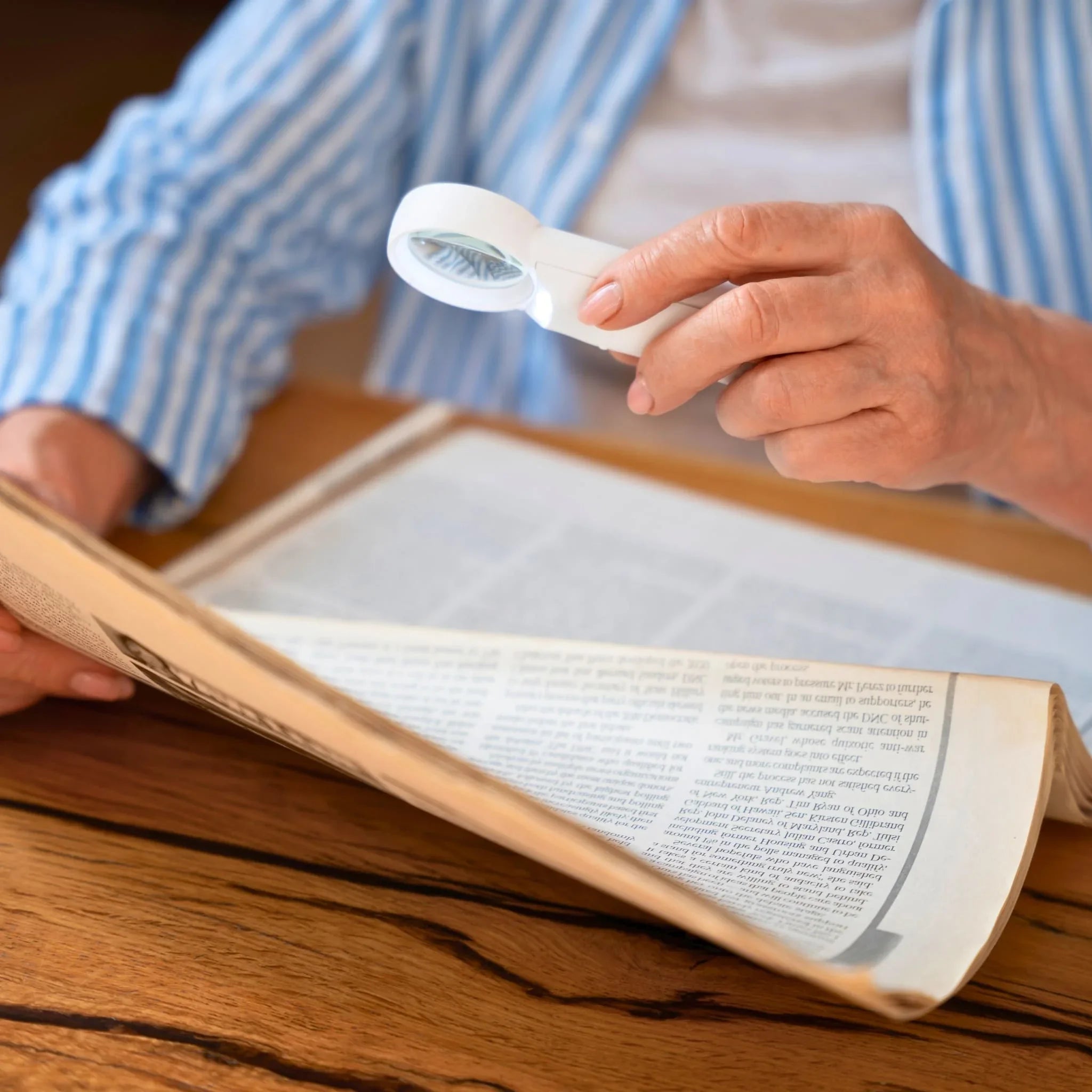
Some models feature integrated LED or bulb lighting, offering increased contrast and reducing eye strain, especially in low-light conditions. It's also important to consider the handle shape, ease of grip, frame material, and total weight, especially if the magnifier is to be used for extended periods.
Finally, some advanced models offer aspheric lenses that reduce edge distortion and increase text sharpness, even at the periphery of the lens. All these features contribute to a pleasant reading experience, without visual discomfort.
- Lens: materials, shape, optical quality
- Magnification: adapted to each need
- Integrated lighting: to reduce fatigue
- Handle and frame: ergonomics and robustness
- Advanced features: aspheric lenses, anti-UV filters
Understanding these elements allows you to choose a magnifier perfectly suited to your specific needs, thus ensuring comfortable and prolonged reading.
📌 The different types of reading magnifiers
There isn't just one, but many kinds of reading magnifiers, each designed to meet specific uses and contexts. The choice of magnifier type can dramatically transform the reading experience and alleviate, or conversely accentuate, visual fatigue. Here's a detailed overview of the three main families of magnifiers: handheld, stand, and electronic.
🔍 Handheld Magnifiers
These are the most traditional and popular models. They consist of a lens mounted on an ergonomic handle, sometimes equipped with integrated lighting. Easy to transport and use, handheld magnifiers offer great flexibility of use, whether at home, when traveling, or in a library. Their main advantage lies in their portability and ease of handling.
Nevertheless, they require holding the tool throughout reading, which can eventually lead to muscle fatigue. To mitigate this, there are ultra-lightweight versions or those with foldable handles for easier manipulation.
| Advantages | Disadvantages |
|---|---|
| Portability, affordable price, immediate grip | Prolonged holding causes fatigue, sometimes limited field of view |
Ideal for occasional reading or for specific needs (labels, instructions, maps).
🔍 Stand Magnifiers
Stand models rest on a structure that holds the magnifier above the document to be read. This frees the user's hands, which is particularly comfortable for long reading sessions, puzzles, or creative hobbies (model making, sewing, collecting, etc.).
They are also popular with seniors or people suffering from osteoarthritis and/or tremors. Generally equipped with a large lens and LED lighting, they offer unbeatable comfort, at the cost of greater bulk and less mobility.
- Advantages: Hands-free, ideal for prolonged use, stability, enlarged vision
- Disadvantages: Bulky, less suitable for travel
The stand magnifier is therefore primarily aimed at users who prioritize maximum comfort when reading at home.
🔍 Electronic Magnifiers
Electronic magnifiers mark the arrival of technology in the world of low vision. These are digital devices that use a camera to display the text image on an integrated LCD screen. This allows for adjustable magnification, contrast adjustment (negative, positive, inverted colors, etc.), and a sharp image, even at high magnification.
Although more expensive, these magnifiers offer exceptional flexibility: they are suitable for both classic reading and consulting administrative documents, photographs, or small technical objects.
- Advantages: Adjustable magnification, excellent contrast, reading comfort, image memory
- Disadvantages: High price, requires power supply or battery, learning curve
The different models of reading magnifiers thus cover a wide range of needs, from the simplest to the most demanding. The choice between these categories largely depends on the desired level of visual comfort, budget, and expected mobility.
📌 Choosing the right magnifier magnification
Magnification is probably the most important feature when buying or using a reading magnifier. But how do you select it to maximize clarity while avoiding eye strain?
Too little magnification will not compensate for your visual needs, while too much magnification will significantly reduce the field of view, forcing you to move the magnifier over each word and thus straining your attention. To find the right balance, you need to consider the usual size of the text read, your visual acuity, and the ambient lighting.
| Magnification | Recommended Use |
|---|---|
| x2 to x3 | Reading books, newspapers, magazines – daily use |
| x4 to x6 | Reading notices, labels, small print – occasional use |
| x8 and above | Observing fine details, plans, stamps – specialized use |
Ideally, try different models or consult the recommendations of an optician or low vision specialist to adjust the choice to your specific visual capabilities.
Also note that some magnifiers offer doublets (two combined lenses), allowing for high magnification while maintaining good brightness and a distortion-free image. Don't hesitate to ask for advice or try them out before purchasing: a suitable magnifier is the secret to relaxed and prolonged reading.
📌 The importance of integrated lighting in reading magnifiers
Lighting plays a fundamental role in combating visual fatigue when using a reading magnifier. Too dim, it forces the eyes to compensate, leading to stinging and headaches; too bright, it risks generating annoying reflections or glare.
The integration of low-consumption LEDs into magnifiers now offers an ideal solution: a white, clear, uniform light, without excessive heat. This helps highlight the sharpness of the text being read, bring out contrasts, and reduce the accommodative effort of your eyes.
- LED lighting: low consumption, high lifespan, constant and non-glare light
- Positioning: LEDs placed around the lens for uniform illumination of the field of vision
- Options: depending on the model, intensity dimmer, cool or warm tones, battery or rechargeable battery operation
To fully enjoy your magnifier without fatigue, prioritize models with integrated lighting, especially if your environment is not naturally bright. Supplemental lighting on the table or as a headband can also complement the device.
Note: electronic magnifiers also have brightness settings and display filters for maximum visual comfort, regardless of ambient conditions.
📌 Techniques for using the magnifier without visual effort
Prolonged use of a poorly optimized magnifier can lead to discomfort, headaches, and a feeling of eye strain. Fortunately, some proven techniques exist to reduce these risks and fully enjoy the tool's functionality. Taking into account distance, movement, and posture allows for long reading without strain.
- Always hold the magnifier steadily, with both hands if possible.
- Ensure the illuminated field coincides with the target text portion.
- Prefer flat and stable surfaces for placing your reading materials.
- Take breaks every 20 to 30 minutes to avoid accumulated fatigue.
🔍 Adjusting reading distance
A common mistake is to hold the magnifier too close to the text or, conversely, too close to the eye. The ideal distance varies depending on the lens's magnification, but a simple rule applies:
- Place the magnifier close to the text and move your eye away until you get a clear and comfortable image.
- Test a few back-and-forth movements to find the perfect spot, where the text appears largest and least distorted.
- Read at a distance where the entire field of the lens is used without focusing effort.
This simple adjustment not only reduces strain on your eyes but also allows you to exploit the magnifier's full potential. On stand models, adjust the height to avoid bending over or straining your neck.
🔍 Fluid movement of text under the magnifier
Too often, the user tries to move the magnifier over each word, causing vibrations and focus variations. For fluid reading, reverse the logic: place the magnifier stably, then gently slide the page or text underneath, at a regular pace.
- Place the document on a smooth surface.
- Stabilize the magnifier, hold it firmly but without tension.
- Move the sheet or support, not the magnifier, to follow your reading frame.
- Use a ruler or holding support to keep the text aligned under the lens.
This technique, although simple, limits unwanted movements, reduces the risk of headaches, and optimizes sharpness and visual comfort.
📌 Preventing eye strain due to prolonged magnifier use
Prolonged use of a magnifier, even a well-chosen one, can lead to fatigue, dry eyes, or headaches. It is essential to adopt healthy habits to protect your eyesight while enjoying your optical aid:
- Take visual breaks every 20-30 minutes: look up, gaze into the distance, blink frequently.
- Stay hydrated regularly and ensure the air in your room is not too dry.
- Opt for soft ambient lighting; avoid reading in complete darkness, even with integrated LEDs.
- Wear your corrective glasses if you have them, in addition to the magnifier.
- Do not strain for long periods: alternate reading with other less visually demanding activities.
🔍 Eye exercises for relaxation
There are simple exercises to incorporate during your breaks to stimulate your eye health and relax the muscles around your eyes:
- Look into the distance (through a window, towards the horizon) for 30 seconds every 20 minutes.
- Slowly make circles with your eyes, in one direction then the other, several times in a row.
- Close your eyes, gently massage your eyelids with your fingertips to release tension.
- Practice "palming": rub your hands together, close your eyes, then place them over your eyelids for 1 to 2 minutes.
Adopting these good habits ensures a serene reading experience and protects your eyes in the long term.
📌 Optimizing the reading environment
A suitable environment contributes as much to visual comfort as the quality of the magnifier. Here are some recommendations for transforming your reading space into an ergonomic and soothing place:
- Choose a quiet space to promote concentration.
- Opt for natural light as much as possible. Sit near a window or use a desk lamp with white light, oriented without glare towards the reading material.
- Adjust the height of the chair and table: your neck should remain straight, arms relaxed, and the reading material in front of you.
- If necessary, install a lumbar cushion or a footrest to prevent muscle tension.
A well-designed environment helps prevent fatigue, reduces distractions, and significantly improves your reading efficiency.
📌 Advantages of magnifiers with aspheric lenses
Aspheric lenses are the new benchmark in low vision and high-end magnifiers. Unlike traditional spherical lenses, they have a complex shape that corrects optical aberrations.
Here are their main advantages:
- Sharper image, even at the periphery of the lens
- Less distortion (characters are not deformed at the edges)
- Wider field of vision at equivalent magnification
- Superior comfort of use for long sessions
These models are recommended for intensive readers, professionals, or anyone suffering from particular visual pathologies (AMD, cataracts, etc.). Although slightly more expensive to purchase, they guarantee significantly increased precision and durability. To learn more, consult our comparison of the most reliable recent reading magnifier brands.
📌 Integrating magnifiers into daily activities
The use of a reading magnifier is no longer limited to simply consulting books or newspapers. Many areas benefit from these tools to improve visual comfort and precision:
- Reading official documents, invoices, contracts: ensure your understanding of amounts and small legal notices.
- Cooking: easily read recipes or ingredient proportions on packaging.
- Creative hobbies: facilitate sewing, knitting, model making, or miniature painting by enlarging small details.
- Collecting: examine stamps, coins, minerals, postcards to appreciate their full finesse.
- Electronics: combat the miniaturization of printed circuits during repairs or diagnostics.
Integrating a magnifier into your routines transforms the approach to every meticulous task, making you more autonomous and precise in your daily life.
📌 Common myths about reading magnifiers
Many misconceptions persist around the use of reading magnifiers. Debunking these myths will help you use them calmly and knowledgeably:
- "They degrade vision in the long term": False, a well-chosen and used magnifier, on the contrary, relieves your eyes and protects your sight.
- "The higher the magnification, the better": In reality, too strong a magnification reduces the field and increases fatigue. Prefer a magnification adapted to your use.
- "One magnifier is enough for all my needs": No, several types can be complementary (handheld, stand, electronic...) depending on the activities.
- "Magnifiers are exclusively for seniors": More and more young professionals, students, or collectors are adopting them for their practicality.
- "Electronic magnifiers offer no added benefit": They offer superior comfort, adjustments, and adaptability to traditional magnifiers for certain uses.
The best approach is to try, compare, and then equip yourself according to your real needs and context of use.
📌 Maintaining your reading magnifier for increased longevity
Proper maintenance ensures your magnifier remains effective and clear for many years. Here are the steps to adopt regularly.
🔍 Regular lens cleaning
Fingerprints, dust, or accumulated residues on the lens impair image quality and unnecessarily strain your eyes. To effectively clean your lenses:
- Use a soft microfiber cloth, never paper or rough fabric.
- In case of heavy soiling, apply a drop of special optical cleaning solution or, failing that, a little lukewarm water.
- Dry without excessive rubbing to avoid micro-scratches.
Never use solvents, pure alcohol, or conventional household products: they risk damaging the protective coating of the lens.
🔍 Proper storage
To prevent any deformation or scratching, it is recommended to always store the magnifier:
- In its provided hard case or in a fabric pouch
- Away from dust, humidity, and direct sunlight
- At a moderate temperature (avoid car trunks, very hot or cold rooms)
If your magnifier is equipped with a battery (electronic models), do not wait for it to fully discharge before recharging it: this extends the life of the battery.
Thanks to these simple habits, your magnifier will maintain its transparency, robustness, and effectiveness for many years.
💡 FAQ about reading magnifiers and eye strain
- How to choose a magnifier adapted to my vision problem?
First, determine the necessary magnification level (by testing different models if possible). Opt for a quality lens, integrated lighting, and an ergonomic frame. Do not hesitate to consult a specialized optician for personalized advice.
- Are electronic magnifiers better than optical magnifiers?
Electronic magnifiers offer advanced magnification and contrast settings, ideal for specific needs but can be more expensive and require some getting used to. The choice depends on your budget, your requirements, and your usage preferences.
- Is it better to choose a magnifier with or without lighting?
Integrated lighting facilitates reading and limits fatigue, especially in low light conditions. We strongly recommend opting for a version with LED for maximum comfort.
- What are the signs of eye strain?
Common symptoms include: tingling, burning sensation, tired or watery eyes, headaches, blurred vision, difficulty focusing. If these signs persist, reduce the duration of reading sessions and possibly consult a specialist.
- Can you use a reading magnifier with glasses?
Yes, in most cases. Prioritize a wide-field or stand magnifier so that your glasses do not hinder manipulation. Also, remember to adapt the reading distance to your optical correction.
- Does the magnifier damage eyesight in the long term?
The reading magnifier does not degrade eyesight. On the contrary, it relieves effort and limits the risks associated with visual fatigue. Its use is safe if adapted and accompanied by regular breaks.
✅ Conclusion: For fatigue-free reading and renewed comfort
Far from being a simple accessory, the reading magnifier is a true ally for preserving your visual comfort, whatever your age or needs. From the careful selection of materials to the choice of magnification, including the integration of lighting, every detail counts to ensure effortless and enjoyable use.
Adapting your technique, taking care of your eyes and your environment, and properly maintaining your magnifier are key steps to avoid fatigue, and even rediscover a love for reading or precision hobbies. Don't hesitate to explore our complete range of reading magnifiers to find the tool perfectly suited to your expectations!