


📌 Understanding low vision and its impact on reading
Low vision affects millions of people in France and poses major challenges for daily reading. This vision impairment directly impacts the ability to perceive texts, whether in personal or professional life, or for access to written culture. Raising awareness of the diversity of low vision disorders is therefore essential to finding adapted solutions and improving the quality of life of affected individuals.
🔍 Definitions of low vision
Low vision is defined as a permanent visual impairment that persists even after optical correction (glasses or contact lenses) and conventional medical treatments. It differs from total blindness: people with low vision still have some residual vision, but it is insufficient to easily perform certain tasks, particularly reading.
Generally, a person is considered to have low vision when they have visual acuity below 3/10 with correction, or a restricted visual field, but are not completely deprived of light perception. This means that one can still see shapes, recognize colors, or distinguish greatly magnified letters. Classic reading becomes very difficult or even impossible, hence the need to use specific tools, such as reading magnifiers.
Contrary to some misconceptions, low vision is not limited to the elderly. Young adults, and even children, can also be affected, depending on the origin of the visual disorder. Difficulties with contrast perception, glare, or blurred vision are frequent manifestations that complicate reading and access to written information.
🔍 Common causes of low vision
Many eye health problems can lead to low vision. Here are the most common medical causes:
- Age-related macular degeneration (AMD): It affects the macula, the central area of the retina responsible for sharp vision, essential for reading.
- Glaucoma: This pathology damages the optic nerve, progressively reducing peripheral vision, then central vision.
- Diabetic retinopathy: Complications of diabetes can damage the blood vessels in the retina, causing a progressive decrease in vision.
- Cataract: Opacification of the lens reduces light transmission, making reading difficult, especially in low light.
- Congenital or genetic diseases: Some, such as retinitis pigmentosa or albinism, result in permanently altered vision from birth.
Other disorders, such as eye trauma, certain strokes, or infections, can also cause low vision. These different causes generate very varied profiles of reading difficulties, and therefore specific needs for visual aids.
📌 Why use reading magnifiers?
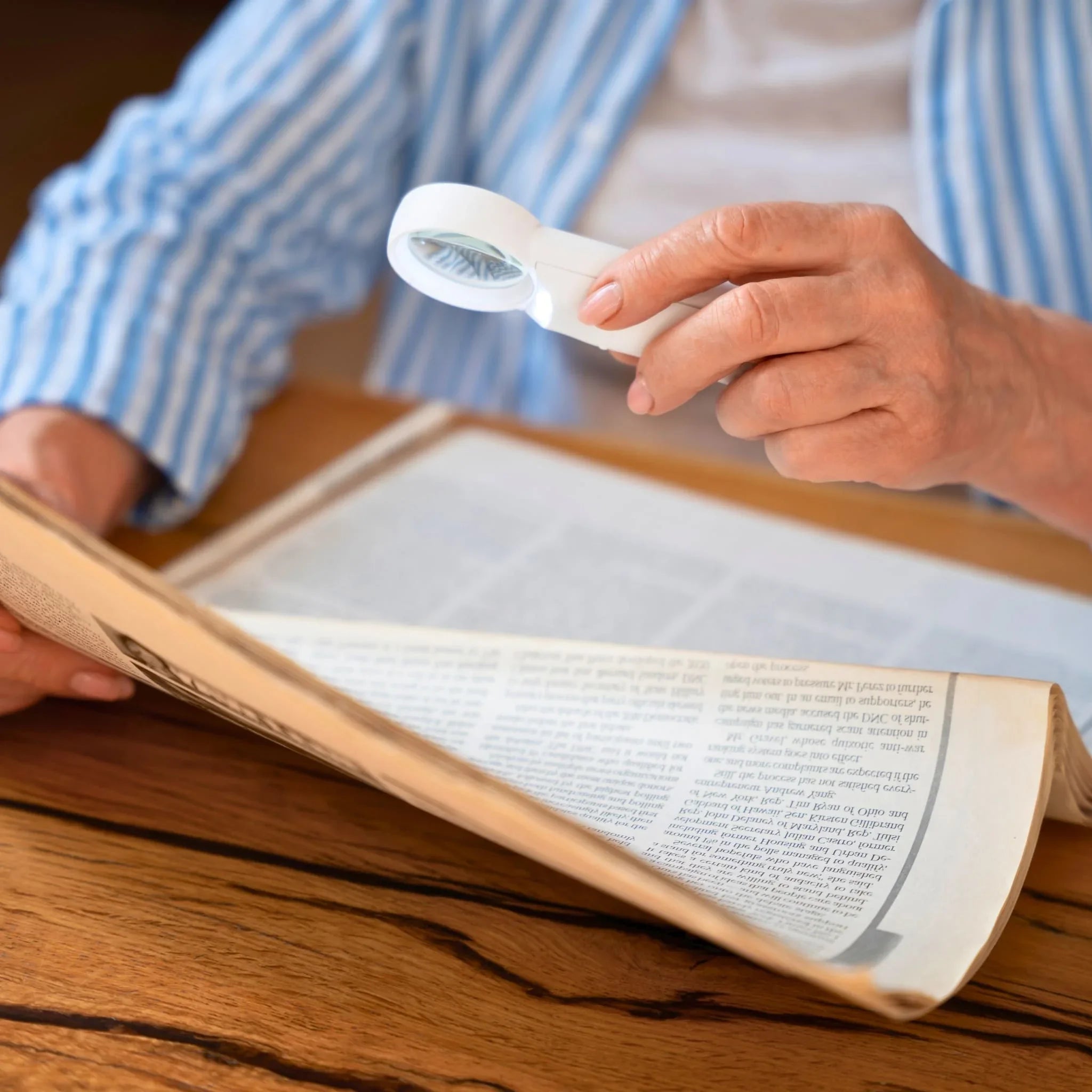
For people with low vision, the reading magnifier quickly proves to be an invaluable daily aid. The use of these devices allows for fluid access to reading and autonomy in many daily activities: reading books, instructions, mail, newspapers, labels, or medical instructions.
Equipping oneself with a reading magnifier is not simply a "gadget": it is a key adaptation to a visual impairment that profoundly disrupts daily life. Many users report a regain of confidence, autonomy, and social inclusion thanks to this tool.
🔍 Advantages of reading magnifiers
The reading magnifier offers considerable benefits to compensate for part of the loss of visual acuity:
- Improved reading comfort: By magnifying characters, the magnifier facilitates word detection, limits eye fatigue, and makes prolonged reading possible.
- Ease of use: Intuitive handling, no special training required.
- Regained autonomy: Visually impaired people regain their independence for many tasks (reading menus, invoices, etc.).
- Adaptability: There is a multitude of models, adapted to very varied needs, environments, and disorders.
- Affordable price: Compared to other aids, many magnifiers are affordable, making the investment accessible to the majority.
Thanks to their careful design, some magnifiers offer a dual aesthetic and practical advantage, making them easy to integrate into daily life.
🔍 Comparison with other visual aids
Given the diversity of visual impairments, several solutions are available:
| Tool | Main functionality | Advantages | Limitations |
|---|---|---|---|
| Reading magnifier | Manual or electronic optical magnification | Portability, simplicity, wide choice | Reading small passages at a time; sometimes require the use of one hand |
| Magnifying glasses | Basic magnification mounted on a frame | Hands-free, long-term wear | Limited magnification, possible distorted vision |
| Electronic video magnifiers | Video magnification on screen | Reading large documents, high comfort | Bulky, high price |
| Speech synthesis software | Automated audio reading | Access to texts without visual effort | No visual access to text, learning required |
The reading magnifier remains an ideal compromise: mobile, economical, customizable. For a complete overview of their role in vision disorders, also consult this dedicated article on our blog.
📌 Types of reading magnifiers for low vision
Wisely equipping oneself with a reading magnifier means knowing the different product families available. Each user, depending on their visual impairment, dexterity, lifestyle, and environment, will benefit more from one type of magnifier than another. Here are the main categories found on the French market.
🔍 Handheld magnifiers
Handheld magnifiers are the most frequently used models. Portable, they consist of a magnifying lens mounted on an ergonomic handle. Some versions include LED lighting for easy reading in all types of light.
- Advantages: Compact, lightweight, ideal for transport and for occasional reading of short texts such as schedules, labels, prices, or mail.
- Limitations: The user must hold the magnifier in hand, which can become tiring for prolonged reading or for those with motor difficulties.
Handheld magnifiers cover different lens diameters, magnification powers (from 2x to 15x) and aesthetic styles. Some versions offer aspherical lenses to optimize sharpness across the entire surface.
Anecdote: A retired woman testifies to using her handheld magnifier daily to check product prices at the supermarket, which allows her to maintain valuable autonomy despite her diabetic retinopathy.
🔍 Stand magnifiers
Stand magnifiers are designed for prolonged use, particularly for reading large documents, files, books, or newspapers. They have a stable base, sometimes articulated, which leaves the user's hands free.
- Advantages: Perfect for hands-free use (practical for writing or manipulating objects at the same time). Optimal long-term comfort of use.
- Limitations: Weight and bulk, reduced mobility compared to handheld magnifiers.
We distinguish mainly:
- Table magnifiers, fixed or mobile, with adjustable arm.
- Desk models with integrated LED lighting, for evening use or in low-light environments.
The adoption of a stand magnifier is highly appreciated by avid readers, those who do detailed manual work (sewing, model making) or professionals with low vision.
🔍 Electronic magnifiers
Electronic magnifiers are a real revolution for low vision. These devices use a camera to film the text and display the magnified image on an integrated LCD screen.
- Advantages: Adjustable magnification (up to 30x or more), contrast and color modification, page memory, image capture, portability on compact models.
- Limitations: Higher price, requires battery or power supply.
They come in the form of portable electronic magnifiers (similar to a smartphone), or more powerful desktop video magnifiers for professional or academic use. Some can be connected to a computer or television to read long texts or take distance learning courses.
Software integration allows for instant adjustment of character size and adaptation of the display to specific needs (yellow background, black letters, etc.). These solutions mark a major advance in accessible reading, as they combine visual amplification, touch technologies, and sometimes text recognition (OCR).
A wide choice of adapted reading magnifiers is now available for all uses and budgets.
📌 How to choose the right magnifier for your needs?
The choice of a reading magnifier must be highly personalized. There is no universal solution: each type of low vision, each use, and each environment requires specific characteristics. A careful evaluation of needs, sometimes carried out with an occupational therapist, ophthalmologist, or specialized optician, is often beneficial before purchase.
🔍 Factors to consider when choosing
Here are the essential criteria to evaluate:
- Magnification power: The more advanced the visual impairment, the greater the necessary magnification (from 2x to 30x). However, too high a magnification rate reduces the available field of view.
- Lens size: A large lens can cover more text, but can generate distortion or heaviness. A small lens is more practical for travel.
- Presence of lighting: Integrated LED light facilitates reading in all circumstances, reducing shadows and reflections.
- Nature of the visual impairment: Central vision (AMD), peripheral (glaucoma), decreased contrast, accommodation disorders… all these elements must be taken into account.
- Autonomy and portability: For reading at home or on the go, mobility is a key factor.
- Budget: Prices vary from single to quadruple depending on the technology chosen and the available options.
| Criterion | Importance | Practical advice |
|---|---|---|
| Magnification | Essential | Favor an evolutive or modular model |
| Lens size | Adapted to the application | Large for reading, small for mobility |
| Lighting | Additional comfort | Soft LED to limit glare |
🔍 Tips for trying out a reading magnifier
Before purchasing your reading magnifier, it is advisable to perform a few tests:
- Test in real conditions: Experiment with the magnifier on your own reading materials (newspapers, books, everyday packaging).
- Evaluate the grip comfort: Ergonomic handle, natural grip, positioning relative to the page.
- Check the brightness: Verify the ambient lighting and the effect of the LED if present. Some very sensitive people prefer indirect light.
- Ask for advice: Do not hesitate to consult a professional or an experienced acquaintance.
- Do not choose too high a magnification: Beyond 10x, the field of vision can become too small and reading less fluid.
Tip: Take a break every 15 to 20 minutes to avoid eye strain, especially during the first few days of use.
📌 Maintenance and care of reading magnifiers
Taking care of your reading magnifier ensures lasting effectiveness and comfortable reading. Regular maintenance considerably extends the lifespan of your visual equipment.
🔍 Cleaning and storage
Magnifier lenses, whether made of mineral glass, organic material, or acrylic, are delicate and must be protected from scratches, shocks, and dust.
- Daily cleaning: Use a lint-free microfiber cloth, slightly dampened. Avoid paper tissues and rough fabrics.
- Suitable products: Opt for alcohol-free optical sprays or lukewarm water with a drop of mild soap. Always dry gently.
- Protection: Store your magnifier in its protective case or a padded pouch when not in use.
- Avoid excessive heat: Do not leave the magnifier exposed behind a window in direct sunlight, to avoid any deformation or cracking of the lens.
Tip: For electronic magnifiers, never apply liquid solution directly to the screen, but always spray on the cloth before cleaning.
🔍 Troubleshooting common problems
Your magnifier may show certain signs of wear or common malfunction:
- Scratches: Limit them by always storing the magnifier after use. If the lens is too damaged, replacement is necessary.
- Defective batteries: Replace them as soon as light intensity decreases. Prefer rechargeable batteries for ecological reasons.
- Falls or shocks: Even without visible damage, a micro-crack can alter optical quality.
In case of doubt about the effectiveness of your reading magnifier, contact the supplier or optician for a diagnosis, repair, or standard exchange. It is better to prevent than to have to reinvest prematurely!
📌 Testimonials and case studies
The best recommendations for a reading magnifier often come from those who use it daily. Here are excerpts from testimonials and case studies illustrating the diversity of user profiles and the real impact of these visual aid devices.
🔍 Success stories
Jacques, 72, with AMD: After several months of increasing discomfort and abandoning reading, Jacques rediscovered the pleasure of reading thanks to a LED desk magnifier. "Being able to read the morning newspaper again has given me a new lease on life. I no longer feel cut off from the world; I can follow the news and chat with my grandchildren!"
Sophie, a young visually impaired student: Her improved electronic magnifier, found after many trials, allows her to follow her science classes independently. "My grades have improved. I can make sketches, access all materials. The reading magnifier has opened the door to higher education for me."
Other users, such as embroidery enthusiasts or DIYers, praise their new ability to indulge in their hobbies without constantly relying on the help of a loved one.
🔍 Specific case studies
Case n°1 – Stand magnifiers and prolonged reading: A center for visually impaired seniors equipped its library spaces with large-diameter stand magnifiers. After 6 months: 62% of users reported a significant improvement in their autonomy, concentration, and the pleasure of "reading for oneself."
Case No. 2 – Electronic magnifiers in the workplace: A large public administration provided its visually impaired agents with portable electronic magnifiers. Result: reduction in absenteeism due to visual fatigue and prolonged employment for 74% of beneficiaries.
These cases show that a suitable magnifier does more than just "help": it transforms self-perception and opens new horizons.
📌 Innovations and trends in reading devices
The sector of reading magnifiers and visual aids is constantly evolving. The rise of new technologies and materials is revolutionizing the possibilities offered to visually impaired people. Staying informed about trends means anticipating a life with more autonomy and visual comfort.
🔍 New materials and techniques
Manufacturers are now designing high-precision aspherical plastic lenses: lighter than glass, they offer distortion-free magnification over the entire surface, coupled with state-of-the-art anti-reflective and anti-scratch coatings.
We are also seeing the integration of Bluetooth connectivity on some electronic magnifiers: images transferred to a tablet or stored in the cloud for automated analysis. Artificial intelligence algorithms promise real-time corrections adapted to each user's exact profile for the future.
Some brands already offer smart magnifiers capable of reading captured text aloud or detecting color inversion. All this in increasingly compact, modular, and aesthetic designs.
🔍 Future prospects for visual aids
The next two decades will see:
- The development of augmented reality glasses integrating digital magnifier and voice assistant functionalities.
- The emergence of ultra-portable magnifiers programmable via smartphone.
- The miniaturization of electronic components to increase battery life and user comfort.
- Greater financial accessibility through the industrialization of manufacturing processes.
These advances will be accompanied by a democratization of the offer and increasing personalization, making each reading experience truly unique. The future of reading magnifiers is thus promising, at the crossroads of technological innovation and support for the autonomy of visually impaired people.
📌 FAQ: All about reading magnifiers and low vision
- What is a reading magnifier?
It is an optical or electronic device that magnifies texts to make reading easier for people with visual impairments, allowing them to perceive letters, numbers, and images more easily.
- How do I know what magnification to choose?
It is recommended to start with moderate magnification (2x to 4x), try different models, and then adjust according to the difficulty encountered on your usual reading materials.
- Can a reading magnifier replace glasses?
No: it complements them. Glasses correct vision, the magnifier magnifies and compensates for deficient acuity. Both are complementary, especially in cases of low vision.
- How to maintain your magnifier to extend its lifespan?
Clean it regularly with a microfiber cloth, avoid scratches, and store it in its case when not in use. For electronic magnifiers, be sure to charge the battery and update the software if necessary.
- Is an electronic magnifier more effective than a conventional magnifier?
Not always. It offers more options (contrast, colors, capture), but its cost and bulk may not suit everyone. The choice depends on the degree of low vision and the context of use.
- Are there social aids for purchasing reading magnifiers?
Yes, certain aid schemes (MDPH, mutual insurance, AGEFIPH, etc.) may finance all or part of a magnifier depending on the pathology and the applicant's personal situation.
📌 Conclusion: Equipping yourself with a reading magnifier, a decisive step towards autonomy
Low vision does not mean the end of the pleasure of reading or life autonomy. Modern reading magnifiers, whether handheld, stand-alone, or electronic, are now designed to adapt to every disorder, every use, every budget. Getting informed, trying out, and investing in a suitable visual aid proves to be a decisive step to maintain self-confidence and preserve one's freedom of action in