


📌 Introduction: Understanding Observation Needs
Before you embark on acquiring an observation tool, it is essential to precisely identify the nature of your needs. Whether you are passionate about exploring the miniature world, a creative hobbyist, a laboratory professional, or simply curious to examine the fineness of a collector's item, choosing between a magnifying glass and an optical microscope is not a trivial matter. These two instruments have distinct advantages and limitations. This comprehensive guide aims to objectively enlighten you on their essential differences, their fields of application, decisive selection criteria, and recent innovations, to allow you to serenely choose the tool best suited to your fine observation expectations.
📌 Fundamental Differences Between Magnifying Glass and Optical Microscope
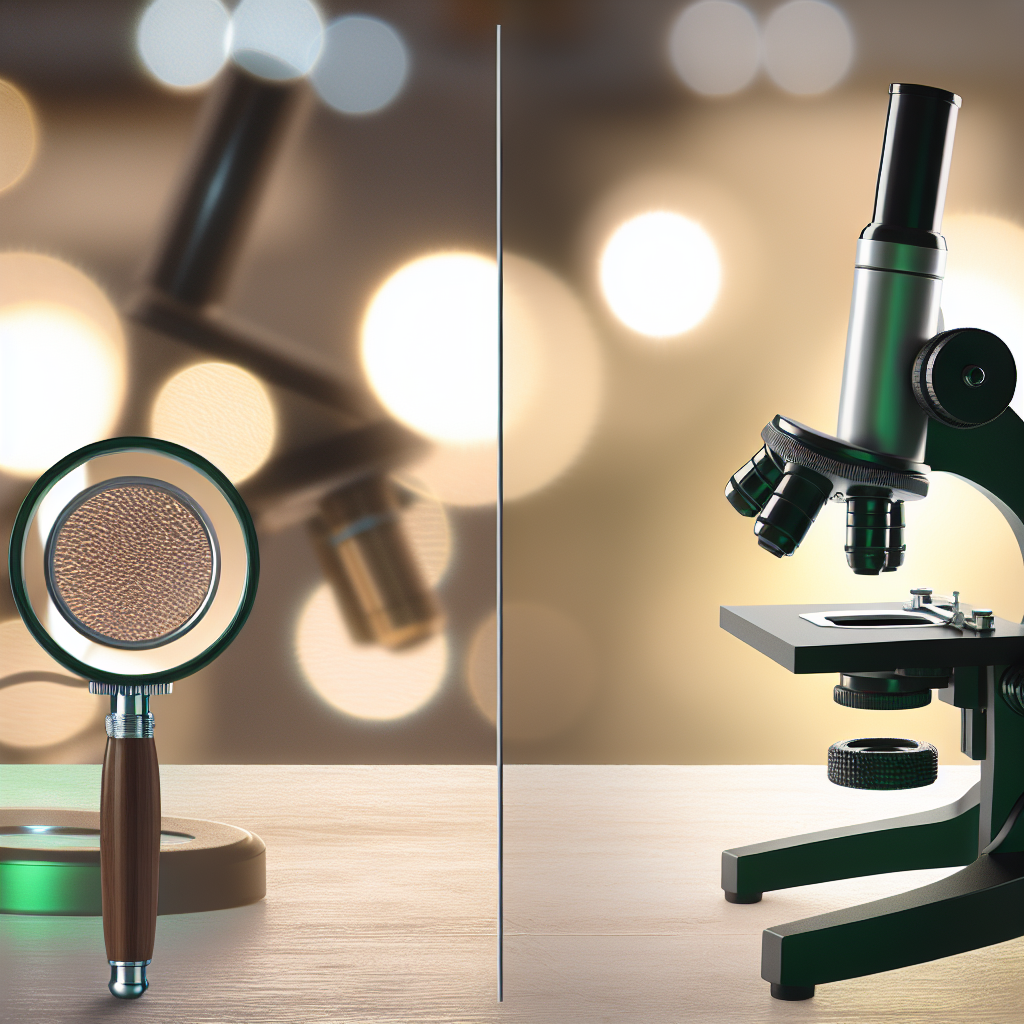
While the magnifying glass and the optical microscope share the same objective—to enhance the perception of small details—they do not operate in the same way, nor at the same level of fineness. Their design, handling, fields of action, and uses differ on many key points.
✅ Design and Structure of a Magnifying Glass
A magnifying glass is a simple instrument, consisting mainly of one or more converging lenses mounted in a frame, sometimes equipped with a handle or a stand, allowing it to be oriented at will. Its operation is based on the principle of light refraction: the lens bends light rays to present an enlarged image of the observed object to the naked eye. Magnifying glasses can offer magnifications that generally vary from ×2 to ×10, perfectly suited for examining details that escape classical observation.
From a technical point of view, several types of magnifying glasses can be distinguished:
- Simple magnifier: a single lens, generally for occasional or portable use.
- Double or triplet magnifier: two or three associated lenses, limiting optical aberrations and enhancing clarity.
- Illuminated magnifier: equipped with integrated LED lighting to optimize visibility in all circumstances.
- Stand magnifier: ideal for prolonged meticulous work while keeping hands free.
Lens compositions (glass, acrylic, or other materials) and the presence or absence of anti-scratch treatment also differentiate optical qualities and ease of use.
The main asset of a magnifying glass lies in its simplicity and portability, making it accessible for a wide variety of daily activities or occasional expertise.
✅ Design and Structure of an Optical Microscope
The optical microscope, on the other hand, is a much more complex machine, designed to scrutinize the infinitely small thanks to a series of converging lenses (objectives and eyepieces) mounted on various mechanical elements. It allows for much higher magnification powers, often ranging from ×40 to ×1000, or even more in some advanced configurations.
The constituent elements of an optical microscope include:
- Eyepieces: the part on which the user places their eye, often interchangeable depending on needs.
- Objectives: several objective lenses mounted on a rotating turret, offering different levels of magnification.
- Stages: support and move the sample under observation.
- Integrated light sources (mirror, LED): to effectively illuminate the object being studied, essential for clear image reproduction.
- Mechanical body: allows precise focus adjustment via micrometric or macrometric knobs.
Using a microscope requires some learning and a stable setup, but it offers unparalleled finesse in the structural observation of matter, useful from cell biology to industrial analysis.
📌 Practical Applications and Uses: Magnifying Glass vs. Microscope
Choosing between these two instruments requires a clear understanding of the contexts and objectives in which each excels. The field of application, ease of use, and expected precision guide the choice towards either a magnifying glass or an optical microscope.
✅ Common Uses of a Magnifying Glass
The magnifying glass stands out for its everyday versatility. Accessible, intuitive, and always ready for use, it is employed in many areas: DIY, gardening, reading small print, philately, numismatics, cosmetics, artisanal quality control, and in schools to introduce young people to the microscopic world.
- Reading and observation of texts or plans: easily decipher small typographies, calculate or annotate, distinguish subtleties.
- Precision work: sewing, engraving, model making, jewelry, or watch repair require careful observation without cumbersome setup.
- Creation or inspection of artworks: inspect the quality of a painting, restore a miniature, examine the texture of an old object.
- Simple scientific discoveries: for examining leaves, insects, or minerals, the magnifying glass is ideal for introducing children to nature or for outdoor observations.
The direct approach and maneuverability of the magnifying glass make it a practical companion for multiple inspections where speed and simplicity take precedence over extreme scientific detail.
✅ Common Uses of an Optical Microscope
Conversely, the optical microscope fully comes into its own when delving into the world of the minuscule, beyond what the eye can discern even with a magnifying glass. It is indispensable in the following fields:
- Biological and medical sciences: cellular analysis, living tissues, bacteria, fungi, microorganisms.
- Education and research: introduction to life sciences from middle school, structural exploration in high school and university.
- Industrial expertise: material control, microelectronics, metallurgy, detection of anomalies invisible to the naked eye.
- Forensics and restoration: identification of fibers, prints, dust, or degradation of artworks.
- Hobby and collection: in-depth study of stamps, coins, precious stones from a new angle.
The use of an optical microscope requires careful sampling and delicate manipulations, but the level of detail and analysis accessible is unparalleled for any serious investigation.
📌 Advantages and Disadvantages
To refine your choice, it is essential to examine the strengths and limitations of each tool, from a practical, economic, and technical perspective.
✅ Advantages of a Magnifying Glass
- Ease of use: no learning curve, immediate handling.
- High portability: compact format, often foldable or lightweight, easy to transport.
- Speed and versatility: allows instant checking without preparation or accessories.
- Economical: very moderate investment.
- Autonomy: no power source needed (except LED models that can run on batteries).
- Adaptability: various models suitable for all uses, professional or personal.
The magnifying glass is therefore the ideal tool for those who frequently wish to inspect objects, without technical constraints or the need for ultra-fine details.
✅ Disadvantages of a Magnifying Glass
- Limited magnification: generally less than ×10, which restricts access to certain structural data.
- Sometimes reduced field of observation: the lens size limits the visible area, especially for very powerful models.
- Edge distortion: cheap magnifiers can exhibit optical aberrations at the periphery.
- Visual fatigue: prolonged observation without support can tire the eye when maintaining position.
These constraints justify a use oriented towards modest magnifications or quick inspections, and not towards the scientific study of microstructures.
✅ Advantages of an Optical Microscope
- Customizable and extreme magnification: from ×40 to ×1000, or even beyond, depending on models and accessories.
- Multidimensional structured observation: in-depth vision, study of sections, cellular or material details impossible to reveal with a magnifying glass.
- Professional and educational use: fundamental instrument in biology, medicine, research, and teaching.
- Photography and documentation: possibility of adding cameras or digital eyepieces to record observations.
- Technological evolution: increasingly compact, ergonomic, and connected devices.
For any in-depth approach, the optical microscope stands out as the ultimate fine observation tool.
✅ Disadvantages of an Optical Microscope
- Higher acquisition price: a more significant investment, especially for professional models.
- Learning required: needs a minimum of training for safe and efficient handling.
- Setup and sample preparation: impossibility of spontaneous observation without adequate preparation.
- Limited portability: devices are much bulkier and more sensitive than magnifiers.
- Specific maintenance: precautions to be taken regarding optical cleaning and humidity.
The choice of a microscope must therefore be perfectly justified by the desire to go beyond routine observation, regardless of the field of application.
📌 Selection Criteria: Magnifying Glass or Microscope?
Given the diversity of models and the wide range of prices and performance, the choice between a magnifying glass and an optical microscope must be based on a precise analysis of several fundamental criteria.
🔍 Precision and Magnification Power Criterion
| Type of Observation | Recommended Magnification | Suitable Tool |
|---|---|---|
| Reading, manual work, quick check | ×2 to ×10 | Magnifying glass |
| Detailed observation of materials, surfaces, tissues | ×10 to ×40 | Very powerful magnifying glass or binocular magnifier |
| Biological analyses, microorganisms, cells | ×100 to ×1000 | Optical microscope |
| Professional scientific research | ×400 to ×1600 and + | Advanced microscope |
The finer the desired level of detail, the more an optical microscope is recommended. For less in-depth or general analyses, a magnifying glass is perfectly sufficient and offers greater maneuverability.
🔍 Ease of Use and Portability
Whether for working on the go, in the field, or at home, the magnifying glass offers unparalleled flexibility and portability: it can be worn around the neck, slipped into a pocket, or mounted on an ultra-light stand.
The microscope, due to its elaborate structure, requires a flat, stable surface and enforces sedentariness. Travel models exist but are more demanding to transport, better suited for temporary installation than for nomadic use.
- For outdoors: the magnifying glass remains unbeatable.
- For prolonged work sessions or shared use: the microscope surpasses in comfort and precision, at the cost of its reduced mobility.
🔍 Budget and Investment
Financially, the gap between the two tools is significant:
- Magnifying glass: from a few euros to about fifty euros for a high-end professional instrument.
- Optical microscope: entry-level accessible from €70-80, but expect several hundred euros for powerful and reliable models. Laboratory microscopes can represent a significant investment, often justified by the required precision and their robustness.
Before deciding, weigh the frequency of use, the nature of your observations, and the potential need for scalable features: some optical microscopes allow the addition of cameras or specialized objectives, whereas a magnifying glass remains a simple tool whose reliability holds few secrets.
📌 Context of Use: Hobbies or Professional?
The purpose of your acquisition—hobby, educational observation, professional, or scientific use—strongly influences the choice of tool. For hobbies, a quality magnifying glass often suffices thanks to its versatility and extreme simplicity. But if your activity requires detailed, repeated observation, or is integrated into research protocols, do not hesitate to opt for an optical microscope adapted to your specialty.
- Education: a magnifying glass is sufficient from primary to middle school; a microscope becomes relevant from advanced biology programs.
- Craftsmanship / Expertise: a magnifying glass is essential for examining pieces, but a microscope allows for deeper expertise (authenticity, micro-fissures, inclusions).
- Scientific hobby: start with a good magnifying glass, then upgrade to a microscope if the passion becomes more specialized.
- Professional: directly opt for robust equipment, with scalable accessories and warranty, taking into account the precise needs of the profession.
Therefore, anticipate the level of demands of your observations to avoid a superfluous purchase or, conversely, an insufficient one!
📌 Care and Maintenance
To ensure the durability and precision of your instrument, whether a magnifying glass or an optical microscope, regular maintenance is essential:
- Lens cleaning: always use dedicated microfiber cloths or wipes and avoid aggressive solvents. A micro-scratched lens significantly reduces visual quality.
- Protection against humidity and dust: store your tool in a hermetically sealed case or cover after each use.
- Checking moving parts: on microscopes, ensure smooth adjustments and lightly lubricate axes if necessary.
- Lighting check: regularly replace batteries or bulbs on models equipped with integrated light.
- Stable temperature storage: avoid sudden changes that could create fog on the optics.
Careful maintenance extends the life of the tool—most magnifying glasses require little upkeep; microscopes, however, demand more rigorous maintenance, especially in professional use.
📌 Innovations and Recent Technologies in Optics
The field of optics is constantly evolving: numerous innovations now make the use of both magnifying glasses and optical microscopes more user-friendly and powerful. Here are some significant trends and novelties:
- Aspherical optics: more magnifying glasses are adopting this type of lens to reduce distortion and maximize clarity across the entire surface.
- Connected and digital magnifiers: real-time image or video capture, screen display, easy sharing for collaborative work or educational monitoring.
- Portable USB microscopes: compact, directly connected to a computer, they democratize access to high resolution even for individuals.
- Adjustable LED lighting: allows precise adjustment of light intensity, essential for revealing delicate details.
- Mobile compatibility: more and more microscopes and magnifiers are associated with applications (measurement, annotation, online storage), revolutionizing sample tracking or training.
- Increased durability through new materials: adoption of resistant composites, scratch-resistant treated lenses, etc.
For an overview of these advances applied to the microscope, see our selection of the latest generation of optical microscopes, suitable for all user profiles.
📌 Frequently Asked Questions (FAQ)
-
💡 What is the main difference between a magnifying glass and an optical microscope?
The main difference lies in the level of magnification: a magnifying glass slightly enlarges the image of an object to observe details visible to the naked eye, while an optical microscope offers much higher magnification to see structures invisible to the naked eye, such as cells or microorganisms.
-
💡 For what activities should one prefer a magnifying glass?
A magnifying glass is recommended for reading, examining stamps, coins, jewelry, watch repair, or any activity requiring slight to moderate magnification in a portable format.
-
💡 Which microscope should I choose for school or amateur work?
For school use, a monocular optical microscope equipped with standard eyepieces and interchangeable objectives, with magnification up to ×400, is more than sufficient. Prioritize robust models that are easy to maintain and upgrade to support the student's progression.
-
💡 Are there magnifying glasses that offer high magnification?
Yes, some trinocular or multi-lens magnifiers achieve magnifications of ×20 to ×40, but beyond that, observation becomes more complex, and the necessary stability then brings the instrument closer to a binocular microscope or a stereomicroscope.
-
💡 What criteria should be used to compare the quality of a magnifying glass?
Check the lens material (glass or high-end acrylic), the presence of anti-scratch or anti-reflective coatings, the diameter of the visible area, and integrated accessories (LED lighting, ergonomic handle or stand).
-
💡 Is an optical microscope suitable for outdoor observation?
Generally not, except for very compact and portable models. For all your field explorations, opt for a robust magnifying glass that is easy to handle and store, designed to withstand environmental hazards.
📌 Conclusion: Choosing the right instrument for your needs
In summary, the magnifying glass appeals with its simplicity, mobility, and low cost, ideally suited for all moderate magnification tasks, from hobbies to minor expertise. The optical microscope, on the other hand, is fully justified when your ambitions turn to exploring the invisible, scientific research, or in-depth analysis. Take the time to define your expectations, anticipate possible changes in your needs, and learn about innovative options that could enhance your observations tenfold. A good investment in optics means a new and precise look at the wonders of the minuscule!