


📌 Understanding the Basics: What is a Magnifying Glass?
A magnifying glass is a widely used optical tool that magnifies the appearance of nearby objects. Used for centuries, it relies on basic optical principles to provide the user with a more detailed view of small objects, texts, or structures that the naked eye struggles to discern. The magnifying glass thus stands out as an essential instrument in many areas of daily and professional life, allowing for precise and facilitated observation of fine details.
Before looking at the differences with a magnifying mirror, it is essential to clearly define the structural and functional characteristics of the magnifying glass to understand its specificity and multiple uses.
🔍 How a Magnifying Glass Works
The core of a magnifying glass lies in its convex lens. This lens, often made of optical glass or quality plastic, has the ability to refract light by concentrating it at a focal point. When an object is placed in the magnifying glass's focal zone (usually a few centimeters from the lens), the user observes an enlarged and clear image.
The magnification of a magnifying glass is determined by the curvature and diameter of the lens. The most common magnifying glasses offer magnifications from 2x to 10x, meaning they enlarge the observed object two to ten times compared to the actual size perceived by the naked eye. Some specialized magnifying glasses can offer higher magnification powers, suitable for specific professional or scientific uses.
- Convex lens: main element providing magnification.
- Frame and handle: for handling and stability.
- Complementary lighting systems (optional): integrated LEDs to optimize visibility.
Different models exist, ranging from simple handheld magnifiers to stand-alone versions with articulated arms, as well as magnifying glasses or head-mounted magnifiers that leave the user's hands free, each meeting a specific observation or ergonomic need.
🔍 Common Uses of a Magnifying Glass
The magnifying glass owes its success to its very wide range of applications. Its use transcends ages, from schoolchildren to professionals, and sectors of activity. Here are some examples of use:
- Reading and writing: An essential aid for people with reduced visual acuity to read small print, decipher instructions, or fill out forms.
- Scientific observation: Entomologists, botanists, watchmakers, and jewelers use the magnifying glass to examine tiny organisms, structures, or mechanisms requiring precision and acuity.
- Philately and numismatics: The observation of stamps and coins, which requires studying fine details, is almost exclusively done with adapted magnifying glasses.
- Industrial quality control: Industry (electronics, textile, mechanical) uses magnifying glasses to check the integrity of welds, fabrics, or printed circuits.
- Crafts and art restoration: Miniaturists, restorers, and artists use magnifying glasses to work on tiny surfaces or repair delicate decorative elements.
The diversity of activities illustrates the universal utility of the magnifying glass. Lightweight, portable, and affordable, it is an irreplaceable visual aid, both for personal curiosity and for demanding professional uses.
For more information on the latest magnifying glass models, you can consult our selection on the magnifying mirror and magnifying glass page.
📌 Exploring the Characteristics of a Magnifying Mirror
The magnifying mirror finds its place in many homes and professional establishments, thanks to its ability to offer an enlarged, faithful, and distortion-free image of the reflected areas. Its main use is not to observe objects through a lens like a magnifying glass, but to allow the user to see their own face or certain parts of their body with greater precision. The magnifying mirror is now commonly found in bathrooms, beauty salons, medical offices, and makeup areas.
Let's understand in detail how this indispensable device works and its advantages for daily and professional routines.
🔍 How Does a Magnifying Mirror Work?
A magnifying mirror uses the curvature of its reflective surface – typically concave – to converge light rays and produce an enlarged image of what is near its focal point. Unlike a classic mirror with a flat surface that reflects an image true to real scale, the magnifying mirror, due to its geometry, increases the field of vision of reflected details, thus offering a close and clear view.
| Mirror Type | Functioning | Result |
|---|---|---|
| Flat mirror | Flat surface | Life-size image |
| Concave mirror (magnifying) | Inward curved surface | Enlarged and precise image |
The most common magnification factor for a magnifying mirror generally ranges from 2x to 10x. Note: optimal use requires being at the correct focal distance. Too close or too far, the image distorts or becomes blurry.
🔍 Practical Uses of Magnifying Mirrors
The magnifying mirror is essential in many everyday contexts, particularly for personal care and precision. Here are some major uses:
- Makeup and facial care: To apply makeup accurately, pluck eyebrows, shave closely, or insert contact lenses, the magnifying mirror offers the possibility of observing every detail with finesse.
- Beauty salons and medical professionals: Beauty professionals or certain health practitioners benefit from magnifying mirrors to examine the skin, perform minor treatments, or meticulous manipulations.
- Daily hygiene: Actions such as removing ingrown hairs, cleaning pores, or oral care are facilitated by an amplified view of the targeted areas.
- Accessibility: Essential for people with impaired vision, it improves autonomy and safety during sensitive operations in front of the mirror (shaving, haircutting, etc.).
Some high-end versions also integrate LED lighting and extendable arms or suction cups for maximum user comfort.
Want to discover current models and recent innovations? Consult our guides like the Top 5 recommended head magnifiers this year.
📌 Major Differences Between a Magnifying Glass and a Magnifying Mirror
Confusion between a magnifying glass and a magnifying mirror is common, as both allow for detailed observation. However, their principles, uses, and designs are distinctly different. Let's analyze these differences to better guide your choice.
🔍 Magnification Difference
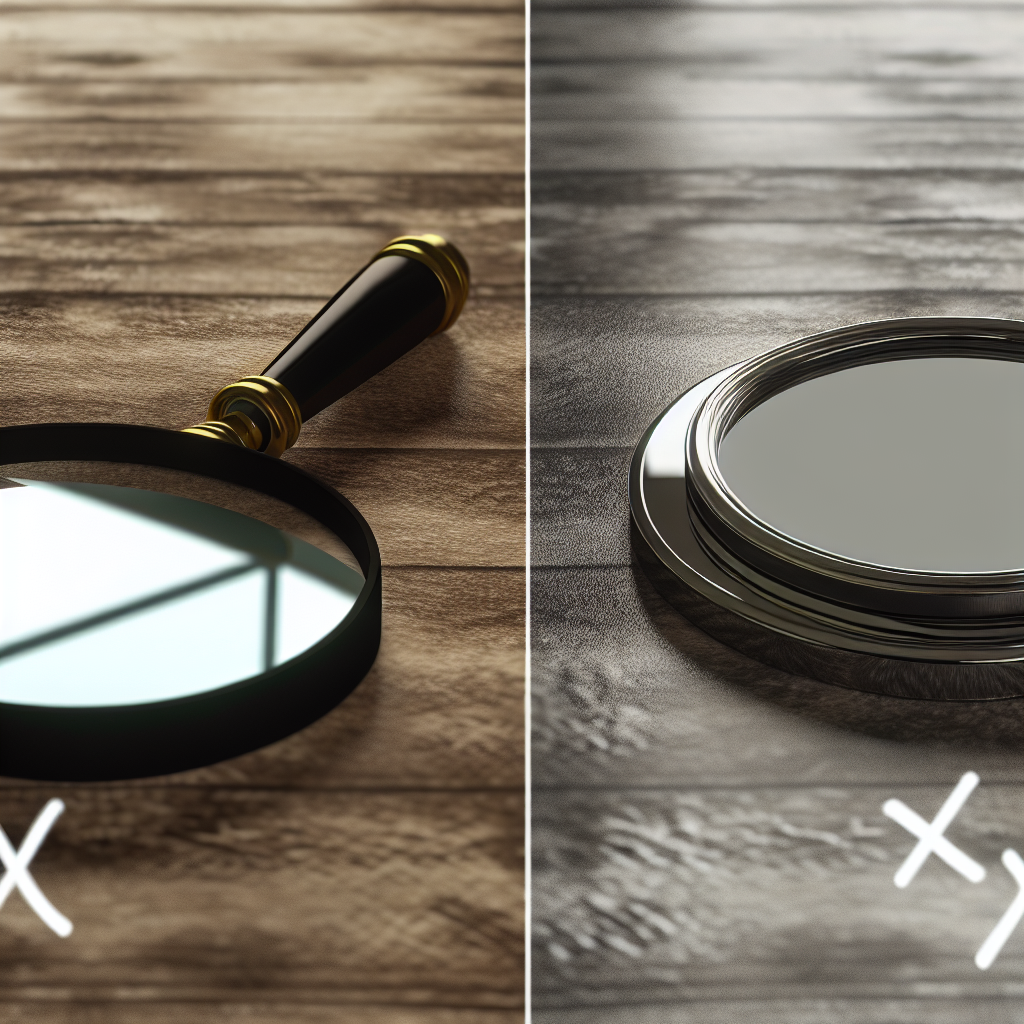
The primary difference lies in how the two devices provide an enlarged view. A magnifying glass uses a lens that converges light through transparent material, creating an enlarged image by transmission of the object placed behind it. In contrast, a magnifying mirror reflects an enlarged image of the face or a body part, working by reflection via its curved surface.
- Magnifying glass: Magnification typically between 2x and 20x; suitable for observing fine objects, texts, stamps, insects, mechanisms, etc.
- Mirror: Frequent magnification of 2x, 5x, or 10x with usage almost exclusively dedicated to reflecting the face or a body part.
It should be noted that the image seen through a magnifying glass remains in its axis (but enlarged), while in a mirror, it is inverted in depth, which, for certain precise manipulations, can be disorienting during initial use.
🔍 Materials and Design: Magnifying Glass versus Mirror
In terms of design, the magnifying glass prioritizes transparency and lens quality (optical glass often scratch-resistant, some models in acrylic or polycarbonate for lightness). Its frame can be movable, foldable, or attach to a work surface.
The magnifying mirror, on the other hand, focuses primarily on the quality of its reflective surface and the regularity of its curvature. It is often made of polished glass then treated to limit fogging or staining. Frames are generally made of metal, robust plastic, or non-slip materials, and can integrate various mounting systems (stand, articulated arm, suction cup, etc.) to ensure stability and comfort.
| Element | Magnifying glass | Magnifying mirror |
|---|---|---|
| Main material | Glass, acrylic, polycarbonate | Polished glass, metal/plastic support |
| Mechanism | Transparent convex lens | Concave reflective surface |
| Shape | Round, oval, rectangular | Round, oval (often) |
| Mounting | Handheld, stand, head-mounted | Desk, wall, suction cup |
🔍 Ease of Use and Comfort
Ease of use depends as much on handling as on context:
- The magnifying glass: Lightweight and portable, it nevertheless requires manual stabilization or precise positioning to achieve optimal magnification, which can make it uncomfortable for long periods of observation.
- The magnifying mirror: Fixed to a wall or placed on a stable surface, it leaves hands free and allows for unconstrained observation, ideal for tasks requiring dexterity (makeup, shaving, facial care, etc.). Some models integrate anti-fog systems or pivots to adjust the angle and distance.
In summary, the magnifying glass is more versatile for handheld observation of all kinds of objects, while the magnifying mirror is formidable for precise gestures in front of the face or a reflected body part.
📌 When to Choose a Magnifying Glass?
There are many situations where a magnifying glass is a much more sensible choice than a mirror. Its unique design meets multiple needs, from scientific hobbies to medical and professional applications requiring high precision.
🔍 Magnifying Glass for Scientific Hobbies
Nature enthusiasts, collectors, and science lovers find the magnifying glass an irreplaceable companion for their activities.
- Entomology: Observing the infinitesimal details of wings, antennae, or insect patterns requires high magnification and a clear image – two strengths of the magnifying glass.
- Botany: Examine the structure of a leaf, the surface of a flower, or the texture of seeds, which is fundamental for identification and scientific study.
- Philately and numismatics: Deciphering micro-inscriptions, detecting flaws, or examining relief on a stamp or coin is only possible with high magnification and distortion-free observation.
- Reading and archives: Genealogists, library researchers, or archivists use magnifiers to read old manuscripts or study miniature artworks.
Lightweight, compact, and often equipped with a carrying case, the magnifying glass is designed for mobile explorers, educators, or curious individuals who wish to decipher the world invisible to the naked eye wherever they are.
🔍 Medical and Precision Use with a Magnifying Glass
In the professional field, the magnifying glass holds a prominent place. It equips many professions where visual precision is crucial:
- Dentists: Binocular loupes increase visibility during complex dental procedures.
- Jewelers, watchmakers: Interventions on tiny mechanical components or precious stones become accessible thanks to a high-definition magnifying glass.
- Dermatologists and health professionals: Observing skin details or detecting anomalies often requires the use of a portable or head-mounted magnifier.
- Technicians and electronics engineers: Inspection, repair, or soldering on miniature printed circuits are performed more easily with an adapted magnifying glass.
The diversity of models (handheld, head-mounted, stand-alone, illuminated magnifiers) allows them to adapt to the constraints of each profession, often offering variable magnification and excellent color rendition.
To make the best choice in this area, do not hesitate to consult our specialized resources or ask our experts for advice.
📌 When to Opt for a Magnifying Mirror?
The magnifying mirror meets specific needs, primarily focused on self-viewing or body parts, for care, hygiene, or aesthetic purposes. Designed to be integrated into home or professional environments, it optimizes the daily lives of millions of people.
🔍 Importance in Cosmetics and Makeup
The beauty and wellness industry has quickly recognized the effectiveness of the magnifying mirror for tasks requiring unparalleled precision:
- Makeup application: Magnification allows for a perfect result, especially for drawing eyeliner lines or applying false eyelashes.
- Facial care: Eyebrow plucking, detection and extraction of blackheads, or meticulous skin cleansing require a clear and sharp vision offered by the magnifying mirror.
- Shaving: Both men and women benefit from increased visibility for precise shaving, limiting cuts and imperfections.
- Institutes and professionals: Aestheticians, dermatologists, or professional makeup artists cannot do without a magnifying mirror to perform their services with utmost care.
This tool improves confidence and precision of gestures, reducing the risk of error and promoting a high-level finish, whether at home or in a professional context.
🔍 Integration into the Bathroom
The magnifying mirror has become almost indispensable in many modern bathrooms for daily hygiene and preparation:
- Oral care: It facilitates checking tooth cleanliness and proper flossing.
- Skin self-examination: Detecting imperfections, ingrown hairs, or monitoring the evolution of small dermatological lesions.
- Contact lens insertion: Magnification secures delicate gestures and reduces the risk of error.
- Accessibility: For elderly or visually impaired individuals, a magnifying mirror makes many hygiene actions more autonomous and comfortable.
Some magnifying mirror models are equipped with additional functions: LED lighting, anti-fog feature, extendable arm, double-sided magnification, allowing their use to be adapted to each family member.
📌 Selection Criteria: Magnifying Glass or Magnifying Mirror?
The choice between a magnifying glass and a magnifying mirror primarily depends on your specific needs, your environment, and your expectations in terms of comfort, precision, and practicality. Here is a guide to help you with this decision.
🔍 Factors to Consider for Magnifying Glasses
Before purchasing a magnifying glass, several criteria must be taken into account to ensure optimal and appropriate use:
- Magnification power: Choose the appropriate power for the task (reading, insect observation, jewelry making, etc.). Too high a magnification reduces the depth of field and can cause distortions.
- Lens size and shape: A large lens offers a wider field of view but can make the magnifier heavier.
- Optical quality: Prefer a treated optical glass lens for a clear vision without chromatic aberration.
- Integrated lighting: LED models are ideal in low light environments or for highlighting fine details.
- Ergonomics: Non-slip handle, lightweight, possibility of fixing or hands-free system for prolonged use.
Finally, consider portability (handheld, foldable, pocket-sized model) if you need to take it with you when traveling.
🔍 Magnifying Mirror Consideration Factors
To select the ideal magnifying mirror, certain criteria are essential:
- Magnification: 2x to 10x, depending on the nature of the use (makeup, shaving, dermatological care).
- Dimensions: Choose a diameter that offers a comfortable field of vision, neither too small (frustrating to use) nor too large (cumbersome).
- Mounting and mobility: Choose between wall-mounted, freestanding, suction cup, or articulated arm to adapt to your bathroom or workspace.
- Additional options: LED lighting, anti-fog system, double-sided (normal and magnifying mirror), pivot, design adapted to the room's aesthetics.
- Safety: Prioritize a sturdy frame and an unbreakable surface, especially in the presence of children.
The final choice therefore depends on the installation location, comfort expectations, frequency of use, and of course the allocated budget.
📌 FAQ: All You Need to Know About Magnifying Glasses and Magnifying Mirrors
- What is the essential difference between a magnifying glass and a magnifying mirror?
A magnifying glass magnifies objects observed through a lens, ideal for examining fine details, while a magnifying mirror reflects a magnified image (e.g., of the face), especially useful for hygiene, makeup, or self-examination. - What magnification levels are available for each tool?
Magnifying glasses generally offer powers from 2x to 20x, with some specialized versions going beyond. Magnifying mirrors typically offer magnifications from 2x to 10x, suitable for personal care. - Can I use a magnifying mirror instead of a magnifying glass for reading text?
No, a magnifying mirror is not designed for this purpose: it reflects an image and does not allow for clear or comfortable reading of flat written documents. Prefer a magnifying glass for reading. - Are there hybrid models combining a magnifying glass and a magnifying mirror?
These devices are very rare and not commonly available: each instrument is optimized for its own use, although some magnifying glass models incorporate a small mirror for specific needs. - Which tool should I choose for hair removal or makeup application?
The magnifying mirror is the most relevant, as it allows you to see the face or the targeted area clearly, without having to manipulate an additional instrument. - Can my magnifying glass be used for medical applications?
Yes, provided you choose a professional magnifying glass with high optical quality and magnification suitable for medical examinations or precision surgery.
📌 Conclusion: Which Option to Choose?
Magnifying glass or magnifying mirror, the choice depends primarily on the intended use. A magnifying glass is essential for studying small objects, scientific observation, manual trades requiring meticulousness, or reading assistance. A magnifying mirror, on the other hand, is the ideal solution for all tasks where precise visualization of the face or parts of the body plays a crucial role: makeup, shaving, dermatological care, hygiene, or accessibility.
The two devices are complementary: one allows you to explore the world of small details, the other optimizes your daily life with a magnified view of yourself. Depending on your needs, your environment, and your comfort expectations, you will now know how to make the best choice between these optical tools. To explore the complete range of our products, visit our specialized collection of magnifying mirrors and glasses and benefit from expert advice for a purchase perfectly suited to your requirements.