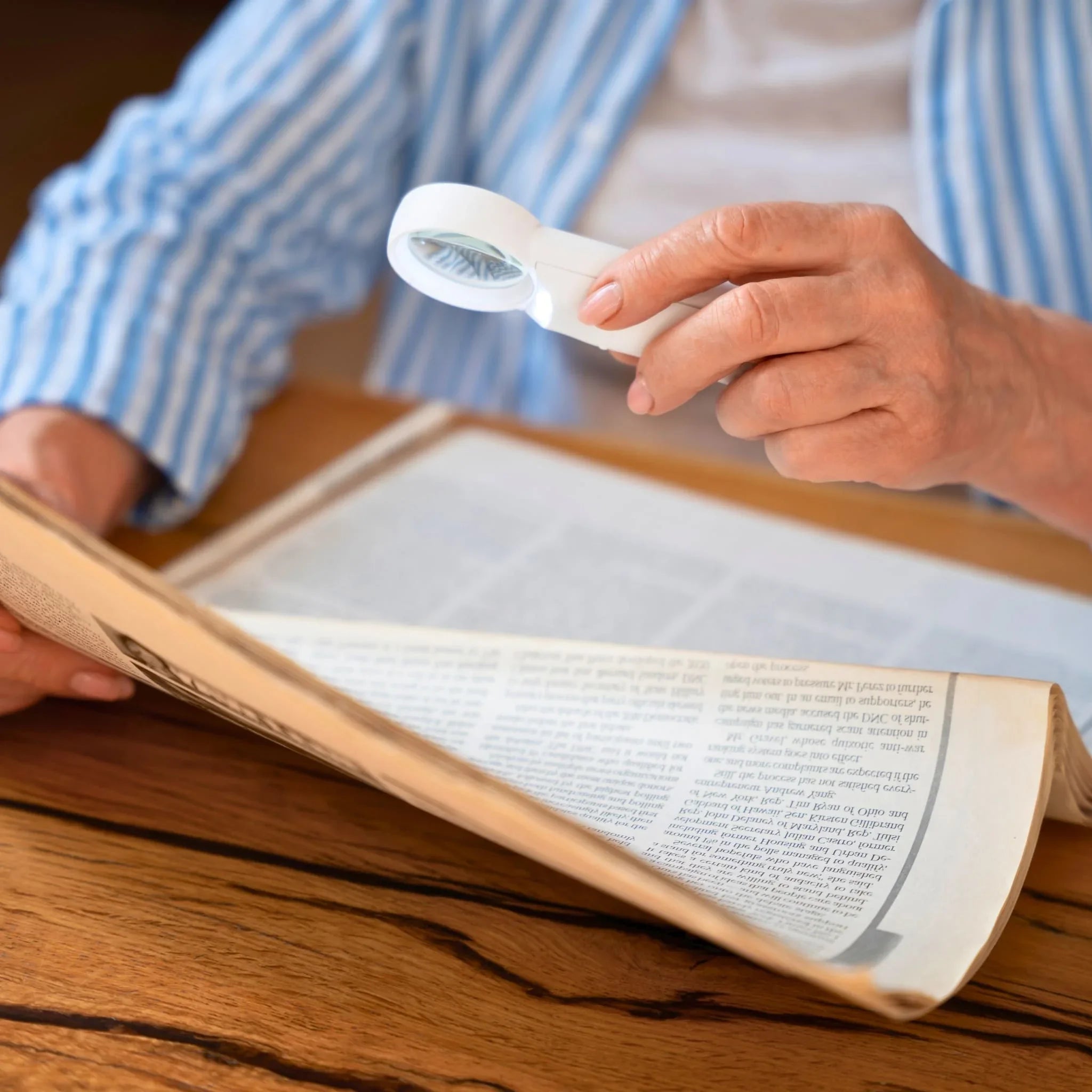


Welcome to France Loupe, your specialist in high-performance magnifiers designed for all your needs. Whether you're looking for a magnifying glass for reading, a handheld magnifying glass, or an illuminated reading magnifier, we have what you need. Our products are perfect for seniors, visually impaired individuals, and those with low vision.
Our magnifiers, equipped with high-quality optical lenses and LED lighting, make reading small texts easier and improve your visual comfort. For effortless use, we offer desktop magnifiers, hands-free magnifiers, and pocket magnifiers.


Welcome to France Loupe, your specialist in high-performance magnifiers designed for all your needs. Whether you're looking for a magnifying glass for reading, a handheld magnifying glass, or an illuminated reading magnifier, we have what you need. Our products are perfect for seniors, visually impaired individuals, and those with low vision.
Our magnifiers, equipped with high-quality optical lenses and LED lighting, make reading small texts easier and improve your visual comfort. For effortless use, we offer desktop magnifiers, hands-free magnifiers, and pocket magnifiers.
#excerpt
Discover our complete range of magnifiers adapted to every use, and enjoy clear and sharp vision for all your daily activities.
Magnifiers and Use Cases
How to choose the right magnifier?
Choosing a magnifier adapted to your needs can transform your daily life. It is essential to determine the primary use of the magnifier. For reading, an illuminated reading magnifier is ideal, while for precision work, a handheld magnifier or an electronic magnifier might be more appropriate. Also, consider the lens and the type of lighting needed.
Magnification suitable for its use
The magnification should correspond to the intended use. For reading small texts, a magnification of 3x to 5x is often sufficient. For detailed work like embroidery or electronics, a higher magnification, such as 10x, may be necessary. Make sure to choose a magnifier that offers a magnification suitable for your specific needs.
Choosing the right field of view for your magnifier
The field of view is crucial for comfortable use. A wide field of view is preferable for reading, as it allows you to see more text at once. For more specific tasks, a narrower field of view but with higher magnification can be more advantageous.
Illuminated or luminous magnifier for better comfort
Illuminated magnifiers are equipped with LED lights that provide uniform and powerful lighting. They are particularly useful for seniors or visually impaired individuals, as they reduce eye strain and allow for better visibility. Luminous magnifiers are ideal for comfortable reading and detailed work.
Electronic or binocular magnifiers for more precise uses
Electronic magnifiers offer high magnification and are perfect for work requiring great precision. Binocular magnifiers are ideal for tasks that require stereoscopic vision, such as medical examinations or watchmaking. These magnifiers are often used by professionals for their precision and ease of use.

Our Products
Magnifying glasses
Magnifying glasses are practical for manual work and prolonged reading, offering comfortable magnification without having to hold the magnifier.
Handheld magnifier
Ideal for versatile use, handheld magnifiers are lightweight and easy to carry, perfect for reading small print or examining objects up close.
Floor lamp magnifier
The floor lamp magnifier combines powerful lighting and a high-quality magnifier, ideal for hands-free work and stable illumination.
AMD Magnifier
Specially designed for people with age-related macular degeneration (AMD), these magnifiers offer high magnification and appropriate lighting to improve vision.
Binocular magnifier
Binocular magnifiers provide stereo vision, ideal for precision work that requires depth, such as medical examinations or laboratory work.
Embroidery pendant magnifier
Practical and elegant, the embroidery pendant magnifier is perfect for sewing and embroidery enthusiasts, offering precise magnification while being worn as a pendant.
Monocular magnifier
Compact and easy to use, the monocular magnifier is ideal for quick and efficient use, offering high magnification for examining fine details.

Headband magnifier
The headband magnifier is perfect for hands-free work, such as repair or modeling, offering direct magnification and lighting for optimal precision.
And many more
Our range includes even more products, each designed to meet specific needs. Whether you are looking for a small magnifier for your pocket or a large magnifier for detailed work, we have the perfect solution for you.
User Questions
What is the best magnifying glass for reading small print?
The best magnifier for reading small print is an illuminated reading magnifier with 3x to 5x magnification and integrated LED lighting. It offers optimal visual comfort and reduces eye strain.
How to choose a magnifying glass for precision work like embroidery or jewelry?
For precision work, choose a binocular magnifier or a handheld magnifier with high magnification, between 10x and 20x. Make sure it has LED lighting for better visibility of fine details.
Why use an illuminated magnifier and what are its advantages?
An illuminated magnifier is equipped with LED lighting, providing uniform and powerful light. It reduces eye strain, improves clarity, and is ideal for dimly lit environments, making reading and precision work more comfortable.
What type of magnifying glass is best suited for people with AMD?
People with AMD will benefit most from an electronic magnifier or a high-magnification illuminated magnifier (minimum 5x), specially designed to improve vision for people with low vision.
What are the differences between a pocket magnifier and a handheld magnifier?
A pocket magnifier is compact and easily transportable, ideal for quick and occasional uses. A handheld magnifier is generally larger, offering a wider field of view and often better comfort for prolonged use.

How to choose magnification?
Choose magnification according to your use. For reading, a magnification of 3x to 5x is sufficient. For precision work, a higher magnification, between 10x and 20x, is recommended. Test different magnifications to find the one that best suits your needs.
How to determine the magnification of a magnifier?
The magnification of a magnifier is determined by the power of its lens. It is often indicated on the product (e.g., 3x, 5x). To estimate the magnification, divide the focal length (in millimeters) of the lens by 250. For example, a 50 mm lens gives a magnification of 5x (250/50).