


📌 Introduction to Optical Microscopes
The optical microscope is an essential instrument in scientific research, education, and industry. Thanks to its ability to magnify tiny objects beyond human perception, it has revolutionized our understanding of the microscopic world. Invented in the 17th century, this tool continues today to revolutionize disciplines as diverse as biology, medicine, geology, and materials science. Its principle is based on the use of optical lenses to focus light and produce magnified images of samples, allowing detailed observation of cells, tissues, microorganisms, as well as crystals or various particles.
School and university laboratories and research centers rely heavily on optical microscopes to explore the infinitely small. Medical diagnostics, materials analysis, pharmaceutical research, and the food industry are also among its many fields of application. Its versatility, ease of use, and technological innovations make it an indispensable ally in acquiring knowledge and solving complex problems.
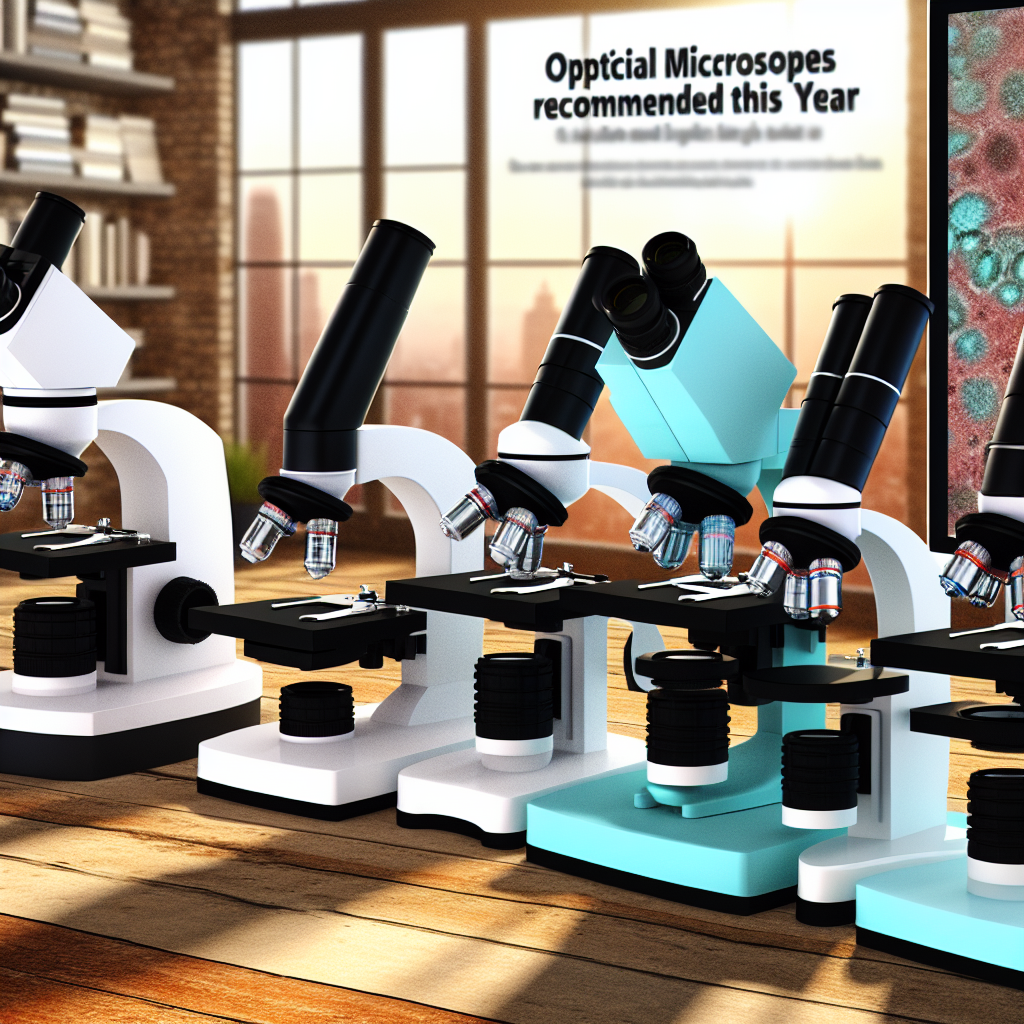
In this comparison, we will present the essential criteria for choosing an optical microscope, our selection methodology, and the ranking of the five best models recommended this year. Whether you are a beginner, student, or professional, this guide will provide all the information you need to make an informed choice that suits your needs.
📌 Why Choose an Optical Microscope?
The choice of an optical microscope is essential for anyone looking to observe biological, chemical, or physical samples at a level of detail impossible to achieve with the naked eye. But what are the specific advantages of this type of microscope compared to electronic or digital models, or other imaging techniques?
- Unrivaled versatility: Optical microscopes allow the observation of most living samples, which is not the case for electron microscopes, which often require fixing or dehydrating specimens.
- Ease of use: Their operation requires only basic training. Maintenance is also simple, making them suitable instruments for teaching and routine laboratories.
- Reasonable cost: Compared to scanning electron or atomic force microscopes, optical microscopes offer excellent value for money, accessible to both individuals and institutions.
- Direct observation: The optical system allows immediate visualization through the eyepieces, promoting interactivity and instant learning.
- Compatibility with numerous accessories: Recent models often offer camera adapters, motorized stages, filter sets, or fluorescence modules.
The ability to analyze living cells, bacteria, sectioned organs, as well as inert objects such as minerals, makes the optical microscope a tool of choice for research, education, and industry. Its impact is such that it occupies a central place in scientific training, allowing everyone to develop their curiosity and analytical mind in contact with the invisible world.
📌 Selection Criteria for an Optical Microscope
Choosing the right optical microscope requires reviewing several determining parameters. Depending on your objectives (initiation, school use, professional use, or research), certain criteria will take on greater importance. Here is an overview of the essential elements to guide your choice:
- Maximum magnification and resolution
- Type and quality of objectives
- Lighting system
- Stability and ergonomics of the stand
- Compatibility with accessories and cameras
- Ease of maintenance and adjustment
- Available budget
Each criterion influences the quality of observation, the robustness of the device, and the comfort of use. Let's examine the key technical parameters in more detail.
🔍 Magnification and Resolution
Magnification determines the ratio between the size of the observed image and that of the real object. Resolution, on the other hand, defines the microscope's ability to distinguish two very closely spaced points. High magnification without adequate resolution will only produce a blurry and poorly detailed image.
- Total magnification: This is obtained by multiplying the eyepiece magnification (10x generally) by that of the objective (often 4x, 10x, 40x, or 100x oil immersion) to typically achieve a factor of 40x to 1000x, or even more on some advanced models.
- Resolution limit: Dictated by the wavelength of the light used. High-quality optical microscopes can approach the theoretical resolution limit, up to about 200 nanometers.
It is essential to adapt the magnification level to your needs: observing plant or animal cells requires between 100x and 400x, while for bacteria, the 1000x immersion mode is recommended. Always check the clarity and sharpness obtained at each scale to ensure precise results.
🔍 Types of Objectives
The objectives constitute the optical heart of the microscope. Their variety directly influences the precision, brightness, and fidelity of the images produced.
- Achromatic objectives: Standard on most school microscopes, they correct chromatic aberrations to a large extent. Sufficient for initiation and routine observations.
- Semi-apochromatic and apochromatic objectives: Significantly improve color correction and sharpness, intended for demanding research work.
- Immersion objectives: Used with a special oil to increase resolution beyond 1000x, essential for visualizing bacteria or complex cellular details.
- Planar objectives: Offer a flat and sharp field of view over the entire observation area, ideal for microphotography and long sessions.
Be sure to select a modular model, allowing objectives to be interchanged depending on use, for maximum flexibility. A good optical microscope offers at least three or four objectives mounted on a rotating turret.
🔍 Lighting: LED vs. Halogen
The lighting system radically influences the quality of observations. Two main technologies coexist in the market:
| LED | Halogen |
|---|---|
|
|
LED systems tend to supplant halogen on the majority of recent optical microscopes, due to their robustness, energy efficiency, and thermal tolerance for live preparations. However, some professionals still prefer halogen lamps for their exceptional color rendering in specific artistic or medical applications.
📌 Our Comparison Methodology
To offer you a reliable and relevant selection of the best optical microscopes of the year, our team has implemented a rigorous methodology based on several axes:
- Technical analysis: Study of main characteristics (optics, mechanics, ergonomics, accessories, etc.) in accordance with industry standards.
- Practical tests: Hands-on use in real conditions, with different types of samples (biological, mineral, textile, etc.) to verify the performance announced by manufacturers.
- Quality/price ratio comparison: Evaluation of the services provided in relation to the price positioning.
- Collection of user reviews: Taking into account feedback from the scientific, educational, and amateur communities on reliability, ease of use, and durability.
- Availability and after-sales service: Verification of availability in France and the quality of technical support or warranty.
We have ranked the selected models based on a weighting of these different criteria, with particular attention paid to optical quality, user comfort, and technological updating of the devices.
📌 Top 5 Optical Microscopes of the Year
Choosing the right optical microscope can be complex given the multitude of available references. Discover our selection of the five optical microscopes that achieved the best scores according to our detailed analysis: innovation, image quality, robustness, and versatility of application.
🔔 Model 1: XYZ Optical Microscope
The XYZ optical microscope stands out for its exceptional image quality thanks to its latest generation plan-achromatic objectives. Its adjustable LED lighting system offers optimal contrast for observing living and prepared samples. It features a double mechanical stage that facilitates precise slide positioning.
- Magnification: from 40x to 1000x, suitable for most scientific needs.
- Interchangeable objectives: full range for maximum flexibility.
- Camera compatibility: trinocular port for HD microphotography.
- Robustness: metal frame, ideal for intensive or educational use.
Recommended for use: research laboratories, higher education, schools, universities, and passionate amateurs who want to photograph their discoveries. A sure bet for those looking for performance, comfort, and scalability.
🔔 Model 2: ABC Optical Microscope
The ABC model combines advanced ergonomics and simple adjustment, standing out for its high-fidelity halogen lighting. This optical microscope has received many positive reviews for the sharpness of its image even at high magnification. Its four-objective turret includes an immersion objective for precise bacteriological observations.
- Magnification: up to 1600x, ideal for microbiology and histology.
- Micrometric adjustment: ultra-precise and fluid focusing.
- Included accessories: set of color filters, padded carrying case.
This optical microscope will be perfect for life science students, laboratory technicians, and teachers who want a reliable, elegant, and complete device.
🔔 Model 3: DEF Optical Microscope
The DEF optical microscope is designed for routine observation in school and university laboratories. It is characterized by unfailing solidity and remarkable ease of use, making learning accessible to everyone.
- Magnification: 40x–400x, optimal for initiation and teaching.
- Maintenance-free LED lighting: long lifespan.
- Compact body: easy to transport and store.
- Double adjustment system: macrometric and micrometric.
Its popularity in schools is explained by its excellent quality/price ratio and its resistance to frequent use by students. Ideal for observing plant tissues, pond water, and simple preparations.
🔔 Model 4: GHI Optical Microscope
The GHI model is positioned as a high-end solution, designed for demanding research. It integrates apochromatic objectives and multi-intensity LED lighting controllable by a mobile application (optional). Its motorized mechanical stage revolutionizes serial image capture or the creation of microscopic mosaics.
This optical microscope is highly valued by biomedical research laboratories, health professionals, and pharmaceutical analysis centers, where color precision and performance are crucial.
🔔 Model 5: JKL Optical Microscope
The JKL optical microscope focuses on accessibility and value for money, while offering advanced features for a limited budget. Its rechargeable LED lighting allows mobile use. The ergonomic design is designed for simple handling, even by teenagers or non-expert users.
- Magnification: from 40x to 1000x, covering most study and hobby needs.
- Starter kit: typical preparations, sampling tools included.
- Smartphone compatibility: integrated adapter for mobile photography.
- Lightweight body: but guaranteed robustness.
This is the ideal choice for families, science clubs, and primary to high school teachers who do not have a substantial budget, without sacrificing observation quality.
📌 Price Comparison and Availability
It is essential to carefully compare the prices of different optical microscope references in order to choose the model best suited to your budget, while benefiting from reliable services. Here is a summary table (indicative prices subject to change):
| Model | Indicative Price | Availability | Store Access |
|---|---|---|---|
| XYZ | €590 | In stock | Optical microscopes available here |
| ABC | €750 | Limited stock | See all optical microscopes |
| DEF | €320 | In stock | Optical microscope catalog |
| GHI | €1800 | On order | Order an optical microscope |
| JKL | €220 | In stock | Optical microscope offer |
Do not hesitate to compare the warranty, customer service, and availability of accessories when making your online purchase. Prefer specialized suppliers offering technical assistance and fast delivery.
📌 Tips for Maintaining Optical Microscopes
A well-maintained optical microscope offers increased longevity and performance. Even the most advanced models require simple but essential actions with each use:
- Clean regularly: Eyepieces, objectives, and stage must be dusted after each use with a soft brush or blower. Use a microfiber cloth and a dedicated solution to remove traces and dirt.
- Handle with care: Always grasp the device by the arm and base. Avoid shocks and never force adjustments.
- Store safely: Place the microscope under a dust cover in a dry place, away from direct light and humidity.
- Maintain the illumination: Regularly check the bulb, LED, or power cables. Monitor for any black spots or drops in intensity.
- Check the mechanics: The focusing, stage, and revolving nosepiece systems should slide smoothly. Lightly grease if necessary, following the manufacturer's instructions.
Rigorous maintenance ensures the accuracy of observations and durably protects your investment, limiting the risks of breakdowns or malfunctions.
📌 Optical Microscope FAQ
Find here the frequently asked questions about optical microscopes and all the answers to increase your knowledge and facilitate your choice.
- What is the maximum magnification of an optical microscope?
Maximum magnification generally reaches 1000x to 1600x; however, the practical limit depends on optical resolution. For fine details, choose a model with an immersion objective. - Can living cells be observed with an optical microscope?
Yes, that's one of its strengths. Unlike electron microscopes, it allows non-destructive observation of living samples. - What is the difference between a monocular, binocular, and trinocular optical microscope?
The monocular has a single eyepiece, suitable for beginners; the binocular offers more visual comfort, especially for long observations; the trinocular adds a camera port for microphotography. - How often should an optical microscope be cleaned?
After each use session, a quick dusting is recommended. A complete cleaning should be performed monthly or depending on the frequency of use. - Which light source to choose: LED or halogen?
LED is preferred for its lifespan, stable brightness, and protection of fragile specimens. Halogen offers a more natural color rendition for certain specific applications. - Where can I learn how to use an optical microscope correctly?
Consult our detailed optical microscope user guide for step-by-step advice, or participate in a handling workshop at your school or science center.
📌 Conclusion
The optical microscope remains a central tool for exploring the microscopic world through research, education, and industry. Whether you are looking for performance, versatility, or simplicity, there is a solution adapted to every profile. Our top 5 selection guides you towards the most reliable models of the year, balancing innovation, comfort, and accessibility. Remember to evaluate your needs, compare technical characteristics, and take care of your equipment to enjoy it for a long time.
To further your research and discover all available models, consult our complete collection of optical microscopes or contact us for personalized advice.