


📌 Introduction
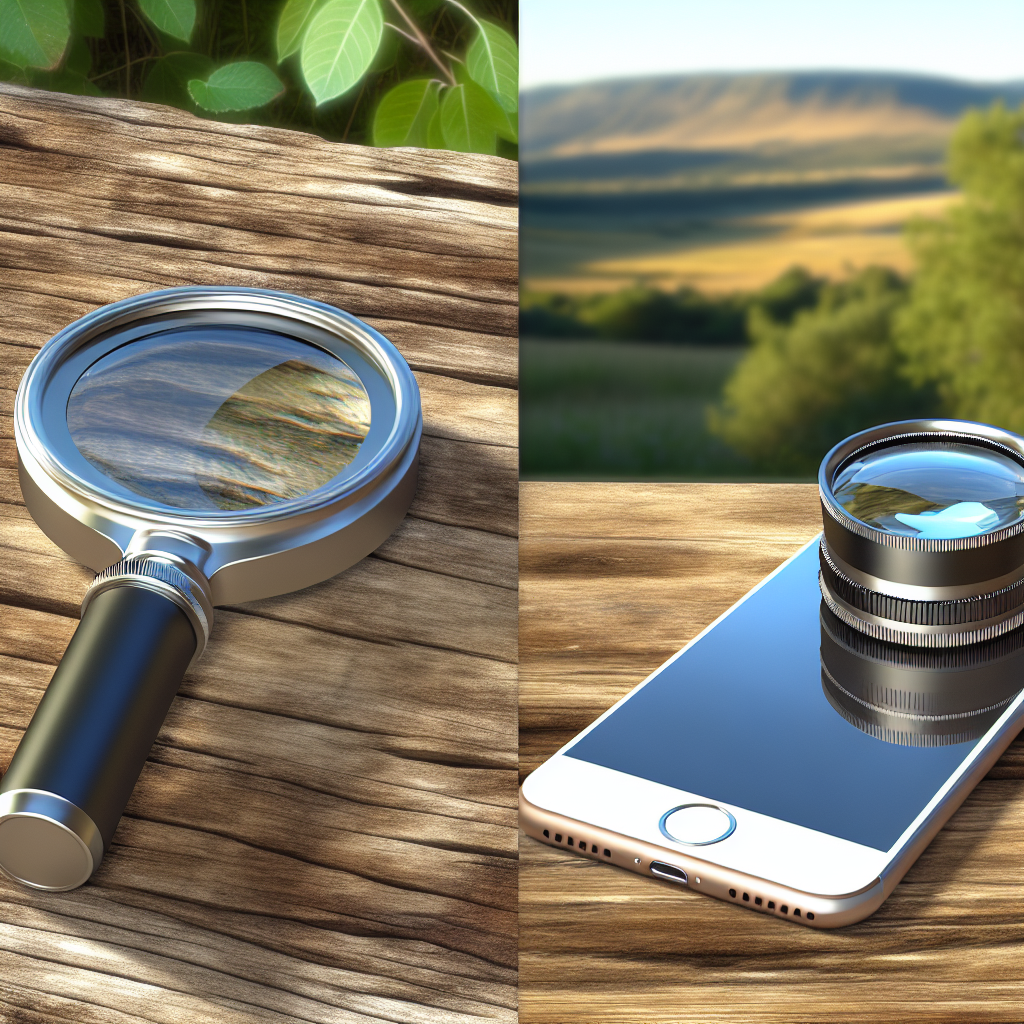
In this article, we examine whether smartphone lenses can replace or complement the use of traditional magnifiers. With the rapid evolution of mobile photography, more and more users are wondering: is the smartphone lens now a credible alternative to the traditional magnifier? On the one hand, magnifiers have always offered great precision for observation, especially for mineralogy enthusiasts, biology students, or collectors. On the other hand, removable smartphone lenses promise new accessibility and a cross-platform function. Through this in-depth comparison, we will explore the advantages, limitations, and specific uses of each solution to provide you with expert insight and help you choose the most suitable tool for your needs.
📌 Understanding Smartphone Lenses
🔹 What is a smartphone lens?
A smartphone lens refers to a removable or integrated optical device that attaches to a mobile phone's camera to modify or amplify its capabilities. There are several major categories, each adapted for a specific use:
- Macro lens: Allows for very close-up shots. Ideal for capturing tiny details, such as insects, textures, or coins.
- Fisheye lens: Offers a very wide-angle effect with a hemispherical image, ideal for artistic photos or panoramic landscapes.
- Wide-angle lens: Extends the field of view, allowing large scenes to be photographed without backing up.
- Telephoto lens: Offers optical zoom to frame distant subjects without loss of quality.
- Polarizing lens and special filters: Reduce reflections, improve contrast, or create color effects.
These accessories are designed to transform the smartphone into a multifunctional photographic tool, sometimes rivalling dedicated devices. The popularization of this type of lens is explained by its compactness, accessibility, and ease of installation. The user then has a miniature optical arsenal in their pocket, ready for use whenever inspiration strikes.
To explore the variety of lenses, a collection of smartphone lenses is available on our specialized website, offering options for all profiles, from amateur scientists to curious photographers.
🔹 How do smartphone lenses work?
The operation of a smartphone lens is ingenious and remarkably simple: simply clip it, screw it, or magnetize it in front of the phone's lens. This device is physically placed over the smartphone's optics to change how light enters, thus modifying the image's rendering. The technology used relies on series of high-precision lenses—often made of tempered glass or optical plastic—that redirect, magnify, reduce, or transform captured light.
Some more elaborate models also offer rotating rings to adjust the focus or the intensity of the desired effect. This universal mounting system ensures, in most cases, compatibility with different smartphone brands and models. Beyond the hardware, optimal use of these lenses may require the use of specialized mobile applications. These allow adjustment of white balance, manual focus, special effects, and depth of field management, thus multiplying the smartphone's potential.
The constant evolution of optical component miniaturization now makes possible performances that, just a few years ago, were reserved for professional cameras. It is therefore understandable why this technology attracts so many new enthusiasts, whether professional or amateur.
📌 Advantages of Smartphone Lenses
🔹 Portability and convenience
One of the main arguments in favor of smartphone lenses lies in their incomparable portability. Unlike traditional magnifiers or professional photographic equipment that require a dedicated bag or reinforced protection, smartphone lenses literally fit in a pocket or a small case. They often feature universal mounts, making it possible to install or remove them in seconds, even in the street or impromptu.
This convenience makes all the difference for capturing an unexpected detail during a hike or immortalizing a scientific observation without carrying heavy equipment. Students, hikers, or travelers can significantly broaden their exploration range without worrying about logistical constraints.
- Lightness: A smartphone lens generally weighs less than 50 grams, compared to 150 to 300 g for a field magnifier.
- Simplicity: No complicated adjustments, no special maintenance needed.
- Discretion: Perfect for analyzing an object without attracting attention in sensitive contexts (jewelry stores, museums, etc.).
Ease of use coupled with mobility makes smartphone lenses an intuitive choice for those who wish to observe or capture the world without constraint.
🔹 Versatility and extended use
Removable smartphone lenses offer versatility that far exceeds that of traditional magnifiers. Thanks to the range of available lenses – macro, wide-angle, fisheye, telephoto – each user can customize their optical solution according to their needs:
- Artistic photography and hobbies: Special effects, original perspectives, improved self-portraits.
- Light scientific study: Observation of plants, insects, tissues, minerals.
- Digitization: Capturing documents, maps, or details for archiving and sharing.
- Education: Visualizing details in the classroom or during educational outings.
- Social media: Creating original content quickly adaptable to platform formats.
This flexibility opens up a world of possibilities. While the magnifier primarily serves for direct observation, the smartphone lens not only allows viewing but also recording, modifying, and instantly sharing discoveries with the whole world. Moreover, the multiplicity of filters and effects makes exploration much more creative and fun.
🔹 Improved image quality
One of the major contributions of smartphone lenses lies in their ability to enhance the often limited performance of integrated sensors. A quality macro lens, for example, allows for impeccable rendering of textures, the hairs of an insect, or the cells of a leaf. The final result, enriched by image processing applications, approaches that achieved with specialized equipment.
From a technical standpoint, close-up focusing becomes accessible: where a standard smartphone is limited to a minimum distance of a few centimeters, a macro lens allows getting as close as 1 or 2 mm from the subject, thus revealing new worlds invisible to the naked eye. Some telephoto lenses, for their part, achieve unprecedented optical zoom performance.
Another dimension of this improvement lies in the interfacing with advanced mobile applications: automatic sharpness management, automatic correction of chromatic aberrations, or the possibility of using high-resolution photos for professional analysis (amateur entomology, mineral identification, etc.). These functionalities, formerly reserved for expensive devices, are now within everyone's reach thanks to the mobile ecosystem.
| Element | Smartphone alone | With smartphone lens |
|---|---|---|
| Minimum zoom (macro) | ~5 cm | 1-2 mm |
| Detailed resolution | Medium | Optimal depending on the sensor |
| Observable details | Large details | Micro-textures, insects, grains |
| Sharing | Easy | Immediate, enriched, possible retouching |
By enabling every user to become an observer and creator of their own images, the smartphone lens literally revolutionizes the relationship with optics and daily scientific discovery.
📌 Limitations of Smartphone Lenses
🔹 Limited image quality
While progress is undeniable, smartphone lenses still suffer from certain technical limitations, especially compared to professional optical equipment or high-end magnifiers. Several factors influence the final rendering:
- Quality of the integrated sensor: Even the best external lens depends on the smartphone's sensor, whose size and sensitivity remain limited compared to a dedicated camera.
- Optical distortion: Some lenses, especially entry-level ones, induce distortion (vignetting effect, edge deformation).
- Loss of sharpness: Miniaturization does not always allow achieving the precision of standard optics, especially for very small details or in low light.
- Chromatic aberrations: Color fringes around highly contrasted objects sometimes remain visible, especially with lenses without anti-reflective or multi-layer coating.
It is therefore recommended to choose quality accessories, adapted to the resolution of the smartphone used. Demanding users will nevertheless have to accept a compromise compared to professional optics, as the physics of miniaturized materials remains a permanent challenge to achieve impeccable quality.
🔹 Need for pre-processing and application
Unlike a magnifier, which provides immediate and intuitive vision upon setup, a smartphone lens sometimes requires a more technical approach:
- Careful installation: Improper alignment of the lens with the smartphone's sensor can degrade image quality or even make it unusable.
- Application compatibility: To take full advantage of all features, specialized applications are often needed (manual focus, HDR, macro modes, advanced retouching).
- Digital processing: To obtain usable or scientifically valid images, a post-processing step (contrast, noise reduction, color adjustment) is often necessary.
- Software mastery: Some novice users may be confused by the multitude of available settings.
The need to carefully choose and configure software, while mastering the physical installation of the lens, thus imposes a small additional learning curve. It is not enough to install the accessory: for optimal results in macro photography or analysis, knowledge of limits and proper settings is essential.
This explains why the smartphone lens, though extremely accessible, does not always match the "plug & play" simplicity of a pocket magnifier. However, software offerings are continuously improving, making this step more intuitive even for non-initiates.
📌 Comparison with Traditional Magnifiers
🔹 Precision and magnification
The magnification criterion is the primary basis for comparing the two tools. A traditional magnifier generally offers a magnification factor of 2x to 20x, depending on the model, with excellent sharpness and little distortion at the center of the image. This accessory has been used for centuries for detailed observation of objects, ranging from philately to dermatological examination.
In contrast, macro lenses for smartphones offer variable magnifications: from 5x to 25x for the best models, but with more fluctuating results. The visible detail level depends not only on the lens quality but also on that of the sensor and associated digital processing. Thus, even with a strong advertised magnification, the actual rendering may lose precision, especially at the edges or in low light conditions.
- Magnifier: Advantage in stability, precision of natural rendering, immediate use without adjustment.
- Smartphone lens: Advantage in versatility, possible digital image recording, creative capabilities.
For strict scientific observation (laboratory, diagnosis), the professional magnifier remains superior. For everyday or creative use, the smartphone lens offers a more flexible alternative, adapted to the digital age.
🔹 Ease of use
From an ergonomic standpoint, the magnifier has an advantage: it provides direct vision, without delay or interface manipulation. Its intuitive grip also reassures seniors or children during exploration. No application is required, and the device works without energy other than ambient light (except for models with integrated lighting).
Conversely, the smartphone lens requires careful placement of the module and turning on the phone. The shooting session mobilizes more resources: attention, software settings, sometimes adjustment of the support or brightness. For some people, the entire process can seem more tedious, especially for field observation.
- Magnifier: Ideal for quick consultations, reading small print, meticulous on-the-spot verification.
- Smartphone lens: More suitable for creative sessions, reporting, or detailed photographic documentation.
However, for transport and storage, the smartphone and its lens kit remain lighter than a specialized magnifier case.
🔹 Scope and flexibility
The scope of application clearly distinguishes each instrument. The magnifier excels in static observation: reading microscopic texts, mineralogical analysis, watchmaking, quality control. Its use remains limited to instantaneous and direct observation, with no possibility of archiving or digital sharing.
The smartphone lens seduces with its adaptability: it captures, records, shares, and modifies. It extends use to education, artistic creation, virtual presentations, and collaborative remote exchange. A student can, in a few seconds, capture an image of a sample and send it to a professor or colleagues. It is also a valuable tool for web professionals, influencers, or anyone wishing to enhance their digital presentations.
In terms of usage scenarios:
- Magnifier: Precision work, quick identification, reading minute details on site.
- Smartphone lens: Documentation, collaborative study, content creators, students, educational activities, observations on smartphone or tablet.
Each tool therefore has its own domain of excellence, leaving the user the freedom to choose according to the context.
📌 Practical Use Scenarios
🔹 Magnifiers in the medical field
The medical sector still largely relies on traditional magnifiers, particularly for rapid visual diagnoses (skin examination, dental check-ups, tissue analysis, parasite detection). The main advantage lies in the direct rendering, the ability to easily manipulate the patient or sample, and the absence of disruption related to digital technology.
However, there is an emergence of coupled solutions: some practitioners now use smartphone lenses to illustrate their diagnoses, photograph lesions for remote expert consultation, or share cases with distant colleagues. The precision then depends on the smartphone-lens combination, but recent advances allow for serious documentation, particularly in dermatology or podiatry.
The magnifier retains superiority for immediate precision gestures, on-site work (minor surgery, splinter removal, prosthesis adjustment). For remote monitoring and information transmission, the smartphone lens takes over, thus illustrating the complementarity of the two tools in the practitioner's daily life.
🔹 Smartphone lenses for amateur photography
The smartphone lens is a revolution in the world of consumer photography. Thanks to the ease of installation and the creativity allowed by different focal lengths, anyone can, in a few gestures, transform their mobile into a veritable pocket photo studio. The types of uses where they excel:
- Natural macro photography: Capturing the detail of a dewdrop, a flower petal, or a pattern on an insect's wing.
- Creation of artistic content: Plays on perspective, fisheye effects for self-portraits or landscapes, improved low-light shots.
- Social media: Producing original and striking photos, optimized for Instagram, TikTok, or Facebook.
- Quick documentation: Archiving documents, reproducing plans, capturing samples for teaching or immediate sharing.
Unlike a magnifying glass, which only allows observation, smartphone lenses allow capture, then modification (cropping, filters, touch-ups) and instant sharing. This opens up a new creative dynamic, particularly suited to a generation for whom digital images are the main vector of communication.
To go further in creation, feel free to consult our comparison of the best magnifying lamps, an optimal complement to macro photography or comfortable reading of paper documents.
📌 Frequently Asked Questions (FAQ)
🧠 What types of smartphone lenses should I choose to start with?
To begin, a basic kit including a macro lens (for detailed close-ups), a wide-angle lens (to broaden the field of view), and a fisheye lens (for creative effects) is sufficient. Clip-on or magnetic attachment models offer good compatibility with most smartphones on the market.
🧠 Is it difficult to install a lens on a smartphone?
Installation is generally very simple: just clip or screw the lens onto the smartphone's lens. It is recommended to clean the sensor surface and check the alignment to avoid any loss of sharpness or blurring. Universal models are designed for ease of use.
🧠 Are smartphone lenses compatible with all brands?
Most universal lenses are compatible with the vast majority of smartphones, provided the camera module is not too prominent. Some models, especially from specialized brands, offer specific adapters for major ranges (iPhone, Samsung Galaxy, Huawei, etc.).
🧠 Can you do science or professional analysis with a smartphone lens?
For discovery, teaching, or amateur photography, smartphone lenses already offer great scientific possibilities. For professional analysis requiring laboratory precision, a magnifying glass or microscope is still preferable, although some medical or educational applications use these accessories for illustration and sharing.
🧠 What is the advantage of a magnifying glass compared to a smartphone lens?
A magnifying glass offers instant, faithful observation without a battery, ideal for direct analysis and reading very fine details. A smartphone lens, on the other hand, offers the possibility of sharing, editing, and documentation, but requires a minimum of handling and post-processing.
🧠 Do I need specific apps to fully utilize a smartphone lens?
Yes, to access all advanced functions (manual focus, color adjustment, filters, HDR, etc.), it is recommended to use specialized photography applications. Many free and paid options exist on Android and iOS, making the experience even richer.
📌 Conclusion
The spectacular growth of smartphone lenses is transforming the daily lives of detail enthusiasts and explorers of the photographic world. While the traditional magnifying glass remains the queen of simplicity and direct observation, the smartphone lens stands out as a digital, intuitive, and fun complement. Thanks to its versatility, it accompanies the user in creative hobbies, scientific discovery, and educational uses, while allowing the capture and immediate sharing of quality images. Thus, the choice between a magnifying glass and a smartphone lens depends primarily on the context: for precision and immediacy, tradition still has its virtues; for modernity, connectivity, and creativity, the smartphone enhanced with a specific lens finds its full place.
📌 Final thought: The future of smartphone lenses
The evolution of materials, miniaturization, and image processing algorithms suggests that smartphone lenses will become even more powerful in the near future. The arrival of aspherical lenses, multi-layer anti-reflective coatings, and dedicated artificial intelligence could further enhance the precision, versatility, and accessibility of these accessories. Already, some models integrate stabilization motors, depth sensors, or interactive flashes, bringing the user experience closer to that offered by semi-professional equipment. It is therefore likely that the smartphone lens will become, in the years to come, an even more essential ally for enthusiasts of optical exploration, digital creation, and scientific discovery, reconciling tradition and innovation in a single gesture.