



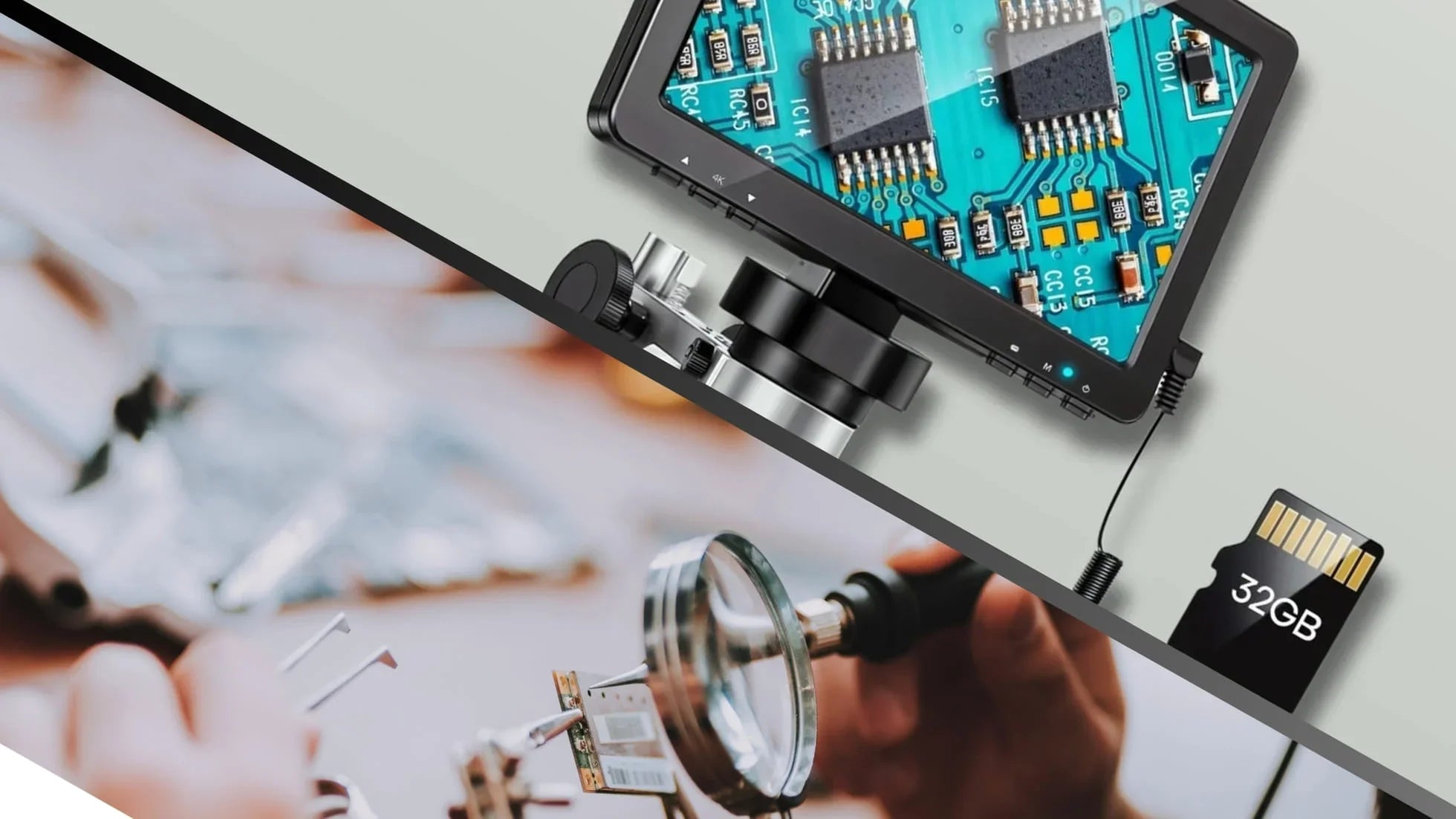
In a world where every detail counts, magnification tools can transform the way you see things. Whether you're looking to read fine print, admire a gemstone, or check an electronic circuit, choosing between a magnifier and a microscope is essential. These tools don't just magnify details: they allow you to reveal the invisible and deepen your understanding of your surroundings. So, how do you know which one to choose? And what do those famous x10, x40, or x1000 magnifications really mean? Let's explore this captivating world and its many applications together.
Magnifiers and Microscopes: What's the Difference?
What is a Magnifier?
A magnifier is not just a common tool you pull out once in a while. It's a true everyday companion, useful in many situations! Thanks to its convex lens, it offers magnification up to 10x for classic models. Electronic magnifiers, meanwhile, push the limits by integrating cameras that reveal fascinating details directly on a screen.

Why Choose a Magnifier?
Its simplicity, versatility, and ease of use make it an indispensable tool for:
- Reading tiny or old texts, whether it's a valuable book or a hard-to-decipher label.
- Inspecting jewelry, making it an essential ally for jewelers and gemologists looking to detect flaws or verify a stone's quality.
- Performing meticulous work like embroidery, sewing, or watch repair, a valuable asset for watchmakers.
Compact and lightweight, a magnifier can go everywhere with you, whether at home, in the workshop, or during your business trips.
What about the Microscope?
The microscope is a true window to the invisible. With magnifications typically ranging from 40x to 1000x, it allows you to explore unsuspected worlds that the naked eye cannot perceive. Standard optical microscopes can go up to 1500x in optimal configurations. For even higher magnification levels, such as 10,000x or beyond, we enter the realm of electron microscopes, which use electron beams rather than light.

When to Opt for a Microscope?
As soon as your needs exceed the capabilities of a magnifier. Whether for scientific observations, in-depth analyses, or even creative projects requiring extensive exploration, the microscope is essential.
A Special Mention: The Titan Krios
For cutting-edge research, particularly in structural biology, tools like the Titan Krios™ electron microscope push the boundaries of scientific exploration. Used at the Institut Pasteur, this advanced microscope allows for the observation of viruses, cellular components, and protein complexes with unparalleled precision. Thanks to technologies like cryo-electron microscopy, it ensures very high-resolution observations while preserving samples in their natural conditions. This revolutionary tool offers researchers a unique opportunity to study the most complex biological structures in three dimensions.

High Magnifications: Between Magnifier and Microscope
x10 to x100: Magnifier or Microscope?
At these magnification levels, the line between magnifier and microscope blurs. Modern electronic magnifiers, with their HD cameras and integrated screens, often compete with portable microscopes. They allow for practical, comfortable, and detailed observation, ideal for various uses.
Application Examples:
- Jewelry: detecting hidden flaws or verifying the authenticity of a precious stone, a must-have for professionals.
- Electronics: examining printed circuits to detect anomalies or faulty solder joints.
- Collection: scrutinizing stamps, coins, figurines, or other collectibles requiring attention to the smallest details.
These tools offer a versatile and powerful solution for users needing moderate but effective magnification.
Beyond x100: Welcome to the World of Microscopes
With magnifications reaching up to 1000x for standard optical microscopes, these tools allow for detailed analyses suitable for biology, industry, or research. Digital microscopes equipped with high-resolution cameras capture your observations in images or videos, ideal for documenting your work.
Typical Applications:
- Biology: observing microscopic organisms, living cells, or tissue structures.
- Industry: analyzing material quality, inspecting technical parts, or detecting defects on manufactured products.
- Research: exploring structures invisible to the naked eye and pushing the boundaries of your knowledge.
For magnifications beyond 1000x, electron microscopes take over with specialized applications requiring atomic resolution.

How to Choose the Right Instrument?
Ask Yourself the Right Questions
Before deciding, take a moment to reflect on your specific needs:
- What will your tool be used for? Is it for professional, educational, technical, or simply recreational purposes?
- Do you need mobility? Is a compact model essential for your travels or field interventions?
- What level of detail are you looking for? This will depend on your projects, whether it's reading, inspecting, or scientific exploration.
Essential Criteria to Consider
To ensure a wise investment, here are the key elements to consider:
- Optical or digital quality: prioritize a high-end lens or an HD camera for clear and precise observations.
- Integrated lighting: bright LEDs offer optimal visibility, especially in dimly lit environments.
- Adjustable zoom: a practical feature to adapt magnification to your specific needs.
Quick Comparison
|
Tool Type |
Magnification |
Applications |
|
Optical Magnifier |
up to 10x |
Reading, simple inspection |
|
Electronic Magnifier |
10x to 100x |
Jewelry, printed circuits, small objects |
|
Digital Microscope |
40x to 1000x |
Biology, research, industry |
The Latest Innovations
Technologies are constantly evolving, transforming magnification tools into increasingly powerful solutions:
- Hybrid magnifiers: combining the functionalities of a magnifier and a microscope, they allow for a seamless transition between simple observation and in-depth analysis.
- Advanced features: automatic zoom, touchscreens, assisted focusing, for an optimized user experience.
- Modern connectivity: share your observations directly via Wi-Fi or USB, capture images or record videos in high definition.
These innovations make these tools accessible to a wide audience, whether passionate amateurs or demanding professionals.
Why Invest in a Quality Tool?
Investing in a quality tool means choosing a reliable, precise, and durable experience. Low-end models, though tempting, quickly show their limitations: blurry images, insufficient lighting, poorly resistant materials. By opting for a high-end product, you ensure consistent performance and comfortable long-term use.
Care and Maintenance of Magnification Tools
To keep your magnifier or microscope performing over time, regular maintenance is essential. Here are some tips to maximize the lifespan of your tools:
- Lens cleaning: use a soft microfiber cloth and, if necessary, a specific lens cleaner to remove smudges and dust.
- Proper storage: store your tool in a case or box to protect it from dust and shocks.
- Checking electronic components: for electronic magnifiers and microscopes, ensure that cables, batteries, and connections are working correctly.
Careful maintenance guarantees optimal performance and significantly extends the lifespan of your equipment.
Educational Applications of Magnifiers and Microscopes
Magnifiers and microscopes are not just technical or professional tools. They also play an essential role in education:
- For children: these tools stimulate their curiosity by showing them the world from a new perspective. Observing insects, plants, or everyday objects becomes a fun and enriching experience.
- In schools: microscopes are key instruments for science learning, offering students an immersion in the microscopic world.
- For hobbyists: whether exploring hidden details in works of art or developing hobbies like collecting, these tools adapt to many passions.
Investing in such educational equipment can inspire the next generation of scientists, artists, or inventors.
Conclusion: Magnifier or Microscope, What's Your Need?
The choice between a magnifier and a microscope depends on your specific expectations. For daily tasks, simple inspections, or creative projects, an electronic magnifier will be ideal. However, if you are looking to explore invisible worlds or conduct in-depth analyses, the digital microscope is the best option.
Still undecided? Browse our selection of magnification tools and let us guide you. Whether you are curious, passionate, or professional, we are here to support you in discovering the smallest details. So, ready to broaden your horizons and reveal the invisible?